



Building a Predictive Maintenance Program: A Practical Six‑Pillar Blueprint
While technology often gets the spotlight in predictive maintenance, it’s only one component of a comprehensive program. A sustainable solution requires the right culture, refined processes, and expertly managed data.
In short, the journey to predictive maintenance is slow but highly rewarding when executed correctly.
This article walks you through establishing a durable predictive maintenance program, detailing the six foundational pillars, how to strengthen each one, and how they collectively deliver long‑term value.
The Maintenance Professional’s Guide to Industry 4.0
A Quick Refresher on Predictive Maintenance
Predictive maintenance (PdM) sits alongside preventive maintenance as a proactive strategy. Both aim to address potential issues before a failure brings operations to a halt. The key difference lies in the methods, lead time, and scheduling precision.
PdM leverages condition‑monitoring tools, real‑time analytics, and historical performance data to forecast equipment failures. By anticipating problems, you can schedule maintenance during optimal windows, minimizing downtime, reducing spare‑part inventory, and lowering overall maintenance costs.
Explore how PdM integrates into your broader maintenance strategy here.
The Six Pillars of a Predictive Maintenance Program
A resilient PdM program rests on six interlocking pillars: People, Data, Processes, Tools & Parts, Equipment, and Technology. Neglecting even one pillar can destabilize the entire system.
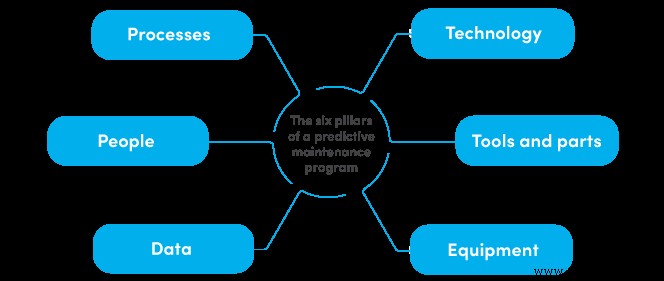
People: Culture Eats Strategy for Breakfast
The journey to PdM always begins with the workforce. According to Fiix solutions engineer Jason Afara, “It doesn’t matter if your predictive maintenance plan looks good on paper if you don’t have buy‑in from the people who are doing the work.”
Every other pillar—data interpretation, technology setup, and tool usage—depends on engaged personnel. Ensuring that every team member understands PdM’s purpose and their role is essential. For practical change‑management tactics, see this Software Advice article.
Data: The Link Between Past, Present, and Future
“Without data, you can’t predict anything,” says SensrTrx CEO Bryan Sapot. “A baseline of normal performance is essential to detect anomalies.”
However, quantity must be paired with quality. MAJiK Systems COO Jared Evans warns, “Good algorithms cannot compensate for bad data from the plant floor.” Accurate, consistent data across systems is the backbone of PdM.
As Jason analogizes, unreliable data is like a weather forecaster predicting sunshine when it’s actually pouring—mistakes lead to costly missteps.
Processes: A Steady Hand on the Predictive Maintenance Ship
Processes define how your team plans, executes, and reviews maintenance activities. They encompass both people‑driven workflows—responsibility matrices, data review cadence, communication protocols—and equipment‑driven routines—data capture schedules, performance mapping, and escalation paths.
Jared emphasizes the need to align data capture with future performance goals. Poor data flow is, again, a warning that leads to operational “rain” on your doorstep.
Tools & Parts: Trusted Sidekicks Ready for the Spotlight
Tools such as infrared cameras, vibration analyzers, and specialized software enable accurate condition assessment. Parts, on the other hand, must be compatible with PdM—meaning they should be monitored, replaceable, and critical to asset reliability.
Jason notes, “Predictive maintenance isn’t new; what’s changed is the advanced tooling and part‑level understanding that reduces costs and complexity.”
Check Out the Four Secrets to Better Inventory Management
Equipment: Not All Machines Are Created Equal for PdM
Some assets simply do not lend themselves to predictive strategies. Focus on critical equipment that generates reliable condition data and offers sufficient lead time before failure.
Jason recommends prioritizing assets with clear failure modes and high impact on operations. For guidance on selecting suitable equipment, explore resources on balanced maintenance strategies, P‑F curves, and condition‑based maintenance.
Technology: The Glue That Keeps the Other Elements Together
Technology orchestrates the entire PdM ecosystem. It aggregates data from diverse sources—ERPs, MES, CMMS, sensors—and provides analytics that translate raw numbers into actionable insights.
As Bryan says, “Technology gives you an extra set of eyes, enabling real‑time monitoring without constant manual oversight.” Jared adds, “You need several technologies to capture, store, and interpret the wide array of data involved.”
Common solutions include integrated ERP systems, advanced MES platforms, and specialized CMMS software tailored for predictive workflows.
Find Out Where Predictive Maintenance Fits in Your Overall Maintenance Strategy
How to Build a Predictive Maintenance Program

Predictive Maintenance: Part of a Balanced Strategy
Think of PdM as a single ingredient in a balanced breakfast—valuable, but not the sole component. As Jason explains, “Predictive maintenance will never replace all other forms of maintenance.”
Establishing a PdM program is a marathon, not a sprint. “It might take 10 years to reach 10% predictive coverage,” he cautions. However, a well‑rooted program delivers reliable operations, cost savings, and continuous improvement.
By reinforcing core maintenance fundamentals—people, data, processes, tools, equipment, and technology—you create a resilient strategy that can withstand future challenges.
Equipment Maintenance and Repair
- Urgent PLC Repair: Real-World Fixes for Festo Controllers on the Plant Floor
- Discover Asset Infinity: Your Trusted Digital Asset Platform
- Enduring Success: Lessons in Persistence from Abraham Lincoln and Maintenance Leadership
- Fairfield Works Launches Innovative Maintenance Training Program to Secure Skilled Workforce
- Case Study: Seamless Coil Width Adjustment via Linear Ball Bushing Upgrade
- How Work Orders Transform Health, Safety, and Compliance in Maintenance
- Diagnosing Excessive Noise & Vibration in SEEPEX Pumps: Universal Joint vs Rotor
- Simplify Your Industrial Electronics Repair Report: Expert Tips for Clear Understanding
- Maximizing Chain Longevity: Expert Tips for Maintenance and Replacement
- Prognostics: Unlocking Industry 4.0’s Greatest Potential