



Track and Manage Maintenance Costs Effectively
Excessive maintenance expenses can erode profitability, yet reliable equipment is essential for business continuity. The key is to monitor and control these costs.
To do so, you need deep insight into every maintenance activity. Which actions and assets generate the highest spend, and why? How can you track maintenance cost at both the organizational level and the individual asset level?
Read on to discover actionable strategies.
Understanding Maintenance Costs
Maintenance cost captures all outlays incurred to keep physical assets in optimal condition—whether it’s a vehicle, a rental property, a generator, or a circular saw. In asset‑heavy industries such as manufacturing, aviation, and construction, managing maintenance budgets is a top priority. Tracking these costs helps evaluate the effectiveness of maintenance teams and serves as a critical KPI.
Rethinking Maintenance as an Investment
Many leaders view maintenance purely as a cost center, pressuring managers to cut spending without considering long‑term impacts. Instead, think of maintenance as an investment: the money spent today extends equipment life, improves performance, and reduces future production delays—ultimately strengthening the bottom line.
Maintenance professionals must stay within budget while understanding what drives costs. This insight is essential for effective expenditure control.
Components of Total Maintenance Cost
Asset value goes beyond purchase price. When acquiring new equipment, factor in ongoing maintenance and repair costs. These can vary widely depending on the asset’s maintenance schedule, wear characteristics, and spare‑part expenses.
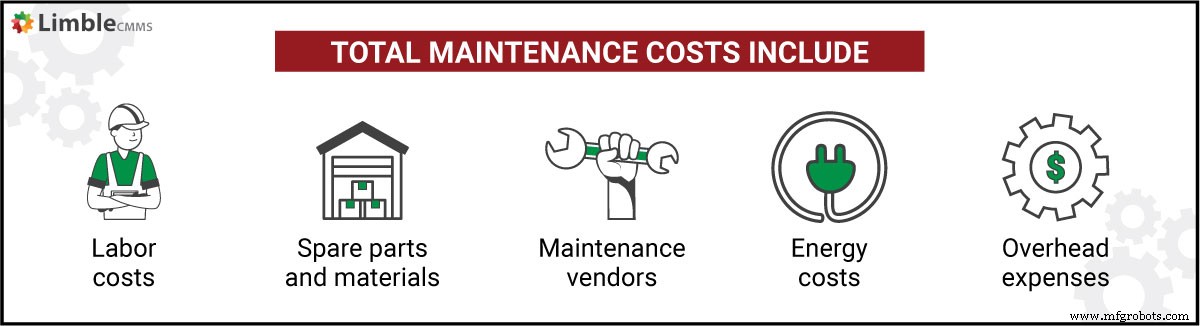
Typically, maintenance directors manage these budgets while keeping total MRO (maintenance, repair, operations) costs within annual limits. MRO expenses break down into labor, parts, vendor invoices, energy, and overhead—each requiring accurate tracking to identify cost‑saving opportunities.
Often overlooked is the indirect cost of lost productivity. When an asset is shut down for scheduled or unscheduled maintenance during business hours, the resulting downtime translates into lost revenue. The magnitude of this cost depends on the asset’s criticality and downtime duration.
Tracking Maintenance Expenses with Limble CMMS
The most efficient way to measure total maintenance cost is through a CMMS. Once configured, it automatically records all ongoing expenses. Technicians enter time and parts during job‑order or preventive‑maintenance closures, ensuring accurate data capture.
Relying on spreadsheets and invoices for reporting is time‑consuming and error‑prone.
Monitoring Overall Maintenance Cost
Effective cost control requires detailed, category‑level data. Limble’s cost view splits expenditures into three primary buckets:
- Parts—the dollar value spent on spare components.
- Labor—including salaries, benefits, and overtime.
- Vendor Invoices—charges from external repair services or retail purchases.
The following custom monthly report demonstrates these breakdowns. Clicking each category reveals deeper details.
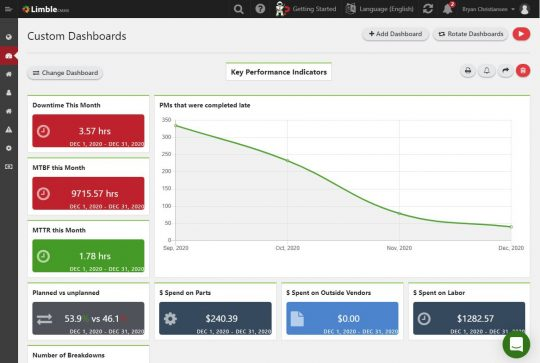
This report offers a high‑level view, but granular data is essential for pinpointing improvement areas.
Examining Costs for a Single Asset
Vendor invoices, spare‑parts purchases, and labor all tie back to specific assets. A CMMS can produce reports that focus on any chosen asset, aggregating all related costs.
Without a digital system, calculating the total cost of ownership for an air‑conditioner would involve manually searching paper work orders, spreadsheets, and vendor bills—a tedious and error‑prone process.
With Limble, all of that information surfaces with a few clicks and is ready for export.
Deep insight into maintenance data is the foundation for trimming waste and achieving cost savings.
To try Limble CMMS, you can:
- Start a free 30‑day trial.
- Request a live demo.
- Explore our self‑serve demo, which simulates a real environment.
While CMMS is powerful, other tactics also help keep maintenance expenses in check.
Strategies to Reduce Overall Maintenance Costs
Here are proven approaches to shrink your maintenance budget:
- Adopt a modern CMMS to track spend and pinpoint high‑cost activities.
- Implement inventory management to forecast needs and lower spare‑part inventory costs.
- Enhance operator onboarding to reduce damage from improper use.
- Negotiate aggressively with vendors and parts suppliers.
- Apply lean maintenance principles to eliminate waste.
- Explore autonomous maintenance where feasible.
- Invest in condition‑monitoring technology to detect asset health and optimize schedules.
- Prioritize proactive strategies such as preventive and predictive maintenance—cheaper than reactive repairs.
These measures are long‑term solutions that address systemic inefficiencies rather than offering quick fixes.
Maintenance Cost vs Capital Expenditure
For accounting, distinguish routine maintenance from capital expenditures. Routine maintenance—routine work, parts replacements, and simple repairs—yields benefits within a year and is expensed immediately. Capital expenditures involve major overhauls or upgrades that increase asset value and are depreciated over time.
When Investing in Maintenance Pays Off
Spending on maintenance is often the smartest long‑term strategy. For example, replacing an aging machine can be more cost‑effective than continuous repairs. Investing in original parts prolongs life and cuts emergency fixes. A CMMS investment also offers a high ROI by improving planning and reducing waste.
Presenting ROI figures to senior leadership is the most persuasive approach. Start with a modest proposal—such as implementing CMMS—and calculate the expected return. Here’s a simple guide on how to calculate CMMS ROI.
Reduce Reactive Maintenance by 73.2%
See the results Red Hawk enjoys with Limble
Read Our
Case Study

We hope this article equips you with practical tools to control maintenance expenses. If you feel we missed a critical point, share your thoughts in the comments below!
Equipment Maintenance and Repair
- How to Use Data and Storytelling to Secure Approval for Your Maintenance Projects
- 12 Essential Maintenance Templates to Streamline Operations and Reduce Admin Burden
- Mastering Preventive Maintenance: Building and Optimizing Fixed & Floating Schedules
- Mastering Preventive Maintenance: Strategies to Optimize Your PM Program
- Mastering Maintenance Storeroom Organization for Peak Productivity
- Transforming Maintenance Culture: Strategies for Reliability & Accountability
- Crafting an Effective Maintenance Policy: A Step‑by‑Step Guide
- Boost Safety in Maintenance: Proven Strategies for Cost Savings and Service Excellence
- Effective Factory Accident Management: Strategies to Mitigate Risks and Ensure Continuity
- Cut Excavator Maintenance Costs: Proven Strategies for Long-Term Savings