



Crafting an Effective Maintenance Policy: A Step‑by‑Step Guide
While often misunderstood, a maintenance policy is a cornerstone of robust business governance. It aligns your maintenance department with your organization’s vision, mission, and core values, ensuring consistent, measurable performance.
What Exactly Is a Maintenance Policy?
A maintenance policy is a formal, senior‑management‑owned document that outlines the organization’s expectations for its maintenance function. It sits beneath the company’s strategic objectives yet above the detailed maintenance plan, acting as the bridge between corporate intent and day‑to‑day operations.
Why a Maintenance Policy Is Essential
It defines clear, quantifiable targets—such as reducing downtime, cutting maintenance costs, and improving asset reliability—providing a roadmap for all maintenance activities. Crafting the policy forces critical decisions on risk, compliance, budgeting, and workforce safety, fostering alignment across the organization.
Moreover, the policy becomes an auditable commitment. Maintenance teams know their actions must deliver on the stated objectives, holding them accountable and driving continuous improvement.
Who Drafts the Policy?
While the drafting can be delegated to engineering or maintenance managers, the policy’s substance must emerge from senior leadership—typically the CEO or Managing Director, supported by the HR, Operations, and Engineering Directors. Their collective input ensures the policy reflects the organization’s strategic priorities and operational realities.
Key Traits of a Strong Maintenance Policy
Below are six essential characteristics that distinguish a high‑impact policy.
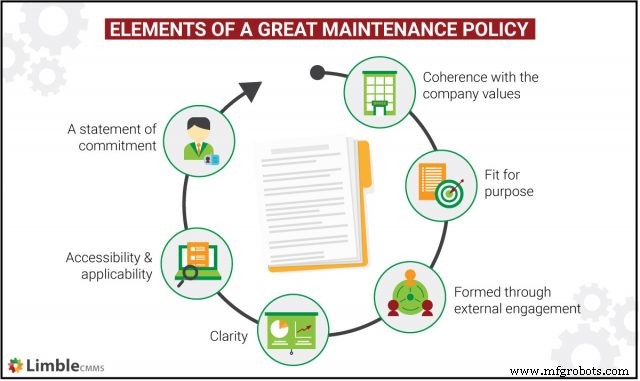
1. Alignment with Company Values
Embed core values—such as safety, sustainability, and quality—directly into the policy. Inconsistency between stated values and policy actions erodes trust.
2. Fit for Purpose
Scale the policy to your organization’s size and complexity. A small team may need a handful of concise documents; a large multi‑site manufacturer will require a comprehensive suite.
3. Clarity
Define the maintenance department’s role, objectives, and boundaries. Specify expectations for both the department and the wider organization.
4. Inclusive Development
Engage those who will be impacted. Policies rooted in practical insight are more likely to be adopted and adhered to.
5. Accessibility & Applicability
Ensure the policy is easily retrievable—via digital platforms like Limble CMMS—so all employees can reference it in daily decisions. Update it regularly to reflect evolving operations.
6. Explicit Commitment
Secure signatures from the CEO and departmental heads. This formal endorsement signals accountability and reinforces the policy’s authority.
Typical Contents of a Maintenance Policy
While each policy is unique, effective documents generally cover the following sections.
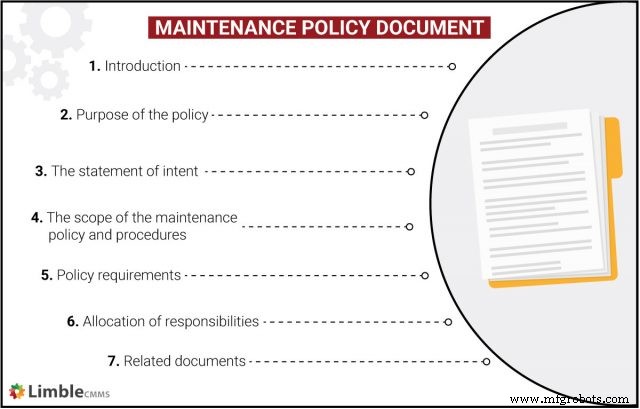
1. Introduction
Provide a concise overview of maintenance’s purpose, benefits, and alignment with corporate goals.
2. Purpose
Clarify the intent—whether it’s safety, uptime, cost efficiency, or quality enhancement—and the business drivers behind the policy.
3. Statement of Intent
Use precise language to commit to outcomes, followed by bullet points that begin with action verbs (e.g., maintain, implement, ensure).
4. Scope and Procedures
Outline the high‑level framework for developing and executing a comprehensive maintenance management process.
5. Policy Requirements
Detail tactical obligations covering EHS, quality, risk, budgeting, data management, contractor procurement, and more.
6. Allocation of Responsibilities
Define roles (not individuals) and the accountability structure for implementing the policy.
7. Related Documents
List supporting internal documents and external regulations—limit to the next hierarchical level to avoid overload.
Need a Starting Point?
Explore public domain examples—such as Medical Equipment Maintenance Policies, Information Security System Maintenance Policies, and Building Maintenance Policies—to inform format and content. Adapt these templates to reflect your organization’s unique values, industry, technology, and equipment.
A Top‑Down Approach to Maintenance
Establishing a clear, auditable maintenance policy is the first step toward optimizing spend, boosting uptime, and aligning operations with corporate values. When communicated effectively, it reduces production losses, enhances product quality, and maximizes the use of resources.
Equipment Maintenance and Repair
- 12 Essential Maintenance Templates to Streamline Operations and Reduce Admin Burden
- Mastering Preventive Maintenance: Building and Optimizing Fixed & Floating Schedules
- Choose Maintenance Wisely: Let Risk and Equipment Guide Your Strategy
- Elevating Maintenance: Aligning Strategy, Building Trust, and Driving Business Value
- Investing in Maintenance: A Proven ROI Strategy for Reliability and Capacity Growth
- Driving Transformational Leadership in Maintenance & Reliability
- Breakdown Maintenance Explained: Rapid Response & Cost Control
- Streamline & Automate Maintenance: Proven Strategies for Reliable Operations
- Track and Manage Maintenance Costs Effectively
- Developing a Standard Maintenance Procedure: A Proven Guide to Reliability