



Breakdown Maintenance Explained: Rapid Response & Cost Control

Like a sudden power surge or a worn component, equipment failure is inevitable. What matters is how you respond. Whether you run a proactive or reactive maintenance program, mastering breakdown maintenance can safeguard your operations, reduce downtime, and keep costs in check.
What Is Breakdown Maintenance?
Breakdown maintenance refers to work performed on an asset after it has failed, with the objective of restoring it to optimal operating condition. While some practitioners use the term interchangeably with “corrective” or “emergency” maintenance, we treat it as a specific type of reactive maintenance—distinct from an overarching strategy.
A Typical Breakdown Workflow
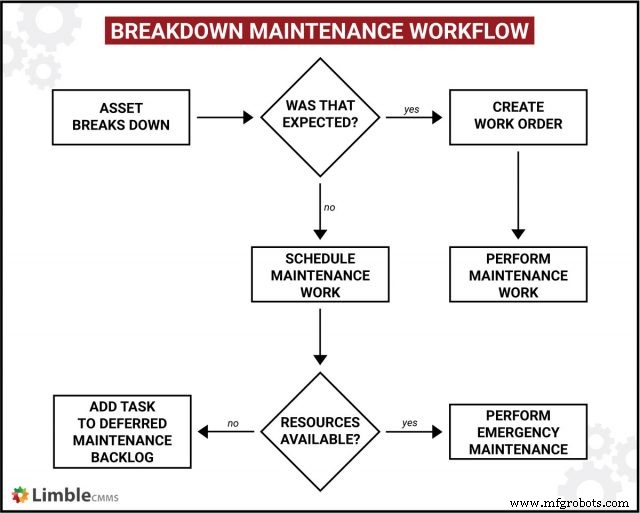
Below is a visual representation of the standard steps for scheduling repair of a critical asset. If the failure involves a low‑priority item, the repair can be queued behind higher‑priority work.
Run‑to‑Failure: A Risky Approach
When technicians spend most of their time fixing broken equipment, it signals a broken asset‑management philosophy. Reactive maintenance becomes costly and productivity declines. The root cause is often a lack of a structured plan: assets are treated as “fix‑it‑when‑it‑breaks” rather than managed with preventative oversight.
Nonetheless, some non‑repairable or end‑of‑life equipment can be intentionally run to failure. In those cases, quick replacement—supported by solid spare‑parts logistics—minimizes disruption.
How Breakdown Fits In
Budget constraints frequently leave a larger number of assets on a run‑to‑failure schedule. When a failure occurs, the maintenance team must react. Ideally, parts, tools, and labor are on hand—a scenario we call “planned breakdown maintenance.” This is achievable with disciplined planning and CMMS support, provided the run‑to‑failure load is manageable.
Otherwise, emergency work orders pile up, postponing preventive tasks and creating a vicious cycle of unplanned breakdowns.
Leveraging CMMS to Manage Breakdowns
Asset failures are expensive. The sooner they’re resolved, the better. A computerized maintenance management system (CMMS) is the most effective way to shave Mean Time to Repair (MTTR).
Prioritize Work Orders
When dozens of issues arise simultaneously, clear visibility of the maintenance workload is critical. A good CMMS displays technicians’ locations and task priority, enabling managers to reassign resources to the most urgent problems.
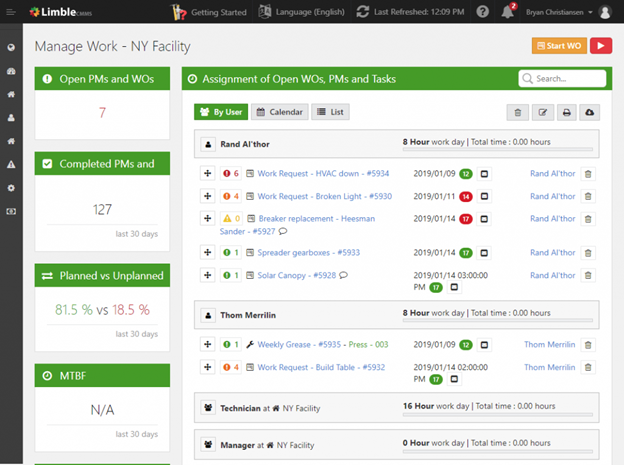
Workload overview in Limble CMMS
Accelerate Repairs with Mobile Access
Imagine production halted because a conveyor motor fails. The coordinator issues an emergency work order, and a technician arrives with a tablet. By scanning the asset’s QR code, the technician instantly pulls up maintenance logs, past repair notes, and a standard troubleshooting checklist—all on the go.
Having real‑time access to asset history, recommended fixes, and tool lists turns a potentially hours‑long downtime into minutes.
Retire Ineffective Assets Early
Equipment that no longer offers a favorable cost‑benefit ratio drains resources. CMMS tracks per‑asset spend, making it straightforward to spot machines that should be retired instead of repaired.
Early retirement reduces the number of breakdowns and frees up budget for more reliable assets.
Inventory & Tool Management
Missing tools or spare parts stall repairs. Digital inventory tracking, coupled with automated alerts, ensures technicians know what is available and where it is located.
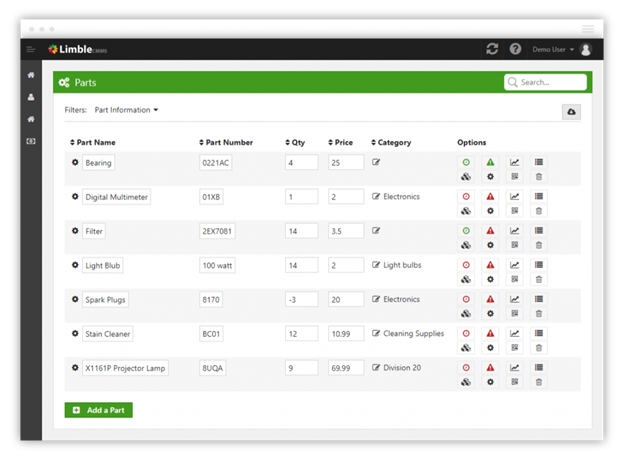
Parts inventory in Limble CMMS
- Instant alerts when a part falls below a custom threshold.
- In‑work‑order stock checks to verify part availability instantly.
- Automatic usage tracking that updates inventory as parts are consumed.
- Real‑time reporting to monitor parts usage and costs.
Limble’s integration with SAP extends visibility across the organization, ensuring that inventory data remains consistent.
Mastering Reactive Maintenance
Even the best predictive programs can’t eliminate every failure. Electrical spikes, operator error, or unexpected wear will still occur. The key is to prepare: define clear breakdown procedures, adopt mobile CMMS, and maintain ready MRO inventories.
With the right tools and processes, you can shift the focus from crisis to control—reducing the stress of the unexpected and the cost of reactive maintenance.
Reduce Reactive Maintenance by 73.2%
See the Results Red Hawk Enjoys With Limble
Read Our Case Study
Equipment Maintenance and Repair
- Preventive Maintenance Software Explained: Features, Benefits, and Implementation Guide
- Lean Manufacturing & Maintenance: How TPM Drives Waste Reduction
- P‑F Curve Explained: Mastering Reliability‑Centred Maintenance
- How Accurate Maintenance Reports Drive Smarter Operations
- Mastering C# Queues: Enqueue, Dequeue, and First‑In‑First‑Out Operations Explained
- How Predictive Maintenance Drives Servitization Success
- Breakdown Maintenance: The Reactive Approach Explained
- Proactive Maintenance Explained: Benefits & How It Differs from Reactive Strategies
- Maintenance Backlog Explained: Strategies to Resolve It
- Precision Maintenance: Definition, Benefits, and Real‑World Examples