



How Predictive Maintenance Drives Servitization Success
Servitization is a relatively new term in the industrial sector but it’s quickly picking up a following; with The Manufacturer magazine even dedicating a whole series of conferences to it. In a sentence, it’s the concept that any product / offering, can be delivered ‘as a service’ (e.g. by the hour or unit) rather than as a discrete product + maintenance combination. A classic example of this is Rolls-Royce in the 80s shifting its business to a ‘Power by the Hour’ model where no longer would they simply sell jet engines and warranties, they would instead offer the operator flight-hours – the responsibility would then be entirely on Rolls Royce to deliver the contracted number of hours whilst achieving certain availability metrics.
We’ve covered predictive maintenance before; it allows you to pre-empt unplanned machine downtime by repairing a machine just at the correct time before failure. It relies on the effective use and analysis of condition monitoring and is starting to make increased use of prognostics (the science of predicting machine Remaining Useful Life) as those techniques become more accessible.
Servitization essentially allows you to get closer with your customer, in a more positive manner than the oft-antagonistic relationship usually in play: 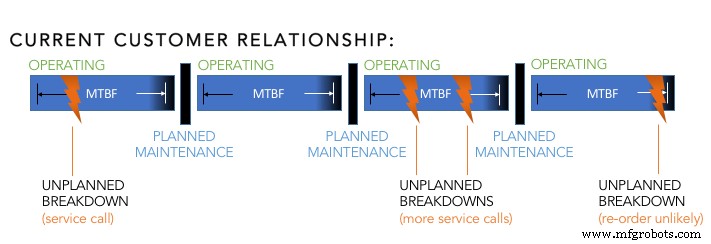
Every time your customer has unplanned downtime caused by your equipment, they’ll be in contact to be asking you to fix it (possibly not very politely) – even if you cover the repair with a service agreement which they’ve taken out and the fault is repaired quickly, you customers won’t be pleased with the fact that your company has supplied something which has caused loss of revenue, quality and reputation through unplanned downtime.
X as a Service
The ideal scenario is one where you can know what is happening with the equipment at your customer site and where you can help them to pre-empt any unplanned downtime. The two main ways this could work are:
- You can detect deterioration in a component that was not part of an upcoming planned maintenance event and you can forecast machine failure as unlikely – allowing you to tackle planned and unplanned maintenance during scheduled downtime.
- You can detect and predict that component deterioration which will cause downtime before the next planned maintenance interval, requiring immediate attention. This will allow you to minimize unplanned downtime as far as practicable. The customer will be happier about this in the longer-term.
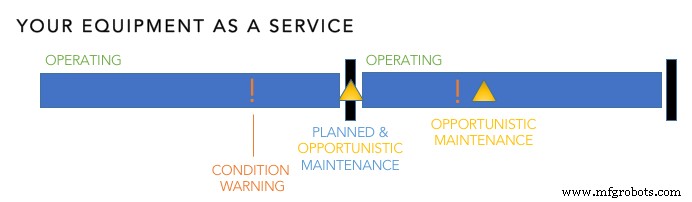
It’s important to realize that you’re not just providing predictive maintenance of your equipment as a service. You’re actually enabling your product as a service. The line between the product and the maintenance becomes blurred, to the point where you could offer something analogous to “Power by the Hour” – lifting by the hour, molding by the hour, pressing by the hour, etc. The possibilities are rich and varied.
The servitization of the Aerospace and Defence industries has many good case studies (such as how much money can be saved) but a wholesale copying of ideas from those industries is impractical; they have certain safety and reliability requirements, the cost of which is crippling to scalability in other industries. The Aerospace and Defence industry typically deal with fleets of hundreds, occasionally thousands of assets, whereas in a modern automotive factory, it wouldn’t be uncommon to find over a thousand heterogeneous assets (robots, conveyors, etc.) in one area of the plant alone. Automation of analysis of condition monitoring and prognostics is the key to driving predictive maintenance and enabling servitization.

Equipment Maintenance and Repair
- Transfer Molding Explained: Process, Benefits, and Variants
- Preventive Maintenance Software Explained: Features, Benefits, and Implementation Guide
- Lean Manufacturing & Maintenance: How TPM Drives Waste Reduction
- P‑F Curve Explained: Mastering Reliability‑Centred Maintenance
- Breakdown Maintenance Explained: Rapid Response & Cost Control
- Predictive Maintenance Explained: How to Minimize Downtime and Maximize Asset Performance
- Predictive Maintenance for Cranes: Why It’s Essential for Safety and Efficiency
- Predictive Maintenance Explained: Why It’s Essential for Modern Facilities
- Why a Conveyor Maintenance Checklist is Essential for Minimizing Downtime
- Periodic vs. Predictive Maintenance: Choosing the Right Strategy for Your Business