



Choosing the Right Maintenance Strategy for Your Assets: A Practical Guide
Maintenance strategies can be complex. While most agree on the categories—reactive, run‑to‑fail, corrective, routine, preventive, condition‑based, predictive, and prescriptive—their real‑world application varies widely. The right choice for an asset isn’t a luxury; it’s a necessity for reliability, safety, and cost control. This guide demystifies the options and walks you through a systematic selection process.
Table of contents
- Step 1: Understand the maintenance strategy types
- Step 2: Identify your influencing variables
- Step 3: Select the appropriate strategy for each asset
- Building a balanced, data‑driven maintenance program
Step 1: Understand the maintenance strategy types
Choosing the correct strategy begins with a shared vocabulary. We don’t need to dissect every nuance, but we must agree on the core concepts.
Reactive Maintenance (No Strategy)
Reactive maintenance is the scramble that follows an unexpected breakdown—akin to firefighters running without a hose. It’s also called emergency or breakdown maintenance and is essentially the absence of a formal strategy.
Run‑to‑Fail Maintenance
Run‑to‑fail (RTF) intentionally allows an asset to operate until failure, with a pre‑planned response that mitigates downtime and cost. Think of a light bulb burning out while you have spares and a ladder ready.
Corrective Maintenance
Corrective tasks address a problem after it is identified, usually during routine inspections. Example: Re‑inflating tires after spotting a pressure drop during a car’s oil change.
Routine Maintenance
Routine maintenance consists of scheduled, low‑complexity checks performed regularly—such as daily safety checklists completed by operators.
Preventive Maintenance (PM)
Preventive maintenance reduces failure risk by performing work on equipment that is still operating. It comes in two flavors:
- Time‑based PM: Tasks scheduled at fixed intervals (e.g., the first of every month).
- Usage‑based PM: Tasks scheduled after a specified operating metric (e.g., 1,000 miles or 10 production cycles).
Condition‑Based Maintenance (CBM)
CBM monitors real‑time performance indicators—vibration, temperature, etc.—to trigger maintenance before a failure occurs.
Predictive Maintenance (PdM)
Predictive maintenance leverages historical and real‑time data to forecast the optimal maintenance window, thereby preventing even minor failures.
Prescriptive Maintenance (RxM)
Prescriptive maintenance builds on PdM by recommending specific actions—what to fix, when to replace, and how to optimize future performance—using machine learning insights.
Maintenance Strategies in Action on a Variable‑Speed Transfer Conveyor
Below is a side‑by‑side illustration of how each strategy would be applied to a conveyor system.
Reactive Maintenance
Conveyor breaks down without a pre‑planned fix.
Run‑to‑Fail Maintenance
Conveyor operates until failure; a recovery plan is in place.
Corrective Maintenance
Technician realigns a misaligned part during a weekly inspection.
Routine Maintenance
Operator inspects the conveyor before each shift to ensure safety.
Preventive Maintenance (Time)
Inspection scheduled every 10 days.
Preventive Maintenance (Usage)
Inspection scheduled after every five production cycles.
Condition‑Based Maintenance
Maintenance triggered when vibration exceeds a set threshold.
Predictive Maintenance
Software predicts failure‑level vibration in 30 days.
Prescriptive Maintenance
Software predicts 30‑day failure and recommends swapping a specific part.
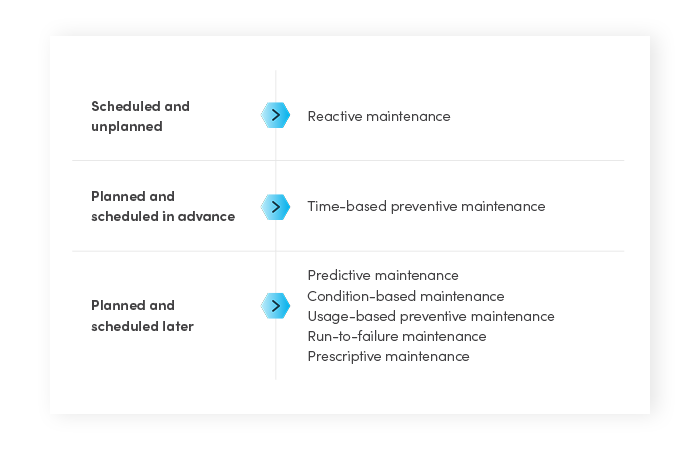
Planned vs. Scheduled Maintenance
Scheduled maintenance assigns a date, technician, and deadline. Planned maintenance focuses on the what, where, why, and how—providing a framework for execution when the time arrives.
For instance, run‑to‑fail is planned (you know how to respond) but unscheduled—failure timing is unknown. Reactive maintenance lacks both planning and scheduling.
Use the following framework to classify strategies and assess how far in advance you can schedule them:
Step 2: Identify Your Influencing Variables
Every facility is unique. To tailor a strategy, examine the drivers that shape your operations: costs, asset characteristics, workforce, and regulatory context.
Costs
- What’s your total maintenance spend—including labor, parts, and downtime—for each asset?
- Which cost component dominates (downtime, parts, labor, etc.)?
- What would be the cost of shifting to a different strategy?
Assets
- Rank assets by criticality.
- Identify underperforming assets against key metrics.
- Determine which assets provide reliable data feeds.
- Mark assets that are safety‑critical or compliance‑dependent.
People
- Ensure safe daily egress for your team.
- Assess current staffing levels and potential for growth.
- Identify strengths, gaps, and training needs.
- Analyze how your team allocates time across tasks.
Step 3: Select the Appropriate Strategy for Each Asset
There is no one‑size‑fits‑all answer. Stuart Fergusson, Fiix’s Senior Manager of Sales Engineering, emphasizes: "The best strategy is the one that keeps equipment running safely and cost‑effectively—reactive maintenance is the worst, but the right approach depends on your unique context."
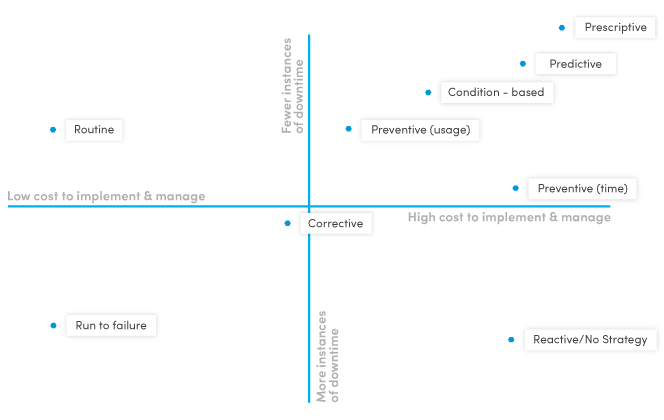
Cost to Implement vs. Downtime Instances
Every minute of uptime has a cost. Use the following chart to balance budget against downtime reduction:
Cost to Implement vs. Asset Criticality
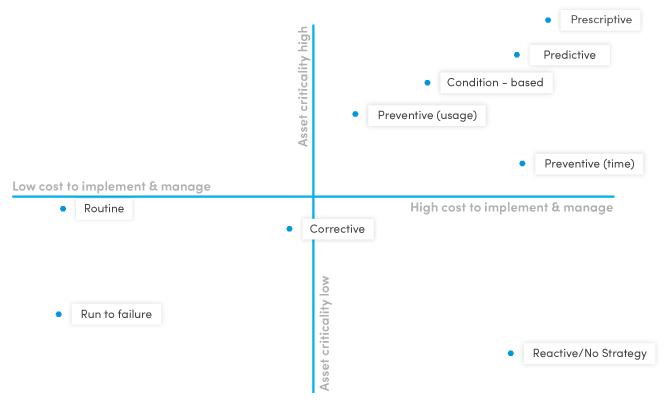
Advanced strategies like predictive or prescriptive maintenance yield high reliability but require significant investment. Align spending with asset criticality:
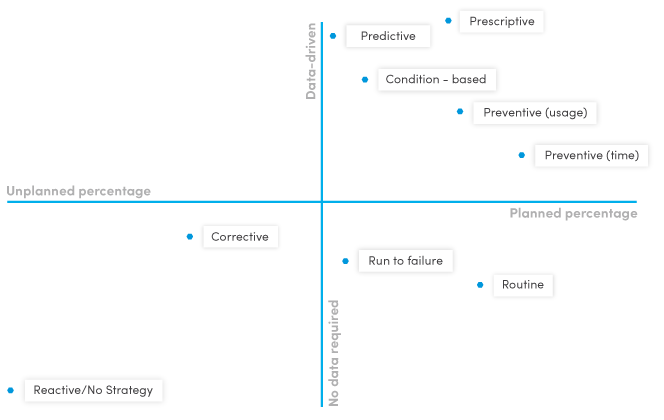
Planned Percentage vs. Data Requirements
More planned work demands more data. This table outlines data needs for each strategy:
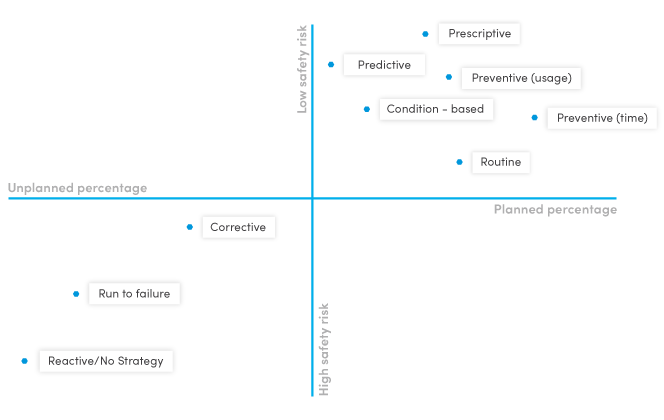
Planned Percentage vs. Safety & Compliance
Higher planning facilitates risk identification and compliance adherence. Visualize the trade‑off here:
Ideal Asset Profiles
| Attribute | Reactive | Run‑to‑Fail | Routine | Corrective | PM (Time) / PM (Usage) | CBM / Predictive / Prescriptive |
|---|---|---|---|---|---|---|
| Criticality | None | None to low | Low | Low | Moderate to high | High to essential |
| Maintenance Cost | None | Low | Low | Low‑moderate | Moderate‑high | High |
| Downtime Cost | None | Low | Low | Low‑moderate | Moderate‑high | High |
| Data Volume Needed | None | Low | Low | Low | Moderate‑high | High |
| Safety & Compliance Risk | None | Low | Moderate | Low‑moderate | High | High |
Building a Balanced, Data‑Driven Maintenance Program
Adopting the right mix of strategies is a journey, not a one‑time switch. Start with preventive maintenance on critical assets, then expand to condition‑based or predictive solutions as data maturity grows. The payoff is fewer disruptions, a stronger bottom line, and a more efficient, confident maintenance workforce.
Equipment Maintenance and Repair
- How Well Your Preventive Maintenance Tasks Support Your Asset Care Strategy
- Optimizing Maintenance Strategy: A Proven Path to Reliability and Cost Savings
- Optimizing Facility Maintenance: Strategies to Minimize Downtime and Boost Productivity
- The Definitive Guide to Selecting Optimal Warehouse Containers for Efficiency and Safety
- 5 Proven Strategies to Extend Asset Value and Maximize ROI
- Prescriptive Maintenance: The Proactive Solution for Superior Asset Management
- 6 Proven Strategies to Optimize Your Maintenance Management Plan
- Essential Features of Predictive Maintenance Systems for Optimal Asset Management
- How to Select the Ideal Insurance Coverage for Your Heavy Equipment
- Preventative Truck Maintenance: Long-Term Benefits That Drive Performance and Save Costs