



Setting Inspection Frequencies for Preventive Maintenance: A Practical Guide
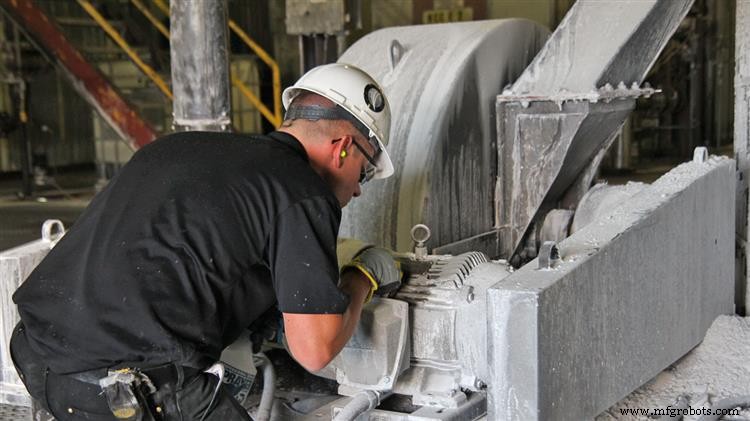
Defining what we mean by "inspection" is the first step. An inspection can be objective—measured with an instrument such as a vibration analyzer, infrared camera, voltmeter, flow meter, or ultrasonic device—or subjective, relying on visual, auditory, tactile, or olfactory cues. Regardless of the method, the goal is to spot a failure before it turns into a breakdown.
The failure‑developing period (FDP), sometimes called the Pf Curve, is the time between the first detectable failure and the eventual breakdown. For instance, a centrifugal pump may begin cavitating at 6 a.m. and fail to deliver the required flow at 6 p.m. four days later—an FDP of 108 hours.
How Often Should You Inspect?
In practice, the inspection interval is roughly half the FDP: Inspection Frequency = FDP ÷ 2. If a pump’s FDP is 14 days, a seven‑day inspection schedule is prudent. Skipping inspections beyond the FDP risks missing the warning signs and ending up with an unplanned outage.
Unfortunately, most plants lack historical data on FDP. Rather than embarking on an exhaustive study with little data, it is wiser to rely on expert judgment, training, and the tools at hand to estimate reasonable intervals.
Tools Shape the FDP
Better detection tools lengthen the FDP. A seasoned technician might notice a bearing issue by ear, giving a few days of warning. A vibration analyzer, however, could reveal the same problem six weeks in advance. Thus, the choice of inspection tool is a primary lever for extending the safe operating window.
Other factors that influence the FDP include:
- Inspector skill and experience
- Environmental conditions (lighting, temperature, indoor vs. outdoor)
- Operational parameters at the time of inspection
- Equipment design and accessibility
- Additional contextual variables
Complexity vs. Practicality
Each component has multiple failure modes, each with its own FDP. A single motor might exhibit over 50 distinct bearing failures, yet only a handful are most common. Rather than attempting a costly, data‑intensive analysis, many facilities opt for a "wild, somewhat educated guess"—leveraging experience, training, and available tools to set inspection intervals.
Illustrative Example: 125 HP AC Motor
Operating conditions: 80 % load, 24/7 operation, dusty environment.
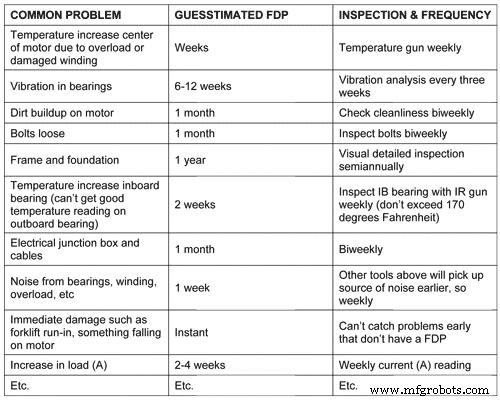
Below is a simplified table of suggested inspection intervals for common failure modes. These figures are estimates; adjust them based on your team’s proficiency and the equipment’s context.
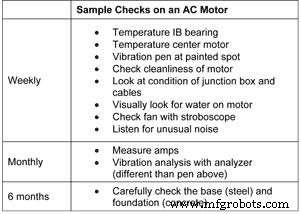
Note: Preventive Maintenance and Condition Monitoring Standards are available through Noria.
Critical Components and Inspection Frequency
While component criticality does not alter the FDP, it informs the level of uncertainty we tolerate. A highly critical motor may receive more frequent checks simply because the consequences of missing a failure are severe, even if the underlying FDP is unchanged.
Common Misconceptions
- Inspection frequency is tied to component life. Component lifespan (e.g., 8–25 years for motors) has no bearing on how often you should inspect for emerging failures.
- A long history of trouble‑free operation allows longer intervals. Past performance does not shrink the FDP; it only reduces the likelihood of failure, not the window for detection.
- Criticality dictates FDP. FDP is a property of the failure mode itself; criticality influences how aggressively you manage uncertainty.
Practical Take‑aways
- Base inspection intervals on the FDP, not component age or criticality.
- When FDP data is scarce, use experienced judgment to estimate reasonable intervals.
- Prioritize training inspectors and scheduling corrective actions over large, data‑intensive FDP studies.
Equipment Maintenance and Repair
- 10 Proven Strategies for an Effective Preventive Maintenance Program
- Mastering Preventive Maintenance: Building and Optimizing Fixed & Floating Schedules
- Preventive Maintenance: A Comprehensive Guide to Reliability, Cost Savings, and Equipment Longevity
- Proactive Maintenance: Essential Strategies for Reliability and Cost Savings
- Build a Robust Fixed‑Asset Numbering System to Accelerate Maintenance
- Maximizing Efficiency: How Preventive Maintenance Software Drives Success in Manufacturing
- Master Planned Preventive Maintenance (PPM): A Step-by-Step Guide to Keep Equipment Running
- Mastering Preventive Maintenance: A Step-by-Step Guide to Scheduling Work Orders
- How to Create a Comprehensive Preventive Maintenance Plan
- Proactive Hydraulic System Maintenance: Reduce Contamination & Downtime