



FRACAS Explained: Turning Failure Reports into Reliability Gains
FRACAS (Failure Reporting, Analysis & Corrective Action System) is a disciplined, closed‑loop process that lets organizations capture failures, diagnose root causes, and implement corrective actions. By integrating data across design, production, and field operations, FRACAS turns failure incidents into actionable insights that improve reliability and reduce costly rework.

What Is FRACAS?
A FRACAS is a structured framework that enables teams to formally report failures, conduct root‑cause analysis, and execute corrective actions. While the core process was first adopted by the U.S. Department of Defense in 1985, it is now a standard practice in safety‑critical, manufacturing, and service industries worldwide.
The process follows three essential steps:
- Failure Reporting (FR): All incidents are logged on a standardized form that captures the asset, symptoms, operating conditions, and time of failure.
- Analysis (A): Engineers perform a root‑cause analysis to uncover the underlying failure mechanism.
- Corrective Actions (CA): Based on the analysis, corrective or preventive actions are implemented, verified, and documented.
FRACAS is often supported by specialized software, which manages thousands of reports, tracks corrective action status, and generates reliability metrics. When paired with DMAIC, MTBF, or MTTR metrics, a digital FRACAS provides a powerful tool for continuous improvement.
How to Implement FRACAS
Implementation is highly customizable and typically follows three stages: reporting, analysis, and corrective action. Below is a practical guide.
Step 1 – Create the Failure Report
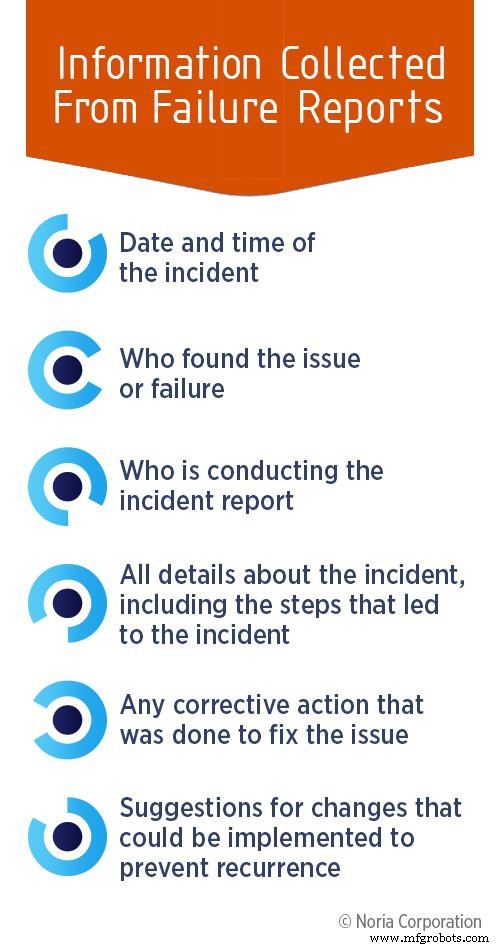
The first interaction with FRACAS is the failure report. It should capture:
- Date and time of the incident
- Reporter and responsible reviewer
- Detailed incident narrative and observed symptoms
- Pre‑failure corrective actions already taken
- Suggested preventive measures
Step 2 – Conduct Analysis
Once the report is logged, the assigned analyst performs a structured root‑cause investigation, often using tools such as Ishikawa diagrams or fault‑tree analysis.
Step 3 – Implement Corrective Action
The corrective action is then executed, verified, and recorded. Closure of the incident confirms the loop is complete and the data can be fed back into the reliability database.
The FRACAS Workflow
Below is an illustrative workflow for a manufacturing environment:
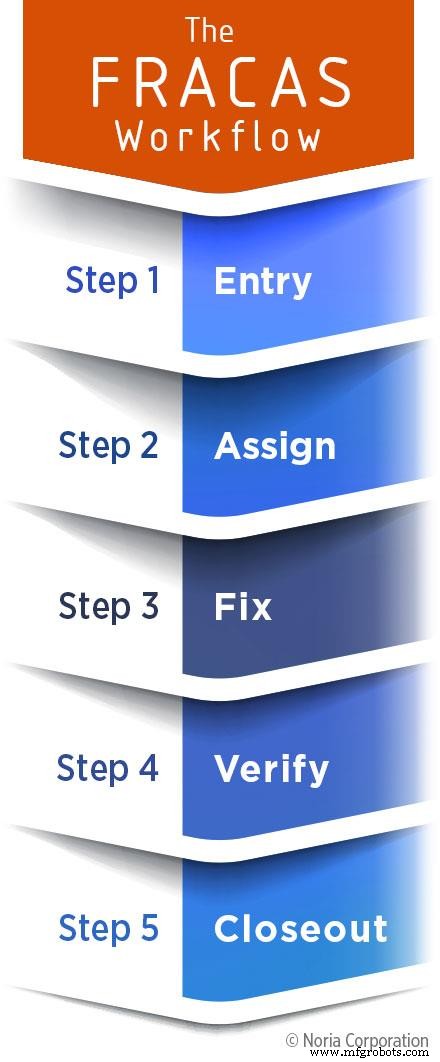
- Entry: A seized bearing is logged.
- Assign: The maintenance lead assigns the case to a technician.
- Investigate: The technician discovers shaft misalignment caused by inadequate training.
- Correct: Training is updated and alignment procedures are documented.
- Verify: Vibration analysis confirms alignment is within tolerance.
- Closeout: The incident is closed in FRACAS.
In aviation and automotive sectors, the 8‑Discipline (8‑D) method is often used, adding a formal team‑based structure to the FRACAS loop.
The Phases of Implementing FRACAS
Effective FRACAS deployment follows three phases—Discovery, Design, and Enactment—outlined in the Journal of Quality and Reliability Engineering.
Discovery Phase
Define tasks, ownership, and information flows. Establish procedures, approval paths, and decision‑making hierarchies. Integrate regulatory guidelines and historical data.
| Task | Ownership | Information |
|---|---|---|
| Observe failure | User | Item data, time, location, environment |
| Document failure symptoms | Testing division | Failure description and expected root cause |
| Verify failure | Testing division | Checklist |
| Isolate suspected item | Testing division | Failure mode |
| Retest replaced item | Testing division | Test report |
| Verify isolated item failure | Testing division | Repair description/verification report |
| Failure analysis | Reliability division | Analysis method and report |
| Check similar failure history | Reliability division | Historical data |
| Determine root cause | Reliability division | Root cause identification |
| Incorporate corrective action | FRB | Analysis results/action specifications |
| Verify action effectiveness | FRB | Effectiveness result |
Design Phase
Standardize the process through software. Separate tasks into human work (e.g., corrective action determination) and document‑based tasks (e.g., failure verification reports).
Enactment Phase
Distribute tasks via email, mobile, or SMS. As each task is completed, the status updates in real time, keeping the closed‑loop cycle intact.
FRACAS Compliance
FRACAS aligns with a broad range of industry standards. The MIL‑STD‑2155 FRACAS framework, though military in origin, is widely adopted for its comprehensive reliability guidance. Additionally, FRACAS satisfies ISO 9001 and ISO/TS 16949 requirements by mapping each FRACAS stage to ISO’s proposal, preparatory, committee, inquiry, approval, and publication phases.
Benefits of Implementing FRACAS
- Reduces direct costs (rework, scrap) and indirect costs (customer dissatisfaction).
- Accelerates reliability growth through continuous monitoring and data‑driven corrective actions.
- Provides clear visibility of reliability trends, enabling proactive improvement.
- Streamlines engineering response with root‑cause analysis, speeding deployment of fixes.
- Creates a knowledge base that informs future design and maintenance decisions.
Bottom Line
While adding more preventive maintenance steps can help, a structured FRACAS approach—backed by FMEA or RCM analyses—ensures that every intervention is value‑added and drives real reliability gains.
Equipment Maintenance and Repair
- FRACAS: Turning Equipment Failures into Business Gains
- Preventive Maintenance: How Proactive Care Drives Reliability & Saves Costs
- FRACAS: Unlocking Reliable Asset Performance
- Maintenance Management 101: How CMMS Drives Efficiency, Cost Control, and Asset Longevity
- MTBF Demystified: A Comprehensive Guide to Reliability & Maintenance
- Run to Failure (RTF): When It Makes Business Sense
- Understanding Single Point of Failure: A Clear, Professional Guide
- C Programming Language: A Comprehensive Overview
- C#: A Comprehensive Overview of Microsoft's Modern Programming Language
- Comprehensive Failure Analysis: Preventing Equipment Loss and Reducing Costs