



Aligning Functional Teams for Manufacturing Reliability and Profitability
Reliability challenges in manufacturing stem from cross‑functional issues, yet many organizations still focus solely on maintenance practices. This narrow approach limits results.
Indeed, outcomes have been modest. Reliability—and the profits it supports—can be undermined by a range of factors, from supply‑chain quality to product designs that outpace plant capabilities.
Addressing reliability requires a cross‑functional mindset, which leads us to examine the organizational vectors that impede collaboration.
Most organizations have a mission or vision that typically centers on maximizing shareholder return through whatever means the company pursues. The problem arises when functional teams interpret that mission in isolation, creating siloed objectives that clash with one another. I call these conflicting directions “organizational vectors.”
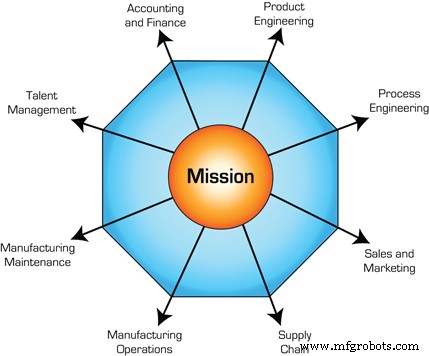
Figure 1. When visions aren’t aligned among the functional players in the organization, each functional group, operating within a silo, pursues its own objectives, which can create problems for other groups.
In engineering terms, a vector has both direction and magnitude. For example, air traffic controllers guide aircraft by specifying a heading, altitude, and speed, ensuring safe arrival. If two forces cancel each other out—like a vector to the east and an identical vector to the west—the result is zero, a state of “homeostasis” that keeps a system stuck.
At the organizational level, misaligned vectors create a similar “stuckness,” costing time, money, and opportunity. Each functional group may be performing optimally within its silo, but the lack of shared vision generates waste—often between silos rather than within them.
Take a common scenario: sales and marketing decide to launch a new product or packaging solution that promises a competitive edge. If the manufacturing system cannot support that solution, the company faces three options:
- Pull the product from the portfolio, which can be difficult once marketing has already committed to delivery.
- Produce the item with existing equipment, compromising availability, speed, or quality—the three pillars of Overall Equipment Effectiveness (OEE).
- Invest in a bespoke machine or system, increasing net operating asset in place (NOAP) while potentially lowering return on net assets (RONA).
Two root causes typically drive this mismatch:
- Sales and marketing, focused on top‑line revenue or market share, introduce a product that lacks manufacturability.
- Manufacturing and engineering, driven by cost minimization, install required capability quickly and cheaply, without building flexibility into the process.
Communication is the key, but it breaks down when teams chase siloed goals. Effective organizations re‑align every functional vector toward the common mission—value creation and contribution margin for the profit‑seeking entity.
Achieving this alignment means blurring barriers between functional groups, not erasing the functions themselves. It requires intentional processes and a culture that prioritizes cross‑functional dialogue and shared metrics.
While tempting to measure revenue or cost alone, true value measurement must account for the impact of every function. When every team focuses on value rather than siloed objectives, collaboration flourishes and profitability follows.
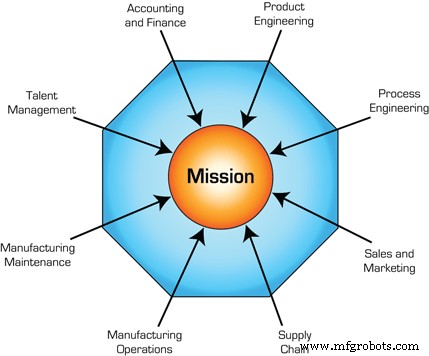
Figure 2. When functional groups align their goals to the mission of the organization, the wasted profits associated with functional vectors can be eliminated. The goal is to “blur barriers, not disciplines.”
Equipment Maintenance and Repair
- Transform Your Plant: A Proven Path to Data‑Driven Manufacturing
- How ERP Drives Efficiency in Manufacturing Operations
- Mastering Maintenance Planning: From Reactive Fixes to Proactive Success
- Laser Alignment for Vertical Shaft Plumbness: Faster, More Accurate Measurements
- Aligning Business and IT: Proven Strategies for Automation Success
- Reduce Energy Use in Manufacturing: Proven Strategies for Cost Savings and Sustainability
- Industry 4.0: Harnessing AI & Smart Tech to Transform Manufacturing
- Boost Manufacturing Efficiency: Proven Strategies for Peak Performance
- Mastering the Manufacturing Module Group: Bill of Materials & Order Management
- Precision CNC Machining for Aerospace: Unmatched Quality & Reliability