



Navistar Huntsville: A Blueprint for Integrated Maintenance and Operations Excellence
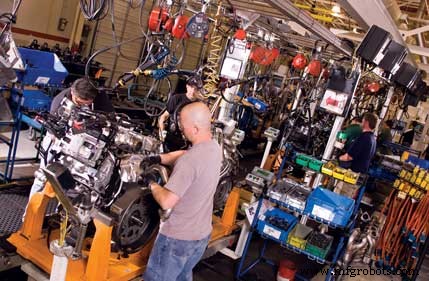
Navistar Diesel of Alabama LLC, a Huntsville‑based subsidiary of Navistar Corporation, transformed a former 650,000‑square‑foot plant into a high‑performance engine manufacturing hub in 2002. The facility now produces 94 V6 and V8 engine models—480 units daily—serving nine customers, including four Ford and five Navistar plants.
From Diverse Roots to a Unified Culture
Unlike traditional plants that recruit from within, Navistar Huntsville built its team from outside the company, drawing talent from automotive giants and niche manufacturers alike. Plant manager Chuck Sibley explains, “We assembled a workforce with varied backgrounds to create the best possible culture.” This approach broke conventional paradigms and gave the plant autonomy to design processes that prioritize reliability, flexibility, and efficiency.
A Three‑Team Business Model
The 650,000‑sq‑ft facility operates around three core business teams—Assembly, Machining, and Manufacturing Services—each overseeing a value chain and staffed with a blend of operators, technicians, planners, and engineers. This structure mirrors a “small plant” environment within a Fortune 500 context, fostering close collaboration and rapid problem resolution.
Maintenance Integrated into Every Team
Navistar Huntsville eschews a centralized maintenance department. Instead, each business team contains its own maintenance technicians (42 full‑time, 200 on‑call), planners, and engineers. Assistant plant manager Mike Regula notes, “The object is to provide every human resource a team needs in order to succeed—no silos, no finger‑pointing.”
The team leaders handle responsibilities traditionally assigned to a maintenance manager: budgeting, capital investment, technology procurement, and staffing. This decentralization ensures that maintenance is embedded in the daily workflow rather than an afterthought.
Operator‑Led Maintenance
Operators at Huntsville perform preventive, predictive, proactive, and reactive maintenance—tasks beyond standard TPM duties. They conduct daily lubrication, tooling changes, and advanced diagnostics such as ultrasonic bolt checks and torque consistency audits. When a minor fault occurs, an operator can often resolve it immediately, reducing downtime to under 20 minutes.
Regula emphasizes, “Operators know everything that can go wrong; they are integral to the problem‑solving process.” Their involvement boosts equipment uptime, which now exceeds 90% overall and 99% for critical facility systems.
Continuous Improvement Through Blended Best Practices
Innovation flows from employees’ diverse experiences and from industry benchmarking. Navistar Huntsville exchanges tours with peers like Toyota, Honda, Nissan, and engages in joint projects—such as deploying infrared cameras and laser alignment tools—shared across the three business teams.
Employees contribute to proactive maintenance planning, including systematic downtime tracking, Pareto analyses, eight‑step root‑cause investigations, and reverse FMEA workshops. These practices sharpen reliability and enhance safety, ergonomics, and quality.
Key Performance Indicators
- Hours per unit: industry‑leading efficiency.
- On‑time delivery: only two missed orders in six years.
- Defect rate: targeting 100 PPM (currently 200 PPM).
- Uptime: >90% overall; >99% for facility essentials.
- Proactive maintenance: 80% of workload, with 80% preventive and 20% predictive.
- Lost‑time injuries: 1.5 M hours without an incident.
- Absenteeism: 1.5% daily, below industry average.
- Employee turnover: <1%.
Future Expansion
A 300,000‑sq‑ft second plant, located one mile from the main facility, will begin production in late July, building 11‑ and 13‑liter tractor‑trailer engines. It will employ 175 highly flexible workers and operate under the same business‑team DNA.
Mission Statement
“Recognizing the strengths of our employees as our greatest asset, we believe that our commitment to ‘Blended Best Practices’ and ‘Empowered Teams Exceeding Expectation’ will maximize product value. We also believe that this approach will foster the level of trust and respect for the individual that is necessary for Navistar Diesel of Alabama LLC to excel and be recognized as the local employer of choice.”
Why It Works
By blending roles, decentralizing maintenance, and empowering operators, Navistar Huntsville achieves remarkable uptime, minimal downtime, and a culture that attracts over 1,500 applicants for a single job posting. The plant’s success is a testament to the power of integrated teamwork and continuous improvement.
Equipment Maintenance and Repair
- Heavy‑Duty Truck Manufacturing: Design, Production, and the Road Ahead
- Digitalization Unlocks Efficiency and Growth in Food Production Plants
- Elevate Automated Welding: Proven Strategies for Peak Performance & Reliability
- Catalyst Paper Enhances Mill Performance with Ivara Reliability Initiative
- Global Maintenance & Availability Performance Indicators: Aligning SMRP and PR EN 15341 Standards
- Leveraging Overall Equipment Effectiveness (OEE) to Drive Plant Performance and Employee Engagement
- Mastering Information Management to Boost Maintenance Performance
- Proven Asset Performance Management Strategies for Industrial Excellence
- Benchmarking Maintenance Performance: How to Measure, Compare, and Improve
- Glass Fiber Performance: Physical, Mechanical & Chemical Properties Explained