



Effectively Managing Assets by Criticality: A Practical Guide
While many reliability programs focus on critical assets, few grasp the full significance of a criticality ranking. In reality, the "critical" assets are those that most directly influence the plant’s mission—whether that’s production rate, product quality, or cost efficiency.
Reliability specialists often overlook the single trait that truly makes an asset critical. By constructing a robust criticality analysis model, engineers can pinpoint the reliability improvements needed to shift an asset’s criticality—and thus refine asset‑management strategies.
Defining the Metrics Behind the Score
The foundation of a credible criticality model is a set of well‑chosen characteristics that capture business impact. Typical criteria include:
- Mission & customer impact
- Safety & environmental impact
- Isolation of single‑point failures
- Preventive maintenance (PM) history
- Corrective maintenance (CM) history
- Mean time between failures (MTBF) or "reliability"
- Probability of failure
- Spares lead time
- Asset replacement value
- Planned utilization rate
Each attribute is weighted on a 0–10 scale, ensuring the aggregate score does not exceed 100. This cap reinforces the relative importance of each factor while keeping the model straightforward.
Beyond a Simple Score Range
Many organizations assign a criticality tier based solely on a score band—for instance, 75–100 = "critical", <25 = "expendable". This approach dilutes the analytical value of the model, reducing every asset to a single number that says nothing about why it matters.
True criticality analysis should surface not only the top‑20% of assets but also the dominant characteristics driving that status. Understanding the underlying drivers enables targeted interventions—such as implementing single‑minute exchange of dies (SMED), stocking ready spares, or tightening critical spares inventory—to lower an asset’s criticality and free resources for genuinely unreliable equipment.
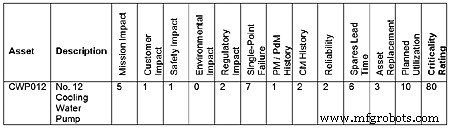
Table 1
For example, a cooling water pump that scores 80 falls in the top 20% but that number alone does not reveal the root cause of its criticality. Deeper analysis may show that the primary issue is the high impact of a single‑point failure, which can be mitigated through improved spare parts management or process redesign.
From Analysis to Action
Once critical assets are identified, reliability specialists typically perform a Failure Modes and Effects Analysis (FMEA) to rank risk priorities and prescribe corrective actions. However, the process must also consider common critical traits across the entire plant. If "Mission Impact" is frequently critical, redundancy plans may be warranted; if "Spares Lead Time" dominates, a materials‑management overhaul may be needed; if "Corrective Maintenance History" is problematic, a structured preventive or predictive program should be implemented.
Ranking Index for Maintenance Expenditures (RIME)
The criticality framework also informs work prioritization. RIME combines the "work classification" ranking with the asset criticality score to generate a single number that planners, schedulers, and materials managers use to prioritize weekly workloads.
For a deeper dive into asset management by criticality, contact Life Cycle Engineering at www.LCE.com.
Equipment Maintenance and Repair
- Mastering Azure Cloud: Proven Strategies for Business Success
- Leveraging Azure DevOps: Proven Practices for Accelerated Delivery
- Ensuring Asset Maintainability for Lubrication Excellence
- Mastering Multi-Technology Condition Monitoring for Large Mining Operations
- How Targeted Training Drives Reliability and Profitability
- Mastering Plant Shutdowns: A Comprehensive Guide for Maintenance and Operations Teams
- Streamline Equipment Disposal Using a CMMS: A Step‑by‑Step Guide
- Mastering Paint Sprayers: A Professional Guide for Even, Safe Coverage
- Leveraging Connected Controls to Optimize Asset Management
- Effective Strategies for Managing Warehouse Safety Hazards