



Fixed Asset Management 101: Maximizing Asset Value for Sustainable Growth
Businesses rely on a mix of assets to drive value—from sophisticated machinery to liquid cash. Fixed assets, however, are the long‑term investments that shape a company’s financial health and operational efficiency.
Effective management of these assets is essential for boosting efficiency, cutting operating costs, and increasing profitability. In the next few minutes, we’ll explore proven best practices and common pitfalls to help you get the most out of your fixed assets.
What Are Fixed Assets?
Fixed assets have a long lifecycle. As Investopedia defines it,
“A fixed asset is a long‑term tangible piece of property or equipment that a firm owns and uses in its operations to generate income. Fixed assets are not expected to be consumed or converted into cash within a year. Fixed assets most commonly appear on the balance sheet as property, plant, and equipment (PP&E). They are also referred to as capital assets.”
In a car manufacturing plant, raw materials such as metals and components are consumed quickly and are classified as current assets. In contrast, robotic arms, the factory land, and the plant structure—each with a long expected lifespan—qualify as fixed assets.
What Is Fixed Asset Management?
Fixed asset management (FAM) is the discipline that tracks, monitors, and maintains these long‑term investments. It evolved from manual, paper‑based record‑keeping to sophisticated digital solutions that streamline asset tracking and maintenance.
Key objectives of FAM include:
- Accurate Asset Tracking: Essential for financial accounting, budgeting, forecasting, and depreciation calculations.
- Theft Prevention: High‑value assets demand robust location monitoring to deter theft.
- Proactive Maintenance: Scheduled upkeep extends lifespan and prevents costly downtime.
- Maximizing Uptime: Early interventions reduce failures and boost machine availability.
- Optimizing Utilization: Continuous monitoring identifies under‑used assets and drives OEE improvements.
- Extending Lifespan: Consistent care prolongs asset life, reducing the need for capital expenditures.
Well‑managed assets lower turnover rates and delay the need for new purchases—an outcome every business strives for.
Common FAM Challenges
Effective FAM must overcome several obstacles:
- Manual data entry errors can compromise asset visibility.
- Multi‑department workflows slow decision‑making.
- Cybersecurity threats risk digital asset data.
- Fragmented data sources hinder actionable reporting.
- Inventory tracking of numerous assets adds complexity.
- Big data from extensive asset fleets demands robust storage and analysis.
Implementing the right software and best practices can mitigate these risks.
Fixed Asset Management Best Practices
Adhering to industry best practices unlocks the full value of fixed assets while minimizing resistance and cost.
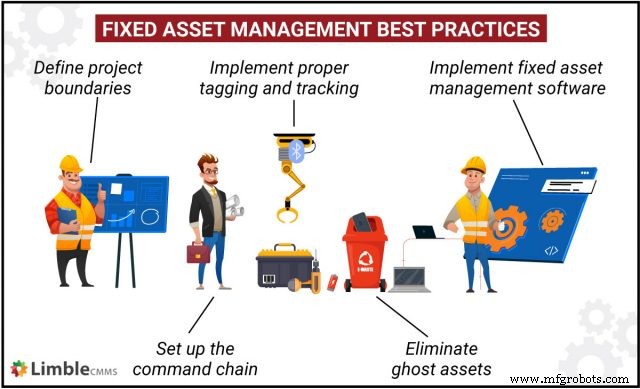
1. Define Project Boundaries
Large enterprises face thousands of assets. Without clear scope, data overload can derail projects and inflate costs.
2. Establish a Command Chain
Clear ownership and measurable metrics are essential. Assign an operations or asset manager to oversee tracking, with support from maintenance and procurement teams.
3. Implement Proper Tagging and Tracking
Use GPS, RFID, Bluetooth, barcodes, or QR codes to maintain real‑time visibility, especially for assets moving to remote sites.
4. Eliminate Ghost Assets
Assets that no longer exist but remain on the register inflate taxes, insurance, and distort financial statements. Periodic physical audits are critical.
5. Adopt Fixed Asset Management Software
Choose software that aligns with budget, support, functionality, security, and deployment preferences (cloud or on‑premise). Proper selection automates workflows and reduces overhead.
6. Additional Tips and Practices
- Leverage depreciation to lower taxes and insurance costs.
- Comply with data security regulations.
- Avoid spreadsheets for tracking; they are error‑prone.
- Time new asset purchases strategically for fiscal advantage.
Mastering these practices drives enterprise asset management (EAM) and inventory control.
Use CMMS as Your Fixed Asset Management Software
Modern CMMS platforms cover all FAM needs, offering:
- Easy asset registry creation and updates.
- Integration with GPS, Bluetooth, and barcode tracking.
- Connection to condition monitoring equipment for real‑time performance data.
- Scheduling of maintenance, repairs, and resource allocation.
- Comprehensive reporting to control asset‑related costs.
Solutions like Limble also integrate with ERP and SAP, ensuring seamless data flow across departments.
Fixed Asset Management on Autopilot
Because fixed assets require significant capital outlay and long lifespans, efficient management is crucial for maximizing output.
Scalable software solutions now make FAM simpler, but adherence to best practices remains essential for smooth operations, lower costs, reduced downtime, and higher productivity.
Equipment Maintenance and Repair
- How IoT is Revolutionizing Asset Management Solutions
- Strategic Asset Management: Unlocking Sustainable Operational Excellence
- 5 Critical Risks That Undermine Asset Management Success
- Industrial Internet: Revolutionizing Asset Management Through Connectivity, Analytics, and User Experience
- Unlocking Asset Value: How Asset Performance Management Maximizes ROI
- Maximizing Asset Value with Comprehensive Asset Lifecycle Management (ALM)
- Elevate Fixed Asset Turnover and ROI with CMMS
- Transforming Asset Management: Harnessing IoT and Connected Assets for Efficiency
- Essential Guide to Utility Asset Management: Mastering Asset Categorization
- Maximizing Utility Asset Value: Proven Best Practices for Long-Term Efficiency