



The Value of Point P: A Strategic Focus for Reliability & Maintenance
Years ago, a colleague mentioned he planned to tattoo the letter "P" over a scar on his ankle. Curious, I asked why he chose that particular letter. He explained that "P" was his favorite letter, and that many of the positive moments in his life began with that letter.
Reflecting on that anecdote and drawing from my experience in reliability engineering, I created a list of "P" terms that resonate with the maintenance and reliability improvement process: Proactive, Planning, Precision, Predictive, Preventive, Protective, Process, and, most importantly, Point P.
My favorite of these is Point P, the point on the P‑F curve where a defect first enters a machine. As the defect lingers, the machine’s functionality gradually deteriorates until it reaches Point F, where total failure occurs.
Many practitioners focus on preventing machines from reaching catastrophic failure—Point F. While that goal is essential, concentrating on Point P unlocks greater rewards: improved equipment health, higher reliability, better product quality, and lower overall costs.
Why prioritize Point P? Here are three key advantages:
- Collateral damage to equipment is reduced, cutting repair costs and the need for spare parts.
- Work can be scheduled in advance, shortening repair time and saving labor costs.
- Maintenance can be performed at the most convenient time, minimizing downtime and production losses.
The true power of focusing on Point P lies in identifying the root cause of the defect when it first appears. By eliminating that cause, you not only prevent the same defect in the current machine but also in all similar machines. This proactive approach yields higher production, superior quality, and sustained cost savings.
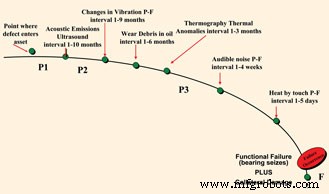
Which point does your organization prioritize? The questions you ask when a defect surfaces reveal your focus. If you ask, "How long will the machine run before catastrophic failure?" or "How much time do we have before failure?" you’re centered on Point F. If you ask, "What caused the defect to enter the machine?" or "How can we eliminate this defect from this and similar machines?" you’re aligned with Point P.
Equipment Maintenance and Repair
- Unlocking Real-Time Value with Predictive Maintenance
- Unlocking the True Value of a Plant Acquisition
- Why Reliability as a Service (RaaS) Is Driving Smarter Predictive Maintenance
- Understanding Machine Criticality Ratings: Balancing Risk, Cost, and Design
- Why Mastering Machine Troubleshooting is Critical for Modern Manufacturers
- Unlocking the Value of IoT Data: Secure, Insight‑Driven Strategies
- Why Analog Measurements Drive Plant Performance
- STAEDTLER Highlights the Critical Role of Automation in Modern Manufacturing
- How Automation Drives Value and Efficiency in Modern Manufacturing
- Investment Casting: Unlocking Precision and Versatility in Metal Fabrication