



Why Analog Measurements Drive Plant Performance

Analog measurements unlock hidden performance potential in manufacturing plants. While digital sensors can confirm a machine is on or off, they miss the subtle shifts that signal emerging issues.
In many facilities, operators rely on simple on/off switches to flag failures. Yet these binary indicators often catch problems only after a part has already degraded, prompting costly rework and downtime.
“Analog data lets us see the gray area between good and bad,” says Joseph Zulick, manager at MRO Electric & Supply. “That intermediate range is where we can intervene before a failure becomes catastrophic.”
Digital sensors provide a clear pass/fail picture, but they lack the granularity needed for proactive maintenance. Temperature, vibration, and motor speed variations are captured more accurately when measured continuously rather than as a single threshold breach.
By pairing analog sensors with servo or inverter controls, operators can adjust motor speeds in real time and immediately observe the effect on process variables. This dynamic feedback loop is far more valuable than a simple on/off status that only changes after a fault occurs.
Analog data also enhances communication and analytics. While a binary switch can be monitored with basic “AND” logic, analog streams feed into sophisticated comparators and predictive models that deliver deeper insights and actionable alerts.
One of the greatest advantages of analog measurement is its visual representation. Graphs and trend curves reveal relationships—such as angle versus position—that are invisible in raw numeric data, empowering teams to spot patterns and anomalies quickly.
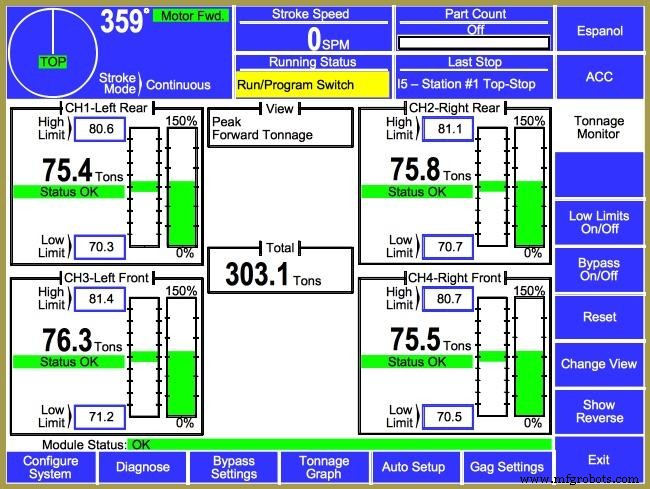
Take a tonnage readout that shows high and low thresholds in color: green for safe, yellow for caution, and red for critical. As the value drifts from the center, the color shift alerts operators to wear before it becomes a failure.
Wear patterns rarely follow a linear path; they often accelerate suddenly. By tracking analog signals over time, AI algorithms can predict when a component is likely to fail, turning reactive maintenance into proactive maintenance.

Overlaying a tonnage curve against the crankshaft’s angular position reveals when material removal spikes or dips, directly correlating to part quality. A single peak number—say 90 tons—doesn’t convey the full story; the waveform shows exactly when and why the peak occurred.
Modern machining centres now publish analog data for motors, cutting speed, and temperature, all of which influence each other. Understanding these interdependencies is essential for optimizing process parameters.
Consider drilling: speeding up the drill motor can increase material removal, but it also raises heat and accelerates bit wear. By monitoring analog temperature and torque, operators can balance speed and tool life.
Every data point is a puzzle piece. One piece offers a glimpse, but a complete picture emerges only when all pieces are combined with a well‑defined historical baseline.
While big data is valuable, the true benefit lies in how analog data is interpolated and applied to other systems—spreadsheets, dashboards, or machine learning models—while preserving data integrity.
Many factories still use binary temperature switches that turn on at a fixed setpoint. However, analog temperature probes provide a continuous readout, revealing temperature drift and enabling early intervention before overheating occurs.
Analog measurement’s impact on ROI is profound: it enhances predictive maintenance, reduces downtime, and improves product quality—all critical factors for competitive advantage.
Author: Joseph Zulick, Manager at MRO Electric & Supply.
Internet of Things Technology
- Unlocking Data Visualization: Why Many Businesses Miss the Mark and How to Win
- Unlocking AI Value with Unlabeled Data: How Hologram Stress‑Tests Autonomous Perception
- Harnessing Data in the Internet of Reliability: Strategies for Effective Management
- The Value of Point P: A Strategic Focus for Reliability & Maintenance
- Democratizing the Internet of Things: Next‑Gen Satellite IoT Brings Universal, Affordable Connectivity
- Unlocking the Value of IoT Data: Secure, Insight‑Driven Strategies
- The Future of Data Centers: Trends, Tech, and Sustainability
- Maximize IoT ROI with Advanced Performance Monitoring
- Unlocking CMMS Success: How Machine Data Drives Maintenance Efficiency
- Unlocking the Power of Machine Data in Modern MES