



Unlocking Asset Value: How Asset Performance Management Maximizes ROI
Assets in the industrial sector come with expiry dates. However, asset life cycles are quite elastic. With proper care and smart asset performance management, firms have the right tools to extract maximum value out of their physical assets before they become unusable or obsolete.
In the past, such an approach was not very practical. Most firms simply did not have access to the right kind of data.
With the advent of advanced computing and software, this is no longer the case. Even smaller companies can harness advanced performance asset management strategies to ensure optimal utilization of critical assets.
Let’s see how.
What is asset performance management?
Asset performance management (APM) represents a diverse set of processes bound together by a common goal – maintaining a sustained level of operational excellence on the production floor. It is predominantly used by businesses in the industrial sector but can be useful to any asset-heavy organization.
The term ‘operational excellence’ refers to the optimal utilization of complex assets involved in the key aspects of production.
The main objective of APM is to reduce unplanned downtime, increase the operational life of the asset, and generally improve its contribution to overall revenue generation.
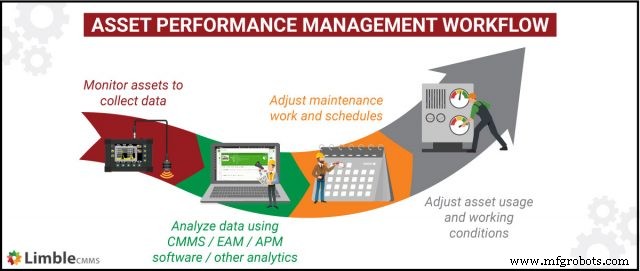
Asset performance management mainly involves the following key processes:
- monitoring assets to collect data (using IoT sensors)
- gaining key insights using software (CMS/EAM, AI analytics)
- performing corrective/pre-emptive maintenance based on those insights
- ensuring a continued optimization of assets for maximum productivity
As you can infer from the list above, sensors and software play a critical role in the APM process. This is a major reason why asset performance came to prominence only in the last few decades, moving along with the general digital transformation. Many of the individual processes did exist in the past, but they only recently became a part of a coherent, focused strategy.
Along with technology, the organization also has a major role to play in the successful implementation of APM.
The processes involved are quite complex and require active participation and support of all levels of an enterprise – from operators, repair techs, and floor managers, right up to the decision-making, C-level executives. A holistic approach is essential for a good asset strategy, combining both human and tech resources to reap the full benefits of APM.
Benefits of performance asset management
Many industrial firms still rely on outdated reactive strategies for asset maintenance. Tight budgets and a failure to look at the big picture are the most common culprits, as well as belated digitalization in some cases.
Success comes to those who are able to think ahead and understand the long-term value of investing in asset performance management:
- Reduced unplanned downtime. The most common reason behind unplanned downtime is asset failure, often due to improper maintenance and misuse. With asset monitoring and proactive maintenance strategies, you can significantly reduce the risk of unexpected equipment failure and increase uptime.
- Lower maintenance costs. While maintenance is unavoidable, you can bring down all associated costs using a predictive maintenance program. The insights generated by APM processes can help prevent excessive maintenance and ensure optimal utilization of all maintenance resources. The thing to avoid here is reaching asset criticality, and a detailed enterprise asset management plan can help with this.
- Lower EHS risk. Unreliable assets can pose health and safety risks. Non-compliance to Environment, Health, and Safety (EHS) regulations will attract hefty fines and make the firm vulnerable to costly lawsuits. Taking good care of your assets helps reduce workplace safety risks.
- Easier transition to Industry 4.0. This is the future of safe and sustainable industrial production – the next big industrial revolution. Firms have to embrace digital technologies to stay relevant. A data-driven APM approach provides a stepping stone to this new paradigm.
In simpler words, performance asset management leads to increased asset reliability, lower operational costs (which increases profitability), and reduced operational risks.
How to measure asset performance?
It is time to lay out the basic roadmap for measuring asset performance in an asset-intensive industrial setting. All of the main steps are outlined below.
Step 1: Identify critical assets
Evaluate the business impact of individual assets on the production floor. In the beginning, pick the ones that are integral to the production process. In later iterations, you can expand the scope of your APM project to involve lower priority assets.
Organizations can use risk-based maintenance to identify the most critical assets. After that, they can apply the RCM methodology to determine which failure modes are worth actively tracking and analyzing.
Step 2: Monitor the selected assets
Data collection for asset health can happen in multiple ways, depending on the type of assets involved. One version includes performance/productivity/maintenance data logged in your CMMS or EAM/ERP software.
The other includes readings measured by IoT sensors installed on equipment, especially those working in high-stress environments. Technicians can also use handheld equipment to perform non-destructive tests and run diagnostics, looking for early signs of equipment deterioration.
Step 3: Analyse collected data using APM software
In this step, organizations use targeted metrics and KPIs to derive actionable insights from the collected asset performance and condition data.
On top of CMMS, they can apply modern APM solutions that combine AI data management, machine learning and analytics to improve asset visibility.
Asset performance management, as a part of asset management, can include a variety of different actions. Hence, the analysis process can include analyzing data trends, conducting RCM, analyzing production losses, conducting root cause analysis, validating operational data, and more.
Step 4: Improve asset care based on the analyzed data
A major impact of the APM approach will be felt in the maintenance strategy employed by your organization. Harnessing the increased asset visibility, you can create targeted maintenance strategies that reduce costs while improving key metrics like equipment reliability.
A holistic approach such as this one, reaping benefits from condition monitoring, various apps and artificial intelligence, will have a tremendous influence on your asset lifecycle.
The role of performance metrics and KPIs in APM
In APM data analysis, the significance of metrics and KPIs cannot be overstated. They provide visibility on critical asset information. Choose the wrong metric and it may give you a skewed or inaccurate picture regarding the status of your assets.
The selection is impacted by a wide range of factors – industry, type of assets, and the role/priorities of the person in charge of APM. Picking the right thing to track is quite tricky as there are 20+ metrics to choose from. We discuss the most common ones below.
Maintenance performance metrics
The mantle of executing an APM program often falls to the maintenance department. They derive maximum value from a host of metrics that focus on maintenance performance, both in the short term and in the long term:
- Work order closure rate: used to gauge the efficiency of maintenance planning and execution (short term).
- Percent productive times: measures the percentage of completed maintenance work as a part of total scheduled (short term).
- Mean time between failures: MTBF is a very common metric that measures the time between asset failures (long term).
- Percent Emergency work: provides insights regarding the efficiency of preventive maintenance programs (long term).
Productivity/finance related metrics
Senior departments within the organization may use higher-level metrics to improve their business intelligence and facilitate a better planning of their business processes. Some of the KPIs popular among senior management and finance departments include:
- Overall Equipment Effectiveness: OEE is a well-known productivity metric that measures three things: availability, performance, and quality of production equipment.
- Availability: a part of OEE, and a great indicator of equipment health.
- Maintenance cost per unit production: often used to decide which assets should be on which maintenance program (making well-informed, cost-effective decisions).
Tracking metrics and KPIs is not just about tracking progress towards set goals. It is also about spotting problem areas.
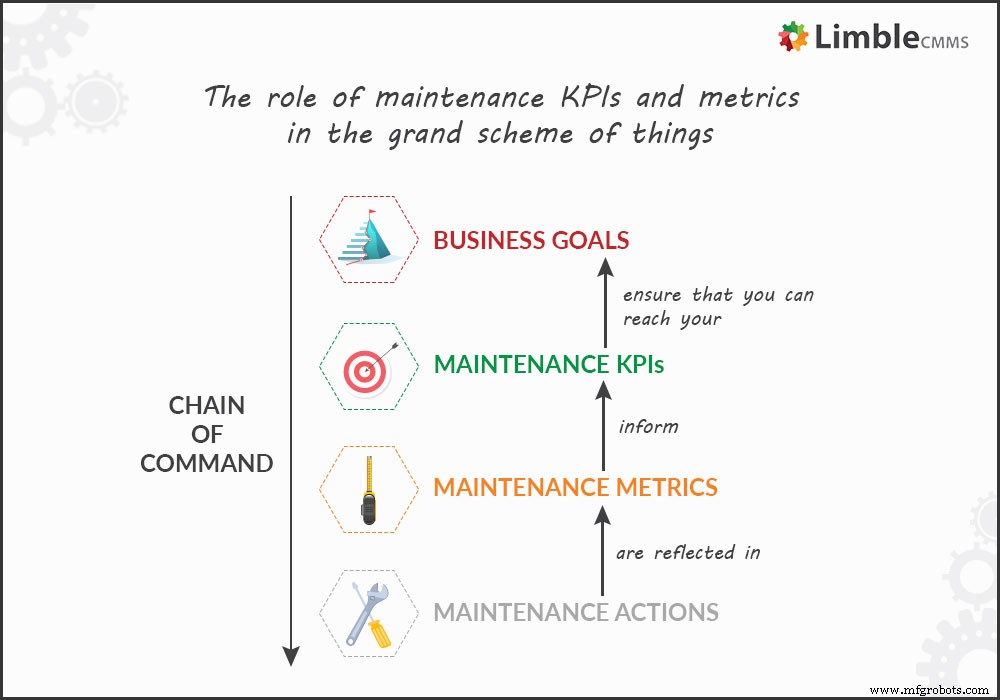
Naturally, in the context of performance asset management, the problems we are trying to identify and eliminate are related to defective assets, poor maintenance practices, and improper equipment use.
Using CMMS for asset performance management
APM requires ready access to a wide range of business and asset data. When organizations use mutually incompatible software solutions for various tasks, isolated data silos can form. Firms with fragmented digital ecosystems will struggle to apply APM principles.
A Computerized Maintenance Management System (CMMS) is one of the solutions to this problem. It is a centralized digital platform that provides a 360-degree view of all important asset-related information.
On top of that, modern CMMS solutions like Limble come with many features that are useful for asset performance management, including:
- detailed asset maintenance logs and history
- sensor connectivity for real-time asset monitoring and asset tracking
- automatic tracking of metrics like MTTR and MTBF
- fully centralized asset data management
- support for organizing, planning, and executing advanced maintenance strategies like predictive maintenance
Reduce Reactive Maintenance by 73.2%
See the Results Red Hawk Enjoys With Limble
Read OurCase Study

Investing in a capable CMMS/EAM software is the first step towards structured asset performance management. You cannot have it any other way – it is a base on which an enterprise builds its digital APM processes.
Final remarks
The true value of an industrial asset is based on its contributions towards production. Poorly maintained assets that are not properly utilized cannot provide good ROI.
Asset performance management helps companies keep their equipment in peak working condition for longer, with fewer failures or serious breakdowns, and without wasting maintenance resources.
To achieve all of that, APM relies on hardware and software to provide the necessary data which will inform future maintenance actions and operating guidelines.
Equipment Maintenance and Repair
- Strategic Asset Management: Unlocking Sustainable Operational Excellence
- Mastering Information Management to Boost Maintenance Performance
- AMP Announces Comprehensive Asset Management Study to Shape 2024‑2026 Practices
- Proven Asset Performance Management Strategies for Industrial Excellence
- Fixed Asset Management 101: Maximizing Asset Value for Sustainable Growth
- Maximizing Asset Value with Comprehensive Asset Lifecycle Management (ALM)
- Construction Asset Management: A Practical Guide to Maximize ROI and Efficiency
- Maximizing Industrial Asset Performance with Advanced APM Strategies
- Asset Management Events 2012: Top Conferences, Training & Exhibitions
- Asset Management Explained: Optimizing Asset Value and Compliance