



Maximizing Asset Value with Comprehensive Asset Lifecycle Management (ALM)
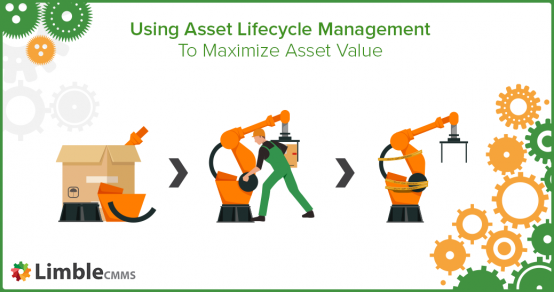
A "money pit" describes any investment that spirals into excessive costs. In industrial settings, where heavy machinery depreciates quickly, an asset without a disciplined lifecycle plan can become a costly liability.
This article demonstrates how structured Asset Lifecycle Management (ALM) can turn those high‑cost machines into high‑value assets, covering every phase from acquisition to disposal.
What is an Asset Lifecycle?
Just as a human life progresses through distinct stages, business assets follow a predictable path: acquisition, deployment, operation, maintenance, and finally decommissioning. Each stage presents unique challenges and opportunities for value creation.
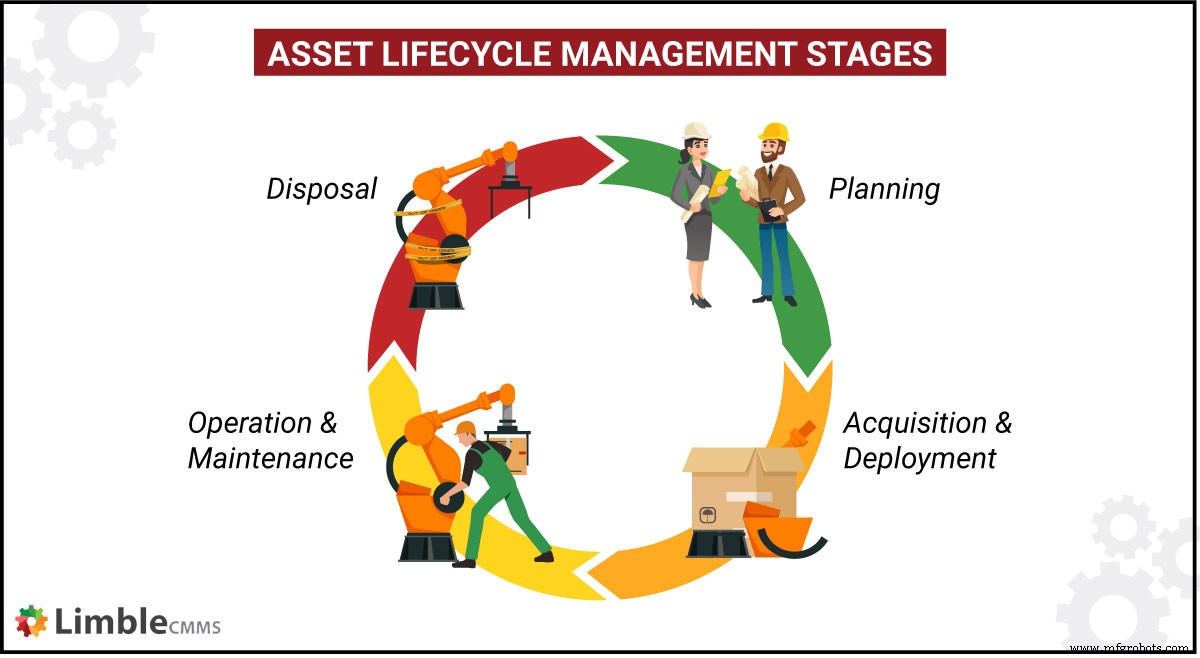
Acquisition is not a mere purchase; it is a strategic decision that should be based on thorough analysis. Buying an incompatible machine can quickly turn into a long‑term liability.
The cost, role, and unique characteristics of an asset influence how closely its lifecycle is monitored. More critical assets merit detailed tracking to extract maximum value.
What is Asset Lifecycle Management (ALM)?
ALM is the systematic monitoring of an asset throughout its life, capturing data on condition, performance, reliability, and maintenance expenses. By integrating this data with insights from finance, operations, and procurement, organizations can craft strategies that extend useful life and enhance profitability.
Consider the case of a new CNC machine. With ALM, you can answer key questions:
- Maximizing profit and revenue: Does the machine enable faster production cycles? Is it fully compatible with existing facilities? Does it require additional training to meet new targets?
- Minimizing cost of ownership: What is the total cost of ownership? What power source does it use? Can it adapt to future demands with minimal retrofits? Is vendor support affordable?
- Extending operational life: Can the machine handle increased workloads? What is the wear rate of critical components? What is the optimal maintenance schedule?
ALM delivers additional benefits such as:
- Accurate financial planning via acquisition cost calculations
- Effective preventive maintenance strategies
- Reduced depreciation and improved resale value
- Enhanced productive efficiency
- Compliance with safety and regulatory standards
Without diligent lifecycle management, assets often generate excess costs, lower productivity, and overall inefficient resource use.
Asset Lifecycle Management Process
Effective ALM depends on real‑time data from across the organization. Legacy, manual systems limit visibility, whereas modern Computerized Maintenance Management Systems (CMMS) or Enterprise Asset Management (EAM) platforms combine software, cloud services, and IoT sensors to provide unparalleled insight.
A customizable CMMS gives businesses a competitive edge at every lifecycle stage. Below is how CMMS supports each phase.
1. Planning
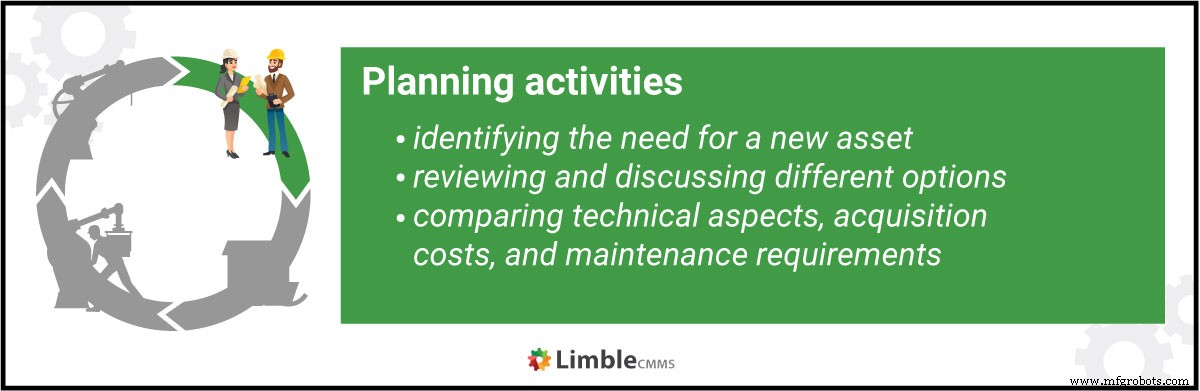
Planning is the foundation of any new asset acquisition. Typical drivers include:
- Replacing obsolete equipment
- Boosting efficiency or productivity
- Ensuring safety and environmental compliance
- Scaling production capacity
Decision makers must review technical specs, acquisition costs, and input from operators, managers, finance, procurement, and engineering. Extensive market research, trials, and comparative analysis lead to the best fit.
CMMS Impact
A mobile CMMS keeps all relevant data—asset performance, maintenance history, and custom KPIs—on hand. Managers can generate real‑time reports and share them with stakeholders, streamlining the approval process.
2. Acquisition & Deployment
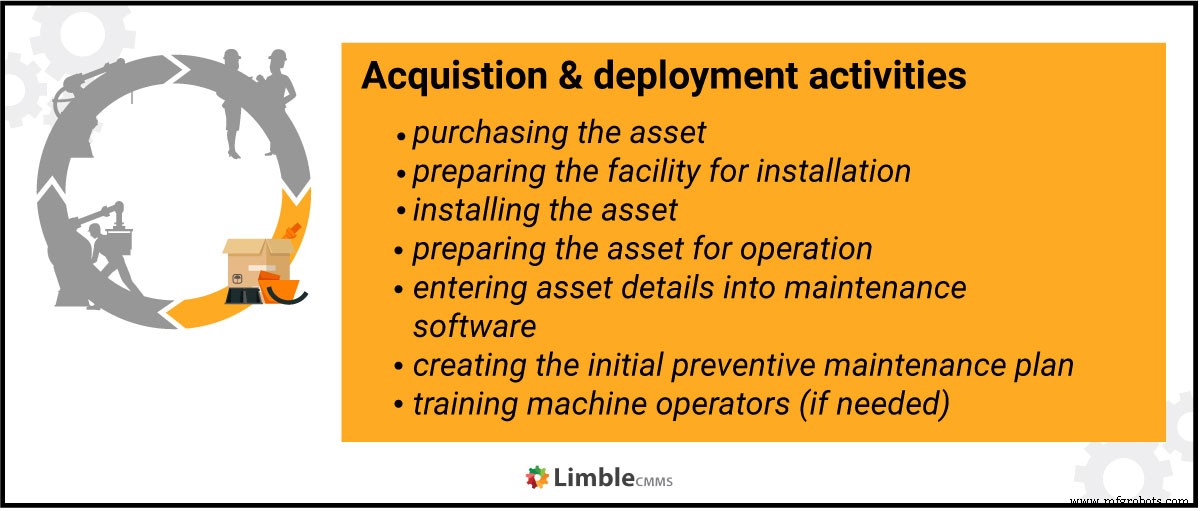
During acquisition, procurement finalizes the specific product based on insights from the planning stage. Deployment involves delivery, on‑site installation, and operator training, requiring close coordination between the business and the vendor.
CMMS Impact
Maintenance managers use the CMMS to schedule preparation, installation, and resource allocation. Asset details are entered, and an initial preventive maintenance plan is created from OEM guidelines and professional experience. For high‑value assets, tracking modules can be enabled.
3. Operation & Maintenance
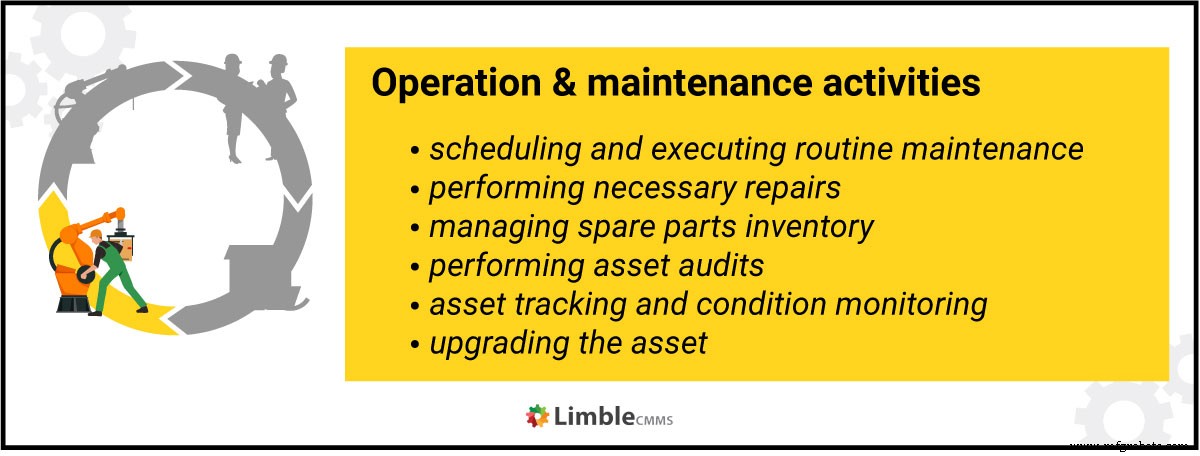
This longest phase focuses on maximizing uptime while keeping operating costs low. Operation schedules must align with vendor instructions and safety thresholds, and continuous monitoring detects performance issues early.
Regular maintenance schedules reduce unexpected failures, emergency repairs, and downtime, thereby extending the asset’s useful life and enhancing profitability. Businesses may also implement upgrades in response to evolving production or compliance needs.
CMMS Impact
Modern CMMS/EAM systems integrate with IoT sensors to monitor assets 24/7, enabling predictive and prescriptive maintenance. They also manage MRO inventory and generate insights into asset productivity and revenue potential, supporting further utilization improvements.
4. Decommission & Disposal
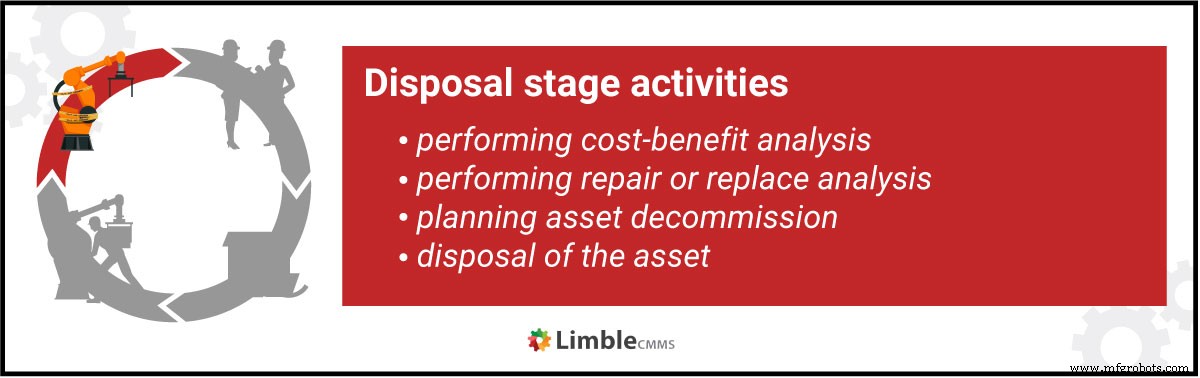
When operational costs outweigh productivity gains, the asset is decommissioned. Post‑removal decisions—sale, auction, donation, or recycling—depend on the asset’s condition and market demand.
Comprehensive ALM in earlier stages can recover a significant portion of sunk costs. A well‑maintained asset may fetch a high resale price.
CMMS Impact
Accurate maintenance histories and reports help managers decide between repair and replacement. During disposal, digital logs enhance resale value and compliance with environmental regulations.
Maximizing Asset Value in a Challenging Landscape
Climate change, economic uncertainty, and global disruptions underscore the need for financial discipline. With tighter budgets, firms must extract maximum value from existing assets and extend their lifecycles.
A feature‑rich, mobile CMMS solution like Limble empowers organizations to navigate every ALM phase, turning potential money pits into high‑value, reliable assets.
Equipment Maintenance and Repair
- Strategic Asset Management: Unlocking Sustainable Operational Excellence
- AMP Announces Comprehensive Asset Management Study to Shape 2024‑2026 Practices
- Unlocking Asset Value: How Asset Performance Management Maximizes ROI
- Fixed Asset Management 101: Maximizing Asset Value for Sustainable Growth
- Construction Asset Management: A Practical Guide to Maximize ROI and Efficiency
- Asset Management Events 2012: Top Conferences, Training & Exhibitions
- 50 Proven Best Practices for Effective IT Asset Management
- 4 Key Objectives for Effective Asset Management
- Optimize Pipeline Maintenance & Cut Costs with Camcode’s Asset Management Solutions
- Asset Management Explained: Optimizing Asset Value and Compliance