



5 Critical Risks That Undermine Asset Management Success
According to the PAS‑551 standard from the British Standards Institute, asset management is defined as: "systematic and coordinated activities and practices through which an organization optimally and sustainably manages its assets and asset systems, their associated performance, risks and expenditures over their life cycles for the purpose of achieving its organizational strategic plan."
This definition spans all asset types—physical, financial, human, information and intangible—and underscores the need for a comprehensive Asset Management Plan. For physical assets, best practice dictates a plan that incorporates Operations, Maintenance, and Risk sub‑plans (or equivalents). In this article we focus on physical assets, but the five risks identified are relevant across all asset categories.
1) Not Knowing What You Have
In manufacturing jargon, this is often called the “fat, dumb and happy” (FDH) approach. Many organizations either underestimate the importance of knowing their assets or simply skip the effort. This lack of inventory is equivalent to playing Russian roulette with your capital.
- Build a complete asset register and verify it against the field.
- Define a physical asset hierarchy—ISO 14224 offers a useful framework.
- Apply criticality criteria that link each asset to its impact on the strategic plan.
- Implement a change or configuration management process to capture every future modification.
2) Over‑ or Under‑Maintenance
During the operational phase, organizations often struggle with excessive or insufficient maintenance. Over‑maintenance drives up non‑value‑added costs and can increase failure risk due to intrusive procedures. Under‑maintenance, driven by profit‑driven cuts, delays proactive work and erodes reliability.
The solution is to start with the most critical assets, determine optimal maintenance through a rigorous methodology such as Reliability‑Centered Maintenance (RCM), then allocate the necessary financial and human resources. Finally, close the skills gap with targeted training.
3) Improper Operation
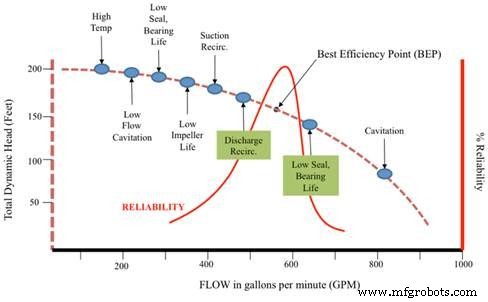
Many operators lack a clear understanding of an asset’s design envelope. Running a centrifugal pump, for example, on either side of its best‑efficiency point shortens its life. Operators must:
- Identify the correct operating regime for each asset.
- Understand the consequences of operating outside the design range.
- Mitigate risk—such as resizing the impeller or adjusting load—to keep the asset within its optimal envelope.
4) Improper Risk Management
Risk management should be an integral part of the asset management plan. It involves identification, analysis, evaluation, treatment, and ongoing monitoring. A classic illustration is the Bhopal disaster, where unassessed and unmanaged risk led to catastrophic loss.
Follow the ISO four‑step model:
- Establish context
- Risk assessment: identification, analysis, evaluation
- Risk treatment
- Monitor and review
5) Sub‑Optimized Asset Management Systems
Enterprise Asset Management (EAM) systems are widely adopted, yet many are under‑utilized or supplemented with secondary tools due to shortcuts taken during implementation. Address this by treating the deployment as a major change program, investing in change management, and aligning technology with people and processes.
True asset management excellence goes beyond avoiding pitfalls—it turns every challenge into an opportunity for improvement.
This article first appeared in the Life Cycle Engineering newsletter RxToday.
References
- PAS 55:2008, Specification for the Optimized Management of Physical Assets, British Standards Institution (BSI), 2008.
- ISO 14224, Petroleum and natural gas industries – Collection and exchange of reliability and maintenance data for equipment, International Organization for Standardization (2005).
- Bhopal Disaster. Trade Environmental Database. TED case studies no. 233, American University, Washington (1 Nov 1997). Link
About the Author
Carl March is a seasoned reliability expert with a background in mechanical and automotive systems engineering. As a licensed Professional Engineer (PE), Certified Reliability Engineer (CRE) by the American Society for Quality, and Certified Maintenance and Reliability Professional (CMRP) by the Society of Maintenance and Reliability Professionals, Carl specializes in RCM, TPM, root cause analysis and Reliability Excellence. Reach him at cmarch@LCE.com. For more information, visit www.LCE.com.
Equipment Maintenance and Repair
- Why Facility Management Drives Industrial Success
- Strategic Asset Management: Unlocking Sustainable Operational Excellence
- Strategic Asset Management: Driving Uptime, Cutting Costs, and Boosting Profits
- Understanding PAS 55: The Global Standard for Asset Management Excellence
- Quintessential Asset Management: Building a Path to Reliability-Centered Maintenance
- Industrial Internet: Revolutionizing Asset Management Through Connectivity, Analytics, and User Experience
- Enterprise Asset Management (EAM): Boost Reliability & ROI in Manufacturing
- Asset Management: Key to Reducing Risks for Utilities
- Prescriptive Maintenance: The Proactive Solution for Superior Asset Management
- The Key Software for Streamlined Maintenance Management