



Why Human Engagement Drives Reliability Success
When a colleague inquires about your reliability program, do you instantly think of vibration analysis, thermography, ultrasonics, motor current monitoring, flaw detection, oil analysis, or other non‑destructive testing methods?
Or do you immediately recall root‑cause analysis, failure mode and effects analysis, reliability‑centered maintenance, CMMS workflows, and other process‑based tools? Even with the best predictive technologies, a program will falter without skilled people executing it.
Traditionally we measure the performance of each technology in isolation, assessing how well assets carry out their intended functions. The real metric, however, is how these tools translate into overall operational productivity.
We often quantify success by how many problems we prevented, using a mix of leading and lagging indicators. In this equation the most critical asset is frequently overlooked – the people.
Employees can elevate or undermine a program through their attitude, daily execution, and cross‑departmental collaboration. Beyond compensation, they seek meaning, recognition, development opportunities, and a sense of belonging. These elements comprise employee engagement.
Defining engagement is challenging. The Conference Board defined it in 2006 as "a heightened emotional connection that an employee feels for his or her organization, influencing them to exert greater discretionary effort."
The 2008 Blessingwhite Report revealed that only 29% of North American employees were fully engaged, while 19% were disengaged.
What Are We Doing Right?
At Cargill’s Cleveland Mine, we have embraced engagement as a driver of business success. Our 2004 employee survey yielded a 61% engagement score, signaling substantial improvement was needed. Subsequent surveys in 2006, 2007, and 2008 recorded 68%, 74%, and 88% respectively – a trajectory we consider world‑class, yet we remain committed to continuous growth.
We gathered employee insights through roundtable discussions, asking, "What are we doing well?" The alphabetized responses highlighted varied priorities: recognition, training, safety, communication, time off, social opportunities, and business awareness. These diverse perspectives illustrate that engagement is multifaceted.
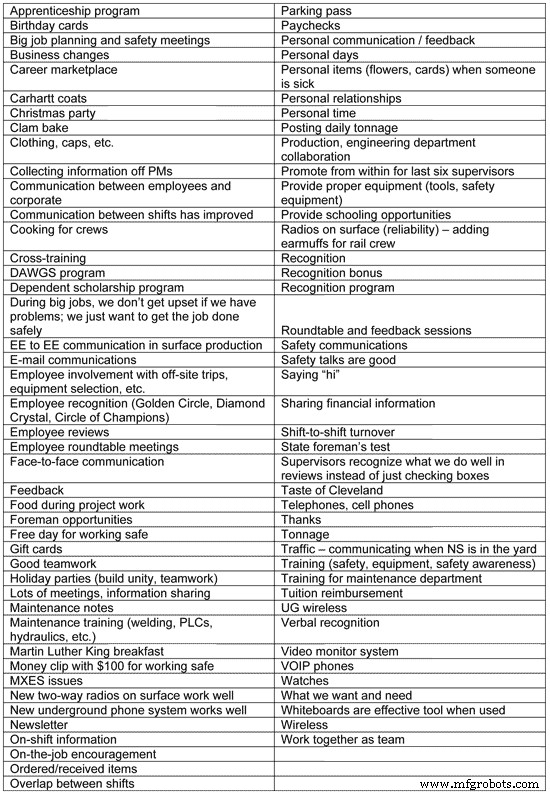
Apprenticeship Program and Educational Opportunities
Facing a shrinking skilled‑craft workforce, we sponsor an in‑house, federally approved apprenticeship for maintenance mechanics and electricians. Apprentices complete 576 instructional hours and 8,000 hours of on‑the‑job training, partnering with Cuyahoga Community College for core coursework and industry‑specific modules such as lubrication and precision maintenance.
The company pays tuition, covers fees, and adjusts schedules to accommodate evening classes. Apprenticeship culminates in a journeyman certificate, aligning talent development with future operational needs.
Beyond formal apprenticeships, we fund tuition for employees pursuing welding certification, PLC, HVAC, and other technical courses. These initiatives represent a true win‑win: employees gain expertise, and the company benefits from applied knowledge.
Safety Training
Our DAWGS program – Develop Awareness With Group Safety – is a behavioral safety training (BST) framework that empowers employees to observe tasks, identify risk factors, and collaborate on mitigation strategies. The process is non‑blame, peer‑led, and rooted in real‑time observation cards that prompt discussion.
Implemented in March 2002, DAWGS reduced lost‑time injury rates dramatically and eventually led to zero reportable injuries. The program is facilitated by a bargaining‑unit employee who trains staff, maintains metrics, and champions continuous improvement.
Get to Know Our Mine
Cleveland Mine is an underground, room‑and‑pillar operation 1,800 feet deep and spanning roughly four miles beneath Lake Erie. We extract de‑icing salt, transport it via conveyor belts to an underground mill, and then hoist the finished product to the surface for distribution by truck, rail, and barge.
Reliability and Engagement at This Cargill Site
Unlike many industries, we lack redundant production lines. A single conveyor or mill failure can halt entire operations. Consequently, reliability is critical, and the workforce – skilled, knowledgeable, and engaged – is our most valuable asset.
Over the past decade, we upgraded our mill, introduced new equipment, and re‑engineered process flows. The 2003 upgrade delivered a 28% productivity increase, but the real catalyst was active employee involvement in design decisions. Operators, mechanics, and supervisors shared their insights, leading to tangible improvements such as replacing a bucket elevator with inclined belts.
Initial engagement scores in 2004 were 61%. By fostering open communication – quarterly manager forums covering costs, projects, and market outlook – and expanding employee participation, we achieved 68% in 2006, 74% in 2007, and 88% in 2008.
The Importance of Lubrication in Reliability
Lubrication is a cornerstone of equipment longevity. A comprehensive three‑day course taught mechanics the principles of correct lubricant selection, application, quantity, and timing. Even seasoned veterans embraced new knowledge, requesting specification updates after training.
We streamlined our lubricant inventory from three pages to a concise 12‑oil and three‑grease catalog, supplemented by a color‑coded application sheet. Operators received basic lubrication training, correcting practices such as improper transmission oil addition.
When an engaged workforce internalizes why a task matters, execution improves, translating into higher reliability and productivity.
Communication and Interaction
We installed an underground fiber‑optic network that delivers VoIP phones, enabling real‑time communication across the mine. Employees can also access intranet data, submit CMMS work orders, and retrieve payroll information through rugged devices.
The network supports an RFID‑based miner‑tracking system, enhancing safety by pinpointing personnel during emergencies.
Cross‑departmental improvement teams and weekly scheduling meetings ensure preventive maintenance remains priority, fostering collaboration between planners, schedulers, maintenance, and production.
Ideas, Improvement, and Innovation
All employees can submit improvement ideas to a centralized database. A cross‑functional team reviews each proposal, recommends feasibility, and implements or declines it, keeping the employee informed throughout.
Recruitment is a team effort: departments participate in interviews to secure talent that fits our culture and skill set, ensuring new hires integrate seamlessly.
While our vibration analysis, thermography, oil analysis, and other advanced technologies deliver valuable data, it is our people – highly skilled, engaged, and collaborative – that ultimately drive reliability.
As Cargill’s de‑icing unit leader, Dale Fehrenbach, puts it, highly engaged employees are safe and highly productive.
Equipment Maintenance and Repair
- Why Data Is the Cornerstone of Reliability Engineering
- The Key to Reliability Success: Culture Change Over Technology
- Why Functional Diversification Drives Plant Reliability Success
- Why the Human Factor is Essential to Cybersecurity Success
- How Simulation Software Drives Design Success
- Why Operators Drive Industry 4.0 Success
- Understanding the Greater Bay Area: Its Role and Significance
- Human Touch: The Key to Successful Automation Projects
- The Critical Role of the Deadman Switch in Robot Safety
- Cobots: Boosting Human Collaboration in Manufacturing