



Cut MRO Costs with Expert Data Cleansing
In today’s fast‑moving industrial landscape, manufacturers are under relentless pressure to trim costs, improve efficiency, and maintain uncompromised quality. With operations spread across multiple sites, each stocking thousands of MRO spare parts, inconsistencies in data entry—often done by different staff in varied languages and without standard guidelines—quickly accumulate. Over time, this lack of uniformity erodes data integrity and triggers a cascade of operational problems.
The most common symptoms of corrupted materials data include:
- Unidentifiable items
- Excess inventory
- Duplication
- False stock‑outs
- Equipment downtime
- Inefficient part searches
- Increased maverick purchases (direct buys)
- Limited benefits from EAM systems
These inefficiencies cost time, money, and the ability to make data‑driven decisions.
The Data‑Cleansing Process
Turning flawed data into a single, reliable corporate catalog demands more than a quick fix. It requires a blend of specialized software, skilled people, and proven procedures. While some vendors tout automated solutions, the reality is that human expertise is essential for accuracy and consistency. Below is a concise, nine‑step framework that applies to every successful data‑cleansing project.
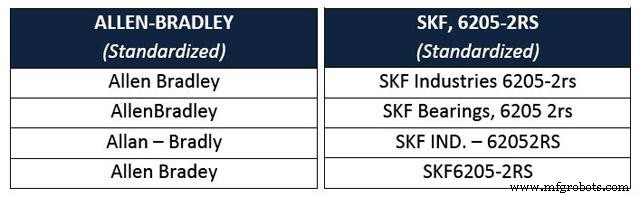
Step 1 – Segregate and Standardize Manufacturer Names and Part Numbers
Using intelligent parsing tools, we extract manufacturer names and part numbers from unstructured descriptions. The system then standardizes each entry, ensuring that every unique manufacturer and part number follows a consistent format across the database.
Step 2 – Assign Noun‑Modifier Pairs and Required Attributes
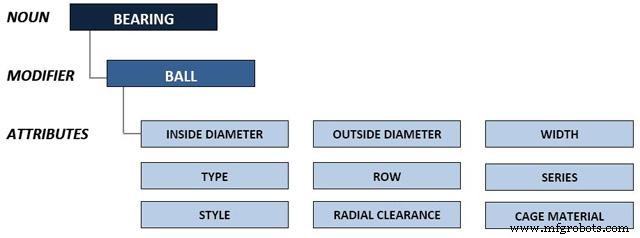
After standardization, a noun‑modifier dictionary maps each item to a primary noun (identifier) and a secondary modifier (descriptor). Each pair is enriched with five to seven attributes that capture the item’s technical characteristics.
Step 3 – Populate Missing Attributes
Remaining attributes are filled using a combination of internal master parts libraries—housing millions of pre‑standardized items—and external research tools that pull data directly from manufacturer catalogs. This step enhances descriptions with verified, high‑quality information.
Step 4 – Assign Classification Codes
With a complete descriptive profile, items receive customer‑specified classification codes. These codes support commodity segmentation, spend analysis, and custom reporting, providing actionable procurement insights.
Step 5 – Detect Duplicate Items
Duplicate detection runs on two levels: exact duplicates (same manufacturer and part number) and form‑fit‑function duplicates (different identifiers but identical in type, size, and material). Identified duplicates are consolidated under a single corporate part number, with identical descriptions, and flagged for review.
Step 6 – Quality‑Control Review
A dedicated quality‑control team performs a final human audit, verifying that every entry conforms to the customer’s naming conventions, that descriptions are accurate, and that all mandatory fields are populated.
Step 7 – Deliver Review List to Customer
Typically, about 10 % of the database requires additional information. These items are compiled into a review list that the customer returns after sourcing the missing data from physical storage or supplier catalogs.
Step 8 – Format Data for the Customer’s ERP System
Once approved, IT specialists reformat the cleansed dataset to match the target ERP’s specific layout, headers, and field limits. Proper formatting is critical to ensure seamless integration.
Step 9 – Return the Cleansed File
After the data file has been fully cleansed, standardized, enriched, de‑duplicated, reviewed, and formatted, it is delivered electronically to the customer for direct upload into their ERP system.
The Results
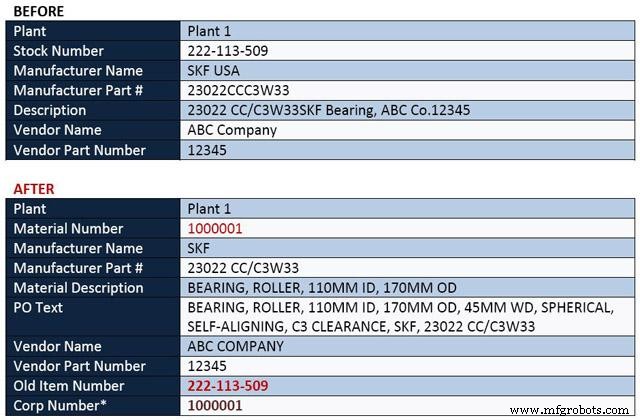
Visually, the transformed catalog displays a uniform naming convention and enriched data across every item. More importantly, the benefits translate into tangible ROI:
1. Cost Reduction
- Identify and eliminate excess and obsolete inventory
- Remove duplicate items
- Reduce equipment downtime
- Cut maverick purchases
- Minimize expedited orders
2. Improved Maintenance Efficiency
- Faster, more accurate part searches
3. Maximized ERP/EAM Value
- Enhanced reporting capabilities
Maintaining data quality is an ongoing commitment. Most data‑cleansing partners offer catalog‑management tools or services to keep the cleaned catalog accurate as new parts arrive or existing items change. If an organization cannot allocate internal resources for this continuous stewardship, outsourcing the task to the experts who performed the original cleanse ensures the highest standard of quality.
About the Author
Jocelyn Facciotti is the marketing manager at I.M.A. Ltd., a leading provider of MRO data‑cleansing services. For more information, visit www.imaltd.com or email info@imaltd.com.
Equipment Maintenance and Repair
- How 3D Printing Reduces Manufacturing Costs: 6 Proven Strategies
- Harnessing Data in the Internet of Reliability: Strategies for Effective Management
- Cut Maintenance Costs with Predictive Maintenance Insights
- Proven Strategies to Cut Maintenance Costs Without Cutting Staff
- Cut CNC Programming Time with WinMax's Advanced Corner Geometry
- 2022 Manufacturing Trends Revealed: Expert Insights from Make UK – Part 2
- Integrating Senseye with ThingSpeak: A Quick Start Guide
- 8 Proven Strategies to Slash Maintenance Management Costs
- Effective Strategies to Cut Equipment Costs for Small Construction and Manufacturing Businesses
- Cut Trucking Expenses: Proven Strategies to Lower Fleet Costs