



Criticality Analysis: Identifying & Prioritizing High‑Risk Equipment
Criticality and reliability are inseparable. We prioritize preventive maintenance for the most vital assets, design TPM plans around critical equipment, and conduct root‑cause analyses for machinery deemed high priority. The core question is: how do we decide what is truly “critical”? The answer lies in risk assessment. A rigorous criticality analysis reveals the potential threats that could jeopardize your operations.
What is Criticality Analysis?
Criticality analysis is a systematic method for assigning a risk‑based rating to each asset. Think of it as a focused component of a broader Failure Modes, Effects & Criticality Analysis (FMEA/FMECA). While FMEA identifies all possible failure modes and evaluates their impact, FMECA quantifies the risk of each mode and prioritizes corrective actions. The result is a clear, data‑driven hierarchy of equipment based on risk.
Why Criticality Analysis Matters
James Kovacevic of Eruditio explains that a structured, risk‑oriented evaluation removes emotion from the equation. Reliability decisions are then grounded in objective risk rather than individual perception. Once assets are ranked, maintenance teams can focus resources where they matter most and reduce risk systematically.
Who Should Conduct the Analysis?
Industry experts agree that criticality analysis is most effective when performed cross‑functionally. Input from operations, maintenance, engineering, materials management, and health & safety teams ensures that diverse risk perspectives are captured and biases are minimized.
How to Perform a Criticality Analysis
Two common approaches yield a Risk Priority Number (RPN) for each asset, enabling prioritization.
1. 6×6 Severity‑Probability Grid
Plot the severity of a consequence on the X‑axis against its probability on the Y‑axis. A high probability of a severe outcome places an asset in the highest risk quadrant, warranting immediate attention.
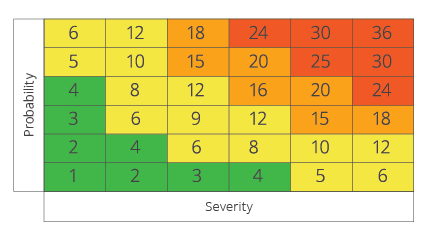
Source: accendoreliability.com
2. Consequence‑Category Multiplication
Separate consequences into categories—Health & Safety, Environmental, Operational. Rate each category’s severity (1–6). Multiply the ratings to calculate the RPN. This method highlights how a failure may impact multiple dimensions.
| Equipment | Health & Safety | Environmental | Operational | RPN |
|---|---|---|---|---|
| Forktruck | 5 | 2 | 1 | 10 |
| Conveyor system | 2 | 1 | 4 | 8 |
| Mixing tank | 2 | 5 | 4 | 40 |
Source: accendoreliability.com
Grouping Assets by Risk Category
| Risk Category | RPN |
|---|---|
| Extreme Risk | 107–125 |
| High Risk | 88–106 |
| Medium Risk | 37–87 |
| Low Risk | 19–36 |
| No Risk | 0–18 |
Source: accendoreliability.com
After ranking assets, maintenance managers can base decisions on quantified risk, streamlining reliability processes and boosting operational resilience.
Learn how to fix a broken maintenance strategy with FMEA.
Download your free FMEA template here
Equipment Maintenance and Repair
- Criticality Analysis: How to Prioritize Assets and Maximize Reliability
- Achieving Reliability and Maintainability: A Dual-Approach to Equipment Availability
- Asset Utilization Explained: How to Measure and Maximize Returns
- Mastering Productive Efficiency: A Practical Guide to Maximizing Manufacturing Performance
- Fault Tree Analysis Explained: Purpose, Process, and Practical Implementation
- Exploring 6G: The Future of Ultra-Fast Connectivity
- Electrochemical Grinding (ECG): How It Works and Its Advantages
- Stick Welding Explained: Equipment, Process, and Step‑by‑Step Guide
- Electrochemical Grinding (ECG): Process Overview & Practical Applications
- Stick Welding Explained: Equipment, Techniques, and Step‑by‑Step Guide