



Criticality Analysis: How to Prioritize Assets and Maximize Reliability

Criticality analysis is a structured process that assigns a risk‑based importance rating to each asset. By quantifying how a failure could impact your operations, you can focus resources where they matter most.
What Is Criticality Analysis?
According to ISO 31000:2009, risk is "the effect of uncertainty on objectives." In practice, this means evaluating all possible failure modes of an asset and the consequences they could bring to your system. While the exact probability may be hard to calculate, the potential impact can be quantified, making criticality analysis a cornerstone of modern reliability engineering.
Why It Matters
Criticality analysis informs a wide range of maintenance strategies—from Total Productive Maintenance (TPM) to condition‑based monitoring and root‑cause investigations. By shifting from subjective opinions to a data‑driven risk view, you ensure that every maintenance decision aligns with the overall business impact.
Key dimensions that a robust model should cover (Life Cycle Institute):
- Customer impact
- Safety and environmental effects
- Single‑point failure isolation
- Preventive and corrective maintenance history
- Mean time between failures (MTBF)
- Spare parts lead time
- Failure probability
Because risk perception varies across departments, a company‑wide team—operations, engineering, maintenance, procurement, and health & safety—must collaborate to assign objective ratings.
How to Perform a Criticality Analysis
There is no one‑size‑fits‑all method, but two common approaches are:
- Start‑up Approach: Identify a manageable list of high‑value assets (ideally <20% of the total) and calculate the cost of downtime and repair for each. The most critical asset may not be the one you expect—often the central boiler outshines dozens of motors.
- Structured FMECA Approach: A three‑step process that aligns risk matrices, builds a functional hierarchy, and assesses failure risks for each asset.
Below is a practical workflow for the structured method.
- Define a Risk Matrix—Align corporate and equipment‑level risk categories. For example, a $1 M revenue loss might be “minor” corporately but “major” on the plant level.
- Build a Functional Hierarchy—Organize by process units, equipment systems, then individual pieces. A well‑structured hierarchy speeds the entire analysis.
- Assess Failure Risks—In workshops, select the Maximum Reasonable Outcome (MRO) event per asset, focus on the single highest risk dimension, and work top‑down through the hierarchy.
Visualizing Criticality
A 6x6 grid plotting probability vs. severity produces a Risk Priority Number (RPN). Most firms score each category (operational, safety, health, environment, reliability) on a 0–10 scale and then aggregate the weighted scores. Visual tools help teams review and refine the analysis over time.
Typical visualization steps:
- Select evaluation characteristics (e.g., customer impact, EH&S, maintenance history).
- Weight each on a 0–10 scale.
- Define clear descriptions for each score.
- Import the asset hierarchy.
- Identify single‑point failures for each asset.
- Calculate the impact across all characteristics.
- Normalize scores to a percentage.
- Identify the top 10–20 % critical assets.
- Review the drivers behind each rating.
- Align findings with reliability, cost, and replacement plans.
Example visual: 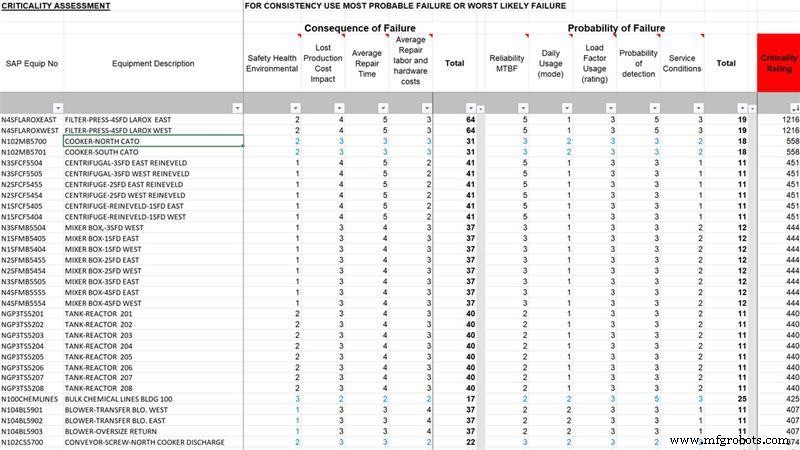
Criticality Analysis Through the FMECA Lens
FMECA—developed by the U.S. military and codified in MIL‑STD‑1629A—adds a quantitative layer to traditional FMEA. It calculates RPNs, ranks failure modes by criticality, and drives targeted mitigation actions.
Benefits span design, operations, and cost:
- Design – higher reliability, safer margins, reduced redesign cycles.
- Operations – optimized preventive/predictive maintenance, lean gains, reliability growth.
- Cost – early failure detection, lower warranty expenses, increased customer satisfaction.
While time‑intensive, FMECA is invaluable for high‑stakes assets and is often supported by specialized reliability consultancies.
The Bottom Line
Criticality analysis turns maintenance into a risk‑aware discipline. By assigning objective ratings, you can:
- Prioritize tasks based on the risk of not performing them.
- Allocate spare parts and budget to the highest‑impact assets.
- Implement tailored mitigation strategies—condition monitoring, redesign, or process changes.
Visual aid: 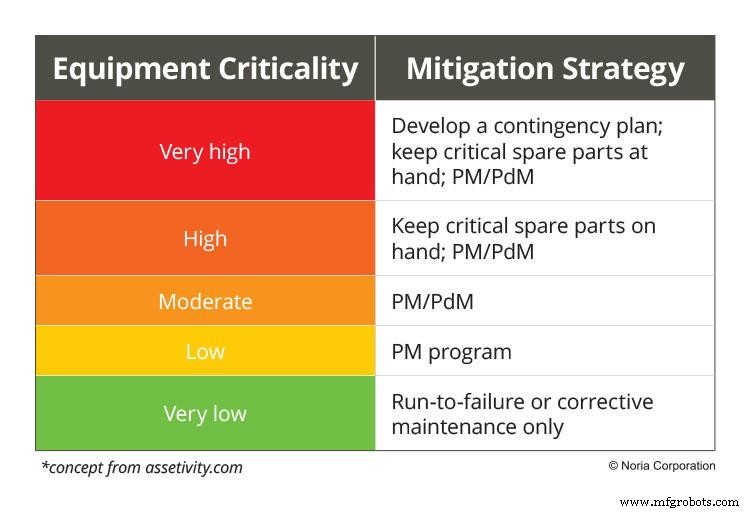
Equipment Maintenance and Repair
- Criticality Analysis: Identifying & Prioritizing High‑Risk Equipment
- Logistics Management Explained: Key Benefits for Modern Businesses
- Facility Operations: Definition, Significance, and Key Benefits
- Mastering MRO: Boost Profitability by Optimizing Maintenance, Repair, and Operations
- Preventive Maintenance Explained: Key Benefits for Asset Reliability
- Predictive Maintenance Explained: Why It’s Essential for Modern Facilities
- Facility Maintenance Explained: Why It Matters for Safety, Efficiency, and Value
- Sustainable Maintenance: Why It Matters for Business and the Planet
- Understanding LED Heat Sinks: Why They Matter for Optimal Performance
- Leased Equipment Tracking: Why It’s Essential for Business Success