



How to Accurately Measure Machine Efficiency – A Practical Guide

Machine efficiency is a cornerstone of modern manufacturing. By reducing operating costs, increasing throughput, and lowering environmental impact, efficient equipment delivers tangible ROI for any plant.
As a maintenance professional or plant manager, you already know how costly manufacturing equipment can be. Efficiency isn’t a footnote – it’s a strategic priority.
Below you’ll find proven methods to measure and calculate machine efficiency.
The Basic Concept of Efficiency
In manufacturing, efficiency measures how well a process converts inputs into outputs without waste—time, materials, or energy.
While 100 % efficiency is unattainable, it remains the target. Lean principles, just‑in‑time, and Kaizen help close the gap.
Physics gives us a starting point:
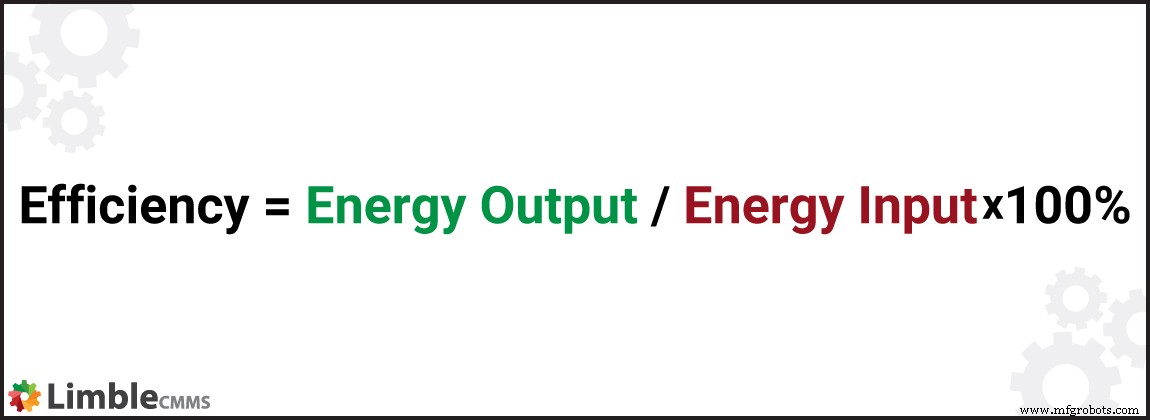
Efficiency = (Output ÷ Input) × 100 %. The result can never exceed 100 %—a 100 % rating indicates a perfect process.
Ways to Calculate Machine Efficiency
Manufacturing involves many inputs. Using the core formula, you can evaluate a machine from multiple angles. The three most common approaches are:
- Energy Production
- Energy Consumption
- Production Efficiency (Productivity vs. Efficiency)
Energy Production
Energy production refers to converting available energy into a more usable form. For instance, a solar panel turns light into electricity.
Formula: Efficiency = (Usable Energy ÷ Available Energy) × 100 %
Example: A diesel generator converts 40,000 kWh of diesel energy into 10,000 kWh of electricity.
Efficiency = (10,000 ÷ 40,000) × 100 % = 25 %.
Energy Consumption
With energy costs and environmental impact rising, measuring consumption efficiency is critical. The DOE reports that electricity accounts for roughly 96 % of a motor’s life‑cycle cost, and motors can use up to half of a plant’s power.
Formula remains the same.
Example: A power tool uses 500 kWh of electricity and delivers 320 kWh of kinetic energy.
Efficiency = (320 ÷ 500) × 100 % = 64 %.
Production Efficiency (Productivity vs. Efficiency)
Productivity focuses on quantity; efficiency focuses on quality and waste reduction. Over‑production can raise defect rates, thereby lowering efficiency.
When a factory pushes output beyond optimal levels, defect rates often rise. Although more units are produced, overall efficiency drops.
Production efficiency is measured by comparing actual output to the machine’s maximum capability.
Example: A printer produces 650 units per hour versus a max of 900 units.
Efficiency = (650 ÷ 900) × 100 % = 72.22 %.
OEE: The Gold Standard in Manufacturing Efficiency
Overall Equipment Effectiveness (OEE) is the industry benchmark for measuring plant performance. It integrates three critical dimensions:
- Availability
- Performance
- Quality
Calculating Availability
Availability = (Actual Running Time ÷ Scheduled Running Time) × 100 %.

Downtime—caused by breakdowns, adjustments, or maintenance—rarely lets availability hit 100 %.
Calculating Performance
Performance = (Actual Output ÷ (Maximum Speed × Actual Running Time)) × 100 %.
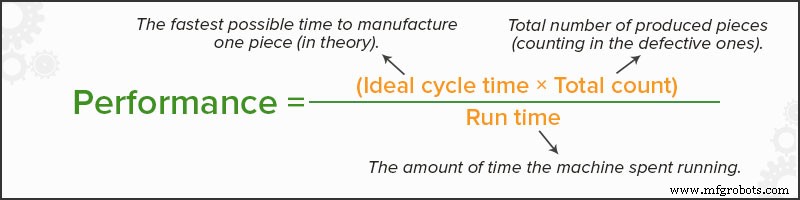
Minor stops, machine defects, or operator inexperience can reduce performance.
Calculating Quality
Quality = (Good Units ÷ Total Units) × 100 %.

Defects—whether from raw material issues, operator error, or equipment faults—lower the quality metric.
How to Calculate OEE
OEE = Availability × Performance × Quality.

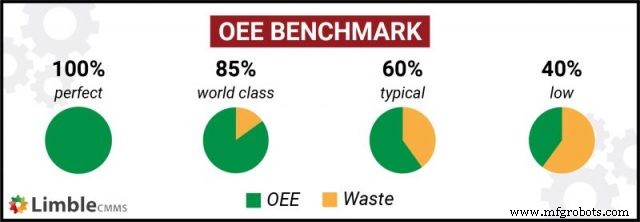
An OEE of 100 % indicates perfect production: no downtime, no defects, and operating at maximum speed.
Industry averages hover around 60 %.
For deeper insights and practical examples, explore our full OEE guide.
Implementing OEE in Your Facility
Calculating OEE is straightforward, but success hinges on accurate data collection and stakeholder engagement. Follow these steps:
- Pick a pilot machine – choose one that’s easy to monitor, involve enthusiastic operators, and assign a skilled maintenance technician.
- Define OEE parameters – set measurement windows, product types, maximum speeds, and data limits.
- Organize data collection – simplify forms and procedures to ensure operators can capture metrics effortlessly.
- Train personnel – explain OEE fundamentals and train on data entry.
- Collect data – empower operators; consider a supervisor for oversight if needed.
- Process data – review and generate clear charts promptly.
- Feedback to operators – share results quickly so adjustments can be made before the next cycle.
- Involve management – present findings to leadership for strategic decisions.
OEE requires a cross‑functional effort: operators, line managers, and executive leadership must collaborate.
Overcoming Machine Inefficiencies
Low efficiency drains profits and hampers production. Unplanned downtime is a major culprit. Proactive, scheduled maintenance mitigates this risk.
Need help tracking maintenance activities? Limble CMMS offers real‑time oversight. Schedule a demo or contact us for more details.
Equipment Maintenance and Repair
- Why Fiber Laser Cutting Machines Outperform CO₂ Lasers in Precision and Efficiency
- Cutting Energy Costs: Proven Green Strategies for Manufacturers
- Reduce Energy Use in Manufacturing: Proven Strategies for Cost Savings and Sustainability
- 5G Operators Prioritize Energy Efficiency for Sustainable Connectivity
- Elevate Production: Mastering Machine Operator Efficiency Measurement & Improvement
- Mastering Machine Availability: Calculation & Enhancement Strategies
- Boost Manufacturing Efficiency: Proven Strategies for Peak Performance
- Calculating VREF for 3D Printer Stepper Motors: A Step‑by‑Step Guide
- Boost CNC Machining Efficiency: Proven Strategies for Superior Performance
- Maximizing Precision and Efficiency in Low-Speed EDM Machining