



Best Practices for Storing and Handling Power Transmission Belts
Belt Storage and Handling
Proper Belt Storage Impacts Performance
Power transmission belts are critical to machinery reliability. Improper storage can damage a belt’s internal cord, leading to premature failure. By following proven storage guidelines, you can preserve a belt’s dimensional stability and service life.
Storage Recommendations
Store belts in a cool, dry location away from direct sunlight. Ideal conditions are below 85°F (29°C) and less than 70% relative humidity. These parameters keep the rubber and reinforcement fibers from degrading and prevent mold growth.
What to Avoid
- Near windows, heaters, radiators, or any source of direct heat or moisture.
- Close to devices that generate ozone (transformers, electric motors).
- Environments with solvents or chemicals that could penetrate the belt material.
- Unprotected floor storage, where traffic may crush or nick the belt.
Never crimp, zip‑tie, or tape a belt during storage. Avoid bending the belt to diameters smaller than the minimum recommended inside bend radius or 1.3 times that radius for back‑side bends. Use gentle handling and avoid hanging the belt from a small pin that forces it into an unsafe curvature.
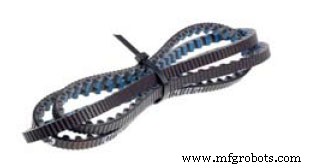
NEVER ZIP‑TIE OR CRIMP BELTS
Storage Effects
Under optimal conditions (≤85°F, ≤70% RH), a belt can be stored for up to six years. For each 15°F (≈8°C) increase above 85°F, the usable storage time halves. Do not store belts above 115°F (46°C). Elevated humidity (>70%) can foster fungus or mildew; while this may have minimal performance impact, it is best avoided. If equipment sits idle for over six months, relax belt tension to prevent set, and ensure the storage environment meets the temperature and humidity criteria. Otherwise, remove belts and store them in a suitable facility.
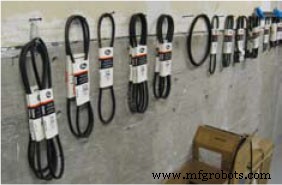
NEVER HANG BELTS FROM A NAIL
Information sourced from www.gates.com.
Equipment Maintenance and Repair
- Expert Insights on Common Mistakes in Selecting Power Transmission Belts
- Essential Tools & Proven Techniques for Quick, Reliable Conveyor Belt Repairs
- How Machine Handling and Repairs Influence Equipment Reliability
- Optimizing Belt Drives: Expert Tips for Reliability and Efficiency
- Hyperconverged Secondary Storage: Driving Unified Data Management for Enterprise IoT
- 8 Essential Conveyor Belt Types & Their Ideal Applications
- Carbon Capture & Storage Technologies: Safeguarding the Planet and Boosting Energy Efficiency
- Belt vs Chain Drives: Key Differences Explained
- Drive Belt vs Timing Belt: Key Differences Explained
- Choosing the Ideal Mining Conveyor Belt: Expert Tips & Best Practices