



Effective Strategies to Prevent Chip Thinning in High Efficiency Milling
The following is just one of several blog posts relevant to High Efficiency Milling. To achieve a full understanding of this popular machining method, view any of the additional HEM posts below!
Introduction to High Efficiency Milling I High Speed Machining vs. HEM I Diving into Depth of Cut I How to Avoid 4 Major Types of Tool Wear I Intro to Trochoidal Milling
Defining Chip Thinning
Chip Thinning is a phenomenon that occurs with varying Radial Depths Of Cut (RDOC), and relates to chip thickness and feed per tooth. While these two values are often mistaken as the same, they are separate variables that have a direct impact on each other. Feed per tooth translates directly to your tool feed rate, and is commonly referred to as Inches Per Tooth (IPT) or chip load.
Download the Free, 50+ Page High Efficiency Milling Guidebook Today
Chip Thickness
Chip thickness is often overlooked. It refers to the actual thickness of each chip cut by a tool, measured at its largest cross-section. Users should be careful not to confuse chip thickness and feed per tooth, as these are each directly related to the ideal cutting conditions.
How Chip Thinning Occurs
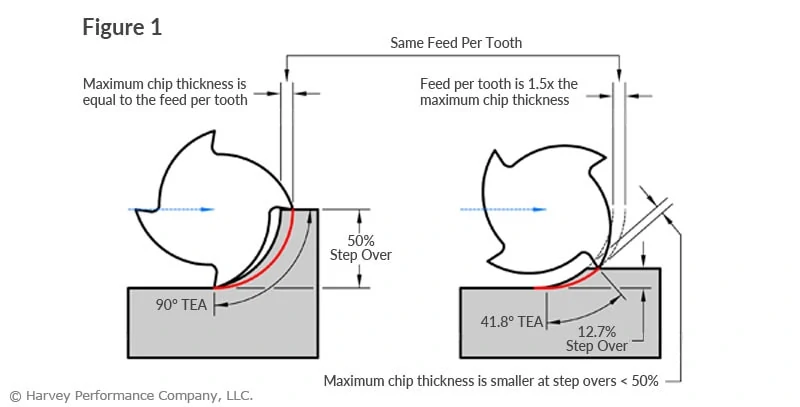
When using a 50% step over (left side of Figure 1), the chip thickness and feed per tooth are equal to each other. Each tooth will engage the workpiece at a right angle, allowing for the most effective cutting action, and avoiding rubbing as much as possible. Once the RDOC falls below 50% of the cutter diameter (right side of Figure 1), the maximum chip thickness decreases, in turn changing the ideal cutting conditions of the application. This can lead to poor part finish, inefficient cycle times, and premature tool wear. Properly adjusting the running parameters can greatly help reduce these issues.
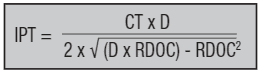
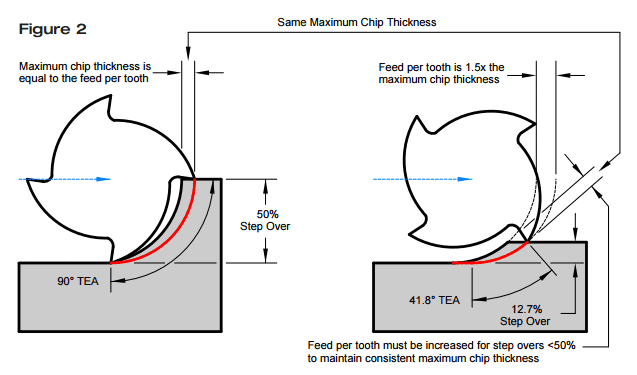
The aim is to achieve a constant chip thickness by adjusting the feed rate when cutting at different RDOC. This can be done with the following equation using the Tool Diameter (D), RDOC, Chip Thickness (CT), and Feed Rate (IPT). For chip thickness, use the recommended value of IPT at 50% step over. Finding an adjusted feed rate is as simple as plugging in the desired values and solving for IPT. This keeps the chip thickness constant at different depths of cut. The adjustment is illustrated in Figure 2.
Inches Per Tooth (Chip Thinning Adjustment)
Lasting Benefits
In summary, the purpose of these chip thinning adjustments is to get the most out of your tool. Keeping the chip thickness constant ensures that a tool is doing as much work as it can within any given cut. Other benefits include: reduced rubbing, increased material removal rates, and improved tool life.

CNC Machine
- Defeating Graffiti: Expert Strategies for Industrial Facility Owners
- Difference Between Pipes and Tubes: Key Distinctions Explained
- Data Science Drives COVID-19 Response: Insights and Strategies
- Master Chip Evacuation in Machining: Boost Speed, Quality, and Tool Life
- Measuring Solder Mask Thickness: A Practical Guide
- Choosing the Right PCB Thickness: Standards, Design, and Manufacturing Factors
- Boost Machine Productivity with Expert Chip Thinning Techniques
- NC State Breaks Record: RFID Chip Shrinks to 125µm × 245µm, Cutting Costs & Boosting Supply‑Chain Security
- Beat Automation: 5 Essential Skills for Manufacturers
- Build Stronger 3D Prints: A Complete Step‑by‑Step Guide