



Absolute vs. Incremental Movement: Key Differences Explained for Machine Shops
Absolute vs. Incremental Movement
Absolute vs. Incremental Movement? These are two terms that you will hear or use in the machine shop, and there are many people who don’t really understand the difference. When I am in a customer’s shop training them on their new machine, it’s a little surprising to me how many people don’t know what the distinction is. Don’t get me wrong, there is nothing wrong with not knowing – after all, if you already knew then you wouldn’t be reading this right now and then my existence would be meaningless.
In my experience there are a couple ways to convey the difference between absolute movement and incremental movement. When it comes to machine movement, simply put:
An ABSOLUTE movement moves TO A COORDINATE based on your ZERO POINT.
An INCREMENTAL movement moves A DISTANCE based on your CURRENT POSITION. An incremental movement does not take your part zero point into consideration.
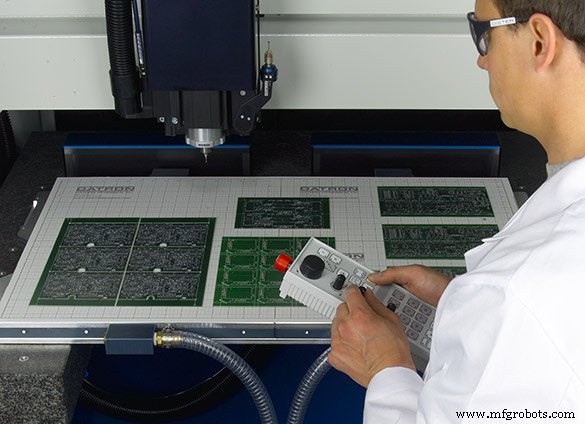
Let’s run through an example. We will work on the assumption that you have a fixture and work piece set up on your machine, and your zero point is the front left corner, with top of stock being Z zero. You just finished setting up your tools so you are located near the back of your table at some random coordinate. We will pretend that your program starts from X0 Y0 Z0.5. So here is your dilemma – you are currently at X6.753 Y14.265 Z2.37 and you need to get to X0 Y0 Z0.5. How will you do it?
Absolute vs. Incremental?
Well, technically you can use either absolute movement or incremental movement. To make this incremental movement you would enter X -6.753 Y-14.265 and then you do some math. You are currently at Z 2.37 and need to reach Z 0.5. 2.37 – 0.5 = 1.87. So for your Z input you would enter Z -1.87. This would get you to X0 Y0 Z0.5. On the flip side, if you make an absolute movement your input will be X0 Y0 Z0.5. You are telling the machine “I want to move the X axis to 0, I want to move the Y axis to 0, and I want to move the Z axis to 0.5.” This is where the real benefit of an absolute movement comes in. When you are moving TO A POINT absolute is the much simpler way to go.
On the other side of this argument, is the situation where you have drilled a hole or pocket in your part, and you know that you need another feature six inches away. Now, if your first feature is at X0 Y0 then it’s really not a concern, since both absolute movement and incremental movement would be the same. However, if you are not at zero, then suddenly your absolute movement becomes more difficult as you need to determine a point in relation to your zero point, rather than a distance from your current position. Let’s use the same numbers as before. You drilled a hole at X6.753 Y14.265. You need a second hole six inches away in the X axis. In order to use an absolute movement your XY input would be X12.735 (6.753 + 6.000) Y14.265. Not too complicated, but certainly there’s a possibility for error. On the other hand, if you choose to do an incremental movement your XY input is X6 Y0. You are telling the machine “I want to move the X axis 6 inches in the positive direction, and I want to move the Y 0 inches.” With incremental movement you are telling the machine A DISTANCE.
It is altogether possible that I just made this more confusing for you. This is not an easy thing to understand at first, and as I have found in my training of others, it is not always an easy thing to teach. Hopefully what I said makes sense – if not feel free to comment and ask any questions you may have. Understanding the difference between absolute and incremental can make your job a whole lot easier and more efficient.Read more CNC Milling Blogs
CNC Machine
- Hose vs Tube: Key Differences Explained
- PTFE vs. Teflon: Same Material, Different Names – What You Need to Know
- C# vs C++: A Clear Comparison of Features, Performance, and Use Cases
- C++ vs Java: Key Differences, History, and When to Use Each
- Understanding Brownouts vs. Blackouts: Key Differences and Business Impact
- Thermoplastic vs Thermosetting Plastic: Key Differences Explained
- Laser Cutting vs. CNC Cutting: Key Differences Explained
- Virtual Reality vs. Augmented Reality: Key Differences Explained
- Transistor vs. Resistor: Key Differences Explained
- Steel vs. Aluminum Angles: Key Differences & Choosing the Right Material