



Hose vs Tube: Key Differences Explained
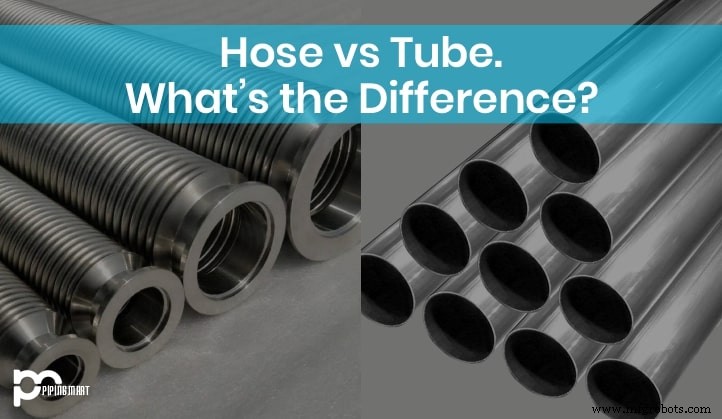
While hoses and tubes are often used interchangeably, the distinction lies mainly in reinforcement and intended use. Hoses are typically reinforced with embedded braids, cables, or dual‑wall construction, enabling them to withstand higher pressures. Tubes, on the other hand, are usually unreinforced and are best suited for low‑pressure, gravity‑fed applications. Always consult the manufacturer’s instructions before selecting a hose or tube.
The differences can be broken down into three core categories:
- Applications
- Sizing Expressions
- Production Process
Applications
Tube is primarily a structural component. It can be produced in a variety of cross‑sections—circular, square, rectangular—and is available in grades that meet ISO and ASTM standards depending on the field of use.
Hoses, by contrast, are versatile “jack‑of‑all‑trades.” They are lightweight, typically made from nylon, rubber, or other non‑metallic materials, and are engineered for a wide range of scenarios. While not intended for permanent piping, hoses are often used where flexibility and quick deployment are essential.
Sizing Expressions
When sizing a tube, the following three measurements are critical:
- Outside Diameter (OD)
- Inside Diameter (ID)
- Wall Thickness (WT)
These dimensions feed into standard size charts, including the Birmingham Wire Gauge (BWG) and the less common Standard Wire Gauge (SWG), which translate wall thickness into millimetres or inches.
Hoses are sized almost exclusively by ID, because flow capacity is governed by the internal passage. The industry’s “dash” scale—increments of 1/16 inch—provides a quick visual reference for selecting the appropriate hose diameter.
Production Process
Tubes undergo a stricter manufacturing cycle to achieve tight tolerances on diameter, wall thickness, straightness, and roundness. This rigorous inspection regime yields higher precision and reliability for structural applications.
Hoses are produced using different processes—often extrusion or molding of elastomers—which suit their flexible, non‑metallic nature. Consequently, the manufacturing and quality control procedures for hoses diverge significantly from those of metal tubes.
Metal
- Plates vs. Sheets: Understanding the Key Differences in Steel and Aluminum
- PTFE vs. Teflon: Same Material, Different Names – What You Need to Know
- Understanding the Difference Between Tube Steel (TS) and Hollow Structural Steel (HSS)
- C# vs C++: A Clear Comparison of Features, Performance, and Use Cases
- C++ vs Java: Key Differences, History, and When to Use Each
- Absolute vs. Incremental Movement: Key Differences Explained for Machine Shops
- Understanding Brownouts vs. Blackouts: Key Differences and Business Impact
- Virtual Reality vs. Augmented Reality: Key Differences Explained
- Transistor vs. Resistor: Key Differences Explained
- Steel vs. Aluminum Angles: Key Differences & Choosing the Right Material