



Understanding the Difference Between Tube Steel (TS) and Hollow Structural Steel (HSS)
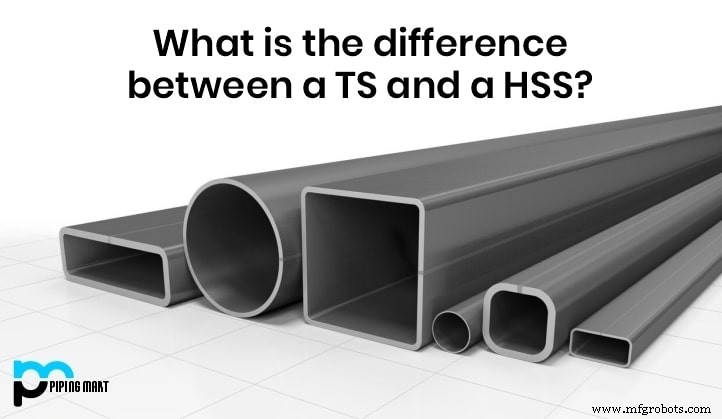
When engineers and architects discuss “tube” versus “hollow” steel, the terminology can feel confusing. Both TS (tube steel) and HSS (hollow structural steel) are closed‑section metal members, but they serve distinct purposes, are specified by different standards, and are used in different construction contexts. Below, we break down the key differences and clarify the terminology you’ll encounter on building plans and specification sheets.
Tube Steel (TS)
Tube steel refers to a long, hollow cylinder designed primarily for fluid transport or for protecting cables and conduits. In the United States, tube steel is defined by ASTM A500 and in Canada by CSA G40. TS can be rectangular, square, or round, and its dimensions are typically expressed in nominal pipe size, nominal outside or inside diameter, and wall thickness. Although “pipe” and “tube” are often used interchangeably, tube steel usually has tighter dimensional tolerances and a more consistent wall thickness, making it suitable for precise engineering applications such as pressure vessels, pumps, and industrial piping.
Hollow Structural Steel (HSS)
HSS is a structural profile that features a hollow cross‑section. Common shapes include rectangular, square, round, and sometimes elliptical. In the U.S. and other countries that follow U.S. building codes, HSS is often identified by the acronym “HSS” and is used extensively in welded steel framing where members experience multi‑directional loads. The Canadian and European standards for these shapes are typically described as CHS (circular), SHS (square), and RHS (rectangular). Unlike tube steel, HSS is not primarily intended for fluid transport; instead, it provides strength and stiffness for structural frames, bridges, towers, and other load‑bearing assemblies.
Key Differences
- Purpose: TS is engineered for fluid flow and conduit protection; HSS is engineered for structural strength.
- Standards: TS follows ASTM A500 or CSA G40; HSS follows ASTM A500 for square and rectangular sections, ASTM A139 for circular sections, and equivalent European codes.
- Geometry: TS may have a uniform wall thickness, while HSS corners are square and often double the wall thickness of the side walls.
- Applications: TS is used in piping systems, hydraulic machinery, and cable trays; HSS is used in building frames, structural columns, and trusses.
- Terminology: In the U.K. and many other countries, the term “HSS” is replaced by CHS, SHS, and RHS, which refer specifically to the shape rather than the material type.
Understanding these distinctions helps ensure that the correct material is selected for a given engineering requirement, avoiding costly redesigns or structural failures.
Metal
- Cloud vs. Virtualization: Key Differences & Business Impact
- Sensors vs. Transducers: Clear Differences & Practical Applications
- FRP vs Fiberglass: Understanding the Key Differences and Industrial Benefits
- Bolts vs. Screws: How to Choose the Right Fastener for Your Project
- Inconel vs. Incoloy: Key Differences, Properties, and Ideal High‑Temperature Applications
- Python vs PHP: Key Differences, Strengths, and Choosing the Right Language
- Python 2 vs Python 3: Key Differences and Choosing the Right Version
- CNC vs VMC: Understanding the Key Differences
- CNC vs NC: Understanding the Key Differences in Numerical Control Technology
- Shuttering vs. Formwork: Key Differences Explained