



Python vs PHP: Key Differences, Strengths, and Choosing the Right Language
What is Python?
Python is a high‑level, object‑oriented programming language renowned for its readability and rapid development capabilities. Its built‑in data structures, dynamic typing, and extensive standard library enable developers to write concise, maintainable code across a wide range of platforms.
Python’s philosophy—“Readability counts”—makes it an excellent choice for beginners while also providing the power needed by seasoned engineers. Its modular architecture encourages code reuse and system scalability.
In this guide, we explore:
- Python fundamentals
- PHP fundamentals
- Python’s advantages
- PHP’s advantages
- Historical evolution of both languages
- Side‑by‑side comparison
- Key features of each language
What is PHP?
PHP (Hypertext Pre‑processor) is a server‑side scripting language designed to create dynamic web content. It integrates seamlessly with major web servers—Apache, Nginx, IIS—across Windows, Linux, macOS, and other operating systems.
PHP remains a popular, free alternative to proprietary web platforms such as Microsoft’s ASP.NET. Its straightforward syntax and rich ecosystem allow non‑technical users to prototype and manage web applications with minimal overhead.
Key Differences
- Python is a general‑purpose language focused on rapid application development; PHP is specialized for dynamic web pages.
- Python dominates AI, data science, and scientific computing; PHP is the de‑facto language for web development.
- Python’s ecosystem features a few flagship frameworks (Django, Flask); PHP offers a broader array of mature frameworks (Laravel, Symfony).
- Python emphasizes clear, indentation‑based syntax; PHP provides a flexible syntax with many naming conventions.
- Core strengths: Python—rapid prototyping, dynamic typing, elegant code; PHP—open source, ease of deployment, continual evolution.
Why Choose Python?
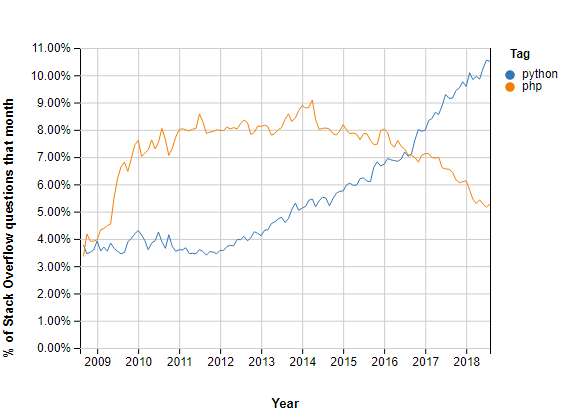
Python offers numerous benefits that make it a compelling choice for many projects:
- Clean, expressive syntax reduces development time and debugging effort.
- Cross‑platform portability: runs on Windows, macOS, Linux, and more.
- Rich ecosystem of libraries accelerates development—from scientific computing to web services.
- Automatic memory management and garbage collection free developers from low‑level concerns.
- Interactive REPL supports rapid experimentation and prototyping.
- Comprehensive database connectors support major commercial DBMSs.
- Robust GUI toolkits (Tkinter, PyQt) and web frameworks (Django, Flask) enable diverse application types.
Why Choose PHP?
PHP offers distinctive advantages for web‑centric projects:
- Runs natively on Windows, Unix, Linux, macOS, and other platforms.
- Fully compatible with Apache, IIS, Nginx, and other popular web servers.
- Low learning curve for developers new to server‑side scripting.
- Free to download from php.net and open source.
- Built‑in error reporting and logging simplify debugging.
- Extensive database integration, including Oracle, MySQL, PostgreSQL, and more.
History of Python
- Conceived in the late 1980s; first implementation released December 1989.
- Created by Guido van Rossum in the Netherlands.
- Version 0.9.0 published February 1991.
- Derived from the ABC language, blending readability with powerful features.
- Maintained by a core team; van Rossum continues to steer its evolution.
History of PHP
- Originated as a Perl‑style script in 1995 by Rasmus Lerdorf.
- Rewritten in 1997, released as PHP 2.0 with a new parsing engine by Zeev Suraski and Gilad Bracha.
- PHP 3 (1998) added ODBC support and multi‑platform capability.
- PHP 4 (2000) introduced a dedicated server‑side engine for enhanced performance.
- PHP 5 (2004) brought Zend Engine II, object‑oriented features, and robust XML support.
Python vs PHP: Comparative Analysis
Below is a concise comparison across key parameters:
| Parameter | Python | PHP |
|---|---|---|
| Frameworks | Smaller but high‑impact: Django, Flask, FastAPI | Extensive mature options: Laravel, Symfony, Slim |
| Popularity | Leading in AI, data science, scientific research | Preferred for web development worldwide |
| Database Connectivity | Broad support via libraries, but fewer native drivers | Native support for >20 databases |
| Community Support | Rapidly growing, active open‑source ecosystem | Large, well‑established developer base |
| Learning Curve | Steady progression, ideal for long‑term projects | Very low entry barrier; quick prototyping |
| Readability | Indentation‑based syntax promotes clarity | Flexible syntax with extensive naming conventions |
| Language Type | General‑purpose | Specialized for web development |
| Syntax | Concise, expressive | Feature‑rich, varied conventions |
| Industry Adoption | Uber, Pinterest, Mozilla | Hootsuite, Viber, Appcelerator |
| GitHub Stars | 30.4 K | 30 K |
| Forks | 8.23 K | 8.04 K |
| TIOBE Index | 4th | 7th |
| Core Strengths | Rapid development, dynamic typing, elegant code | Open source, easy deployment, continuous improvement |
| Top Frameworks | Django, Flask, FastAPI | Laravel, Symfony, Slim |
| Average Salary (US) | $120,024 | $86,017 |
Python Features
- Readable, maintainable syntax
- Runs across diverse hardware and operating systems
- Extends interpreter with low‑level modules
- Supports large‑scale application structure
- Automatic garbage collection
- Interactive testing and debugging via REPL
- Dynamic data types with type checking
- Interoperability with Java, C, and C++ code
PHP Features
- Native support for major databases: Oracle, MySQL, PostgreSQL, etc.
- User‑friendly syntax compared to other scripting languages
- Competitive performance against ASP.NET and JSP
- Open source, free distribution
- Built‑in error reporting constants
- Access logging for monitoring user activity
Which Language Is Better?
Choosing between Python and PHP hinges on project goals. Python excels in data science, AI, and cross‑platform applications, while PHP remains the backbone of dynamic web services. Consider your domain, ecosystem, and long‑term maintenance when making a decision.
Python
- Cloud vs. Virtualization: Key Differences & Business Impact
- Sensors vs. Transducers: Clear Differences & Practical Applications
- FRP vs Fiberglass: Understanding the Key Differences and Industrial Benefits
- Bolts vs. Screws: How to Choose the Right Fastener for Your Project
- Understanding the Difference Between Tube Steel (TS) and Hollow Structural Steel (HSS)
- Python vs. Go: Which Language Wins for Your Project?
- Python vs JavaScript: Key Differences, Features, and When to Choose Each
- Python vs Ruby: A Comprehensive Comparison of Features, Advantages, and Use Cases
- Python 2 vs Python 3: Key Differences and Choosing the Right Version
- Python vs. C++: Key Differences & Which Is Right for You