



Selecting the Optimal Spindle: A Comprehensive Guide to Tooling Excellence
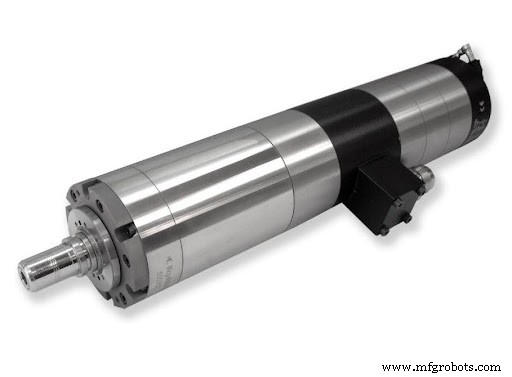
Successful machining begins with a meticulously planned strategy. Programmers evaluate the workpiece, fixturing, and cutting tools to craft precise toolpaths that meet both quality and productivity goals.
Choosing a spindle that offers broad tool capacity and a wide shank diameter range dramatically simplifies workflow optimization, reducing cycle times and enhancing part quality. That’s why spindle and tooling decisions should be grounded in a thorough machine configuration assessment, considering both current workloads and future expansion.
One key factor is tool magazine capacity. While DATRON systems allow later expansion, adding capacity after installation is cost‑intensive compared to configuring it correctly from the factory. Evaluate the spindle’s collet size, and the availability of adapters or alternative collets for varied shank diameters. The shank size refers to the diameter of the tool blank that is secured in the collet.
This article explains how spindle selection influences collets, adapters, and tooling options, equipping you with the knowledge to configure your machine for lasting performance. A DATRON representative is available to guide you through the best tooling system for your specific application.
DATRON Spindle Options Overview
DATRON offers two primary clamping systems:
- Direct shank clamping
- HSK (Hohl‑Schaft‑Kegel) precision tool holding
Direct shank spindles are available in 600 W, 1.8 kW, and 2 kW models. HSK systems are offered on 3 kW, 4 kW, and 8 kW spindles. Note: The DATRON neo series is available exclusively with direct shank clamping.
Direct Shank Clamping Spindles
Typical spindle collet sizes include:
- 3 mm
- 1/8″
- 6 mm
- 1/4″
- 8 mm
The collet is fixed inside the spindle and generally remains unchanged during machining, similar to selecting a drill chuck size. Choose the collet that best matches your tooling requirements from the outset.
If your application exclusively uses small tools (3 mm or 1/8″ shanks) such as PCB drilling, either of these collet sizes will suffice. DATRON offers a ring system that is press‑fit onto the tool—or pre‑installed—to provide a precise stop reference, eliminating the need to re‑measure tool length after each change.
For larger tools up to 6 mm shank diameter, a 6 mm spindle collet is recommended. This size aligns with DATRON’s standard tooling range (note that DATRON does not provide 1/4″ shank tools).
Adapter Systems for 6 mm Collets
Adapters enhance the versatility of a 6 mm spindle collet, offering a cost‑effective alternative to upgrading to an HSK system. With adapters, you can use:
- 3 mm tools
- 1/8″ tools
- 6 mm direct shank tools
The adapter is spring‑steel and expands with an Adapter Insertion Tool that wedges into the sleeve, allowing the tool shank to slide in. Once released, the sleeve clamps securely around the shank.
For 6 mm shank tools, DATRON provides brass rings that are press‑fit directly onto the tool, establishing a consistent length reference. These single‑use rings are discarded when the tool reaches end‑of‑life.
DATRON also offers larger cutting diameters—such as 12 mm tools with 6 mm shanks—for surfacing operations. These tools are optimized for light material removal and support automatic tool changes.
Overall, the direct shank system delivers excellent value and flexibility across a wide range of machining tasks.
8 mm Collet Configurations
Spindles with an 8 mm collet expand tooling options further. The operating principle mirrors the 6 mm system, with the following distinctions:
- Adapters are used for 6 mm tools instead of rings
- 8 mm shank tools are mounted directly using 8 mm rings
Larger 8 mm tools are ideal for heavier machining operations, offering a robust middle ground before moving to the more expensive HSK system. If your application demands shanks larger than 8 mm, HSK becomes the only viable option within the DATRON lineup.
When to Choose an HSK Spindle System
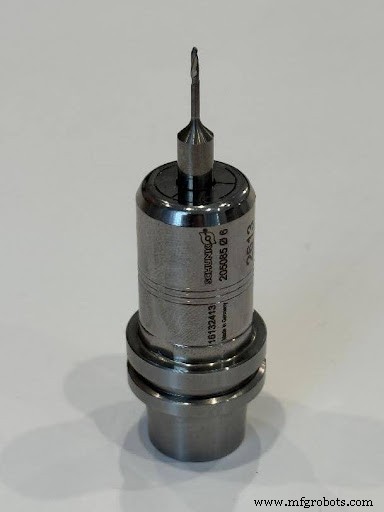
HSK spindles excel when high precision, micro‑sized tools, or significant material removal are required. HSK tool holders are highly balanced, exhibit extremely low runout, and perform consistently across micro end mills, drills, and larger cutting tools. For operations limited to small tools, direct shank remains a cost‑effective choice. However, if you need a broad range of tool sizes, especially those exceeding 6 mm, HSK offers clear advantages.
HSK Tool Holding Systems Explained
DATRON utilizes HSK‑E25 collets on its 3 kW and 4 kW spindles. These collets accommodate a wide array of shank sizes, including:
- 3 mm, 4 mm, 5 mm, 6 mm, 8 mm, 10 mm
- 1/8″, 3/16″, 1/4″, 3/8″
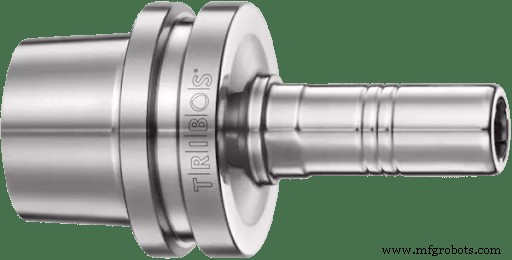
Collets are available in standard and extended‑reach variants, ideal for tight pockets or deep wall features. Tools are inserted and removed with the Tribos® clamping system.
The HSK collet is secured inside the spindle via an internal gripper that locks into the hollow taper at the rear of the collet. As spindle speed rises, gripping force increases, ensuring a rigid, dual‑contact interface between spindle taper and face.
Advantages of the HSK Design
- Enhanced Z‑axis accuracy through face contact
- Greater rigidity and pull‑out resistance under heavy loads
- Higher holding force at elevated spindle speeds
For safety, DATRON spindles include a protection mechanism that prevents operation without a collet installed, safeguarding the internal gripper.
Tribos® Clamping Technology
HSK collets feature a polygon‑shaped bore. When placed into the Tribos manual pump, external pressure temporarily deforms the bore into a circular shape, allowing the tool to be inserted. Once the pressure is released, the collet returns to its polygonal shape, applying uniform three‑point pressure around the shank.
This design delivers exceptional strength, balance, and rigidity, with runout as low as ±3 µm—ideal for precision, flexible tool sizing, and high material removal rates.
High‑Power HSK Options
For demanding applications, DATRON offers an 8 kW spindle on the MxCube platform. This spindle employs HSK‑32 collets, accommodating tool shanks up to 16 mm (5/8″) in diameter.
Configure for Performance. Plan for Growth.
When configuring your machine, consider not only today’s parts but also how production needs may evolve. Spindle power, tooling range, and tool magazine capacity all influence long‑term flexibility and return on investment.
If future requirements are uncertain, the decision often hinges on whether the added cost of a higher‑capacity spindle today is justified. Investing in a DATRON high‑speed machining system delivers strong performance, rapid ROI, and the resilience to stay competitive for years.
Ready to configure the right spindle for your application?
Consult a DATRON machining expert to assess your tooling requirements, material types, and long‑term production goals. We’ll help you select the spindle system that maximizes performance and ROI from day one.
Contact DATRON today to start building your ideal machine configuration.
CNC Machine
- Understanding and Mitigating Tool Deflection in CNC Machining
- Expert Rotation Techniques for Heidenhain CNC Programming
- Advanced E-70JAD Edge Banding Machine with Dual Glue Pots Shipping to Mexico
- German Client Receives Dual Laser CNC Machines: CO2 Cutter & Fiber Laser Marking System
- Cut CNC Downtime, Boost Profits: Quantify Hidden Costs & Master 4 Proven Prevention Strategies
- Choosing the Ideal CNC Router for Your Small Workshop
- How CNC Routers Revolutionize Every Industry: Precision, Efficiency, and Innovation
- Shopfloors Expand Opportunities for Women CNC Machinists – See the Photos
- Complete Okuma OSP-P300S/P300L Alarm-C Reference Guide
- CYCLE81 Drilling Cycle on Sinumerik 840D Turning – Expert Guide