



Forging Futures: University Partnerships Spark America’s Next‑Generation Makers
This is the second post in our dedicated series on community outreach. You can read the first post, Community Outreach: Investing in Manufacturing Workforce Development, to learn more about our early education initiatives.
For decades, American manufacturers have supplied the parts that keep our economy running—everything from tractors and trains to construction components and medical equipment. Today, the industry is synonymous with quality and reliability that few overseas competitors can match. Yet, despite cutting‑edge innovation and growing urgency, we still struggle to find enough people to design, build, and operate manufacturing facilities.
We have the capability. We have the need. To secure the future of American manufacturing, we must harness manufacturing education to inspire and train the next generation of professional makers.
At the Eagle Group, a core part of this effort is our ongoing partnerships with local universities. Each year, these collaborations introduce students to the art, science, and problem‑solving that drive foundry work. What began as an outreach experiment has evolved into an educational model that fuses engineering theory with hands‑on craftsmanship. Eagle Group foundry professionals share invaluable lessons with budding engineers at the start of their careers.
Cast in Steel: The Premier Collegiate Metalcasting Competition
Launched in 2018 by the Steel Founders’ Society of America (SFSA), Cast in Steel has attracted colleges nationwide and has become one of the most visible examples of manufacturing education in action. The competition unites curiosity, creativity, and a growing technical skill set with a single mission: to create the best casting possible—and, true to collegiate spirit, to beat the competition and claim the trophy for your school.
For the SFSA, it began as a venue for real‑world experience rather than a typical performance contest. “We wanted them to run it like a real industrial project where they can reach out to the world’s experts and get support from people,” explains Raymond Monroe, Executive Vice President of the SFSA.
For students, the competition is a crash course in applied metallurgy. For foundries like the Eagle Group, it offers an opportunity to nurture future metalcasters by giving students direct exposure to professional processes, materials, and standards. “It gets more students involved with and aware of the foundry industry—especially steel foundries—and we always need capable people,” says Jason Bergman, Eagle Alloy’s Quality Manager and Metallurgist. “It’s a foot in the door for participants who may end up working somewhere like here.”
Interested in learning more about past, present and future Cast in Steel competitions? Check out the Cast in Steel timeline from the Steel Founders’ Society of America.
Manufacturing Education: From Classroom to Foundry Floor
The Eagle Group first joined Cast in Steel as a casting partner for a student team from Iowa State University—an alma mater of two of our senior engineers, Jason Bergman of Eagle Alloy and AJ Menefee of Eagle Precision. Over the years, Eagle Group companies Eagle Alloy and Eagle Precision have partnered with other Michigan colleges such as Central Michigan University, Ferris State University, and Grand Valley State University, which sits just a short drive from our Muskegon campus.
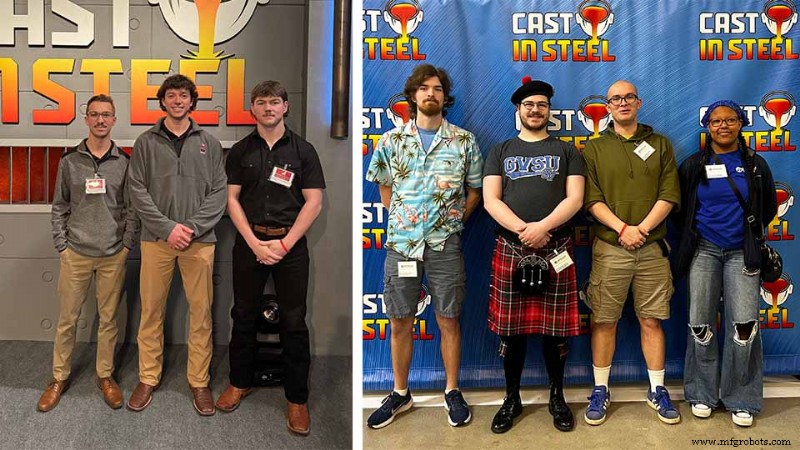
2026 teams supported by Eagle Alloy: Ferris State University (left) and Grand Valley State University (right)
Cast in Steel competitions focus on tools and weapons with historical significance—a Viking axe, a Celtic sword, a Halligan bar—but require reconstruction using modern metalcasting processes. Throughout the project, students learn to think critically about design, translate a digital model into a manufacturable tool, configure solidification software, balance creativity with practicality, and finally, pour, post‑process, and finish the casting.
The GVSU Casting Club: Students Take a Long‑Term Interest in Metalcasting
The early success of these collaborations inspired students to make casting a permanent campus fixture. GVSU participants formed a casting club, secured university support, and recruited new members to keep the program alive year‑round. The club gives even more students the chance to experience metalcasting, whether or not they join Cast in Steel.
The drive and ambition to step confidently into real manufacturing careers after graduation is exactly what the Eagle Group aims to foster when investing time and resources into educational outreach. As a foundry, we provide technical guidance, tooling assistance, and mentorship, while students take ownership of design, analysis, and testing.
Designing, Pouring, and Learning from Mistakes
Working on a Cast in Steel project means balancing imagination with real‑world constraints. Students must consider casting geometry, material properties, tooling cost, and available pouring schedules.
In 2025, the GVSU team designed a sword targeting a specific alloy. Because the foundry’s production schedule didn’t include that material at the right time, Eagle Alloy helped them pivot. The team switched to a different alloy, altering performance characteristics and the required workflow. The lesson proved invaluable: timing and logistics are as crucial as design acumen. Students also documented these decisions in their competition reports, demonstrating that engineering success often lies in managing real‑world variables.
Manufacturing Education in an Immersive Environment
Unlike standard engineering labs, foundry collaborations immerse students in an environment where the stakes are physical—a defining feature of effective manufacturing education. Every outcome tells a story and teaches a lesson, whether it’s a success or a failure.
Along the way, students gain insight into process control, quality inspection, root‑cause analysis, and final inspection—just a handful of the skills that translate directly to careers in design, production, and materials science. Eagle Group engineers and metallurgists guide them through every stage, offering perspective that only comes from years of pouring castings for real customers.
The lessons learned each year compound. Rock Phelps, President of the GVSU Casting Club, describes the experience: “It’s actually crazy how much you’re able to learn in a year. That’s one thing I’ve really come to appreciate — every year you build on the last. We use the competition as a practical way of learning the casting process. It takes time and effort, but year after year, just showing up and going through the process adds up to a lot of experience.”
Learning Goes Both Ways: What Foundries Gain from Mentorships
Mentoring students provides manufacturers a window into emerging academic research and the mindsets of future engineers. It also gives companies like Eagle Alloy a platform to showcase modern foundry technology—robotic automation, digital modeling, and data‑driven process monitoring—that counters stereotypes about outdated or “dirty” manufacturing jobs.
That exchange of ideas reinforces the Eagle Group’s broader philosophy: progress in manufacturing comes from the crossroads of collaboration and competition. By working with schools, peer foundries, and professional societies, we strengthen the entire industrial ecosystem and ignite the ambition of hungry engineering and manufacturing students.
Bridging the Gap Between Cast in Steel and Casting Careers
Even though Cast in Steel is a competition, the Eagle Group’s focus is on participation and learning, not necessarily podium finishes. We celebrate student teams that place well, but the true value lies in witnessing a concept evolve from a napkin sketch to a CAD file and finally to a polished physical casting—regardless of the trophy.
Students often carry these lessons into internships, graduate studies, or full‑time engineering roles. Jason, for one, takes a personal interest in helping these students succeed: “It matters to me on a personal level because we need young, talented people to keep entering our industry, to keep it alive.”
For students like Rock, competitions make career opportunities feel closer and more attainable. “The casting club really opened my eyes to manufacturing engineering and what that can be. I didn’t know much about it when I started college, which is why I chose mechanical engineering. After working with Eagle for so many years, I know I want to go into manufacturing engineering.”
Debbie Pipoly, President of Eagle Precision Cast Parts, served as a judge in the 2026 competition. She noted the dozens of students who traveled to Grand Rapids, MI, and observed that the SFSA and local foundries must be doing something right. “If one or two of [the contestants] decide to jump into our industry, kudos to us because most of them had never seen metal poured before. Many schools don’t have foundry facilities, so they have to partner with somebody like Eagle Alloy.”
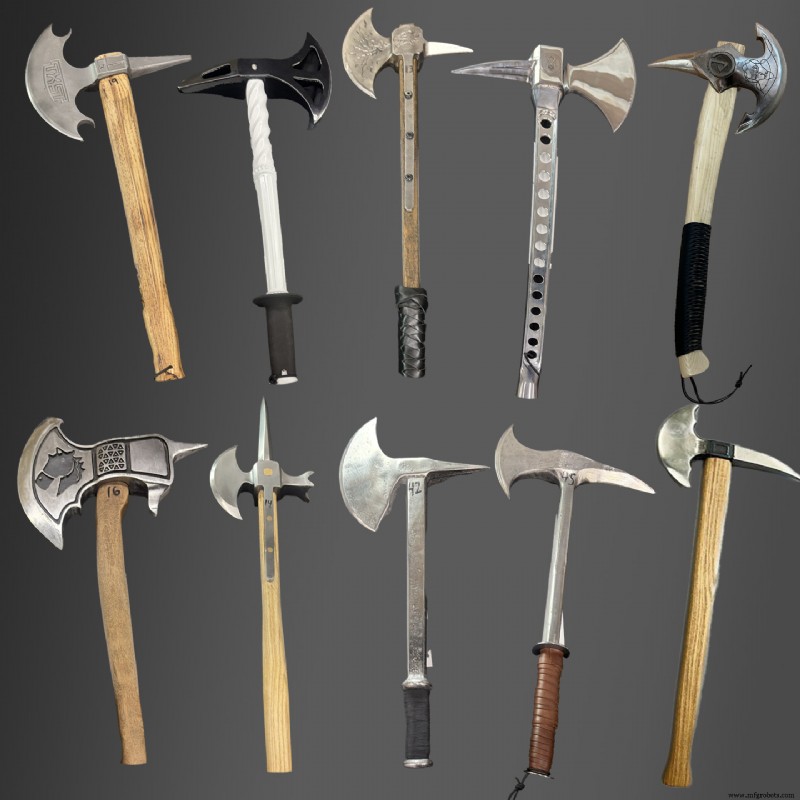
Above: a selection of “horseman’s axe” entries from the 2026 Cast in Steel competition
Why Manufacturing Education Matters
University collaborations like this one are essential for the health of the manufacturing sector and play a critical role in metalcasting education in the United States. They address the same challenge the Eagle Group tackles through elementary outreach: updating and revitalizing the perception of manufacturing as a career path. The industry still suffers from the old stigma of being dirty, dangerous, and dull—but today, the truth is far more nuanced.
By engaging students at multiple points along their educational journey—first sparking curiosity, then continuing mentorship—the Eagle Group helps ensure that students have the knowledge they need to make informed choices about their futures. Manufacturing is a very viable career path, both now and in the future. If students aren’t exposed to it before graduation, they might never learn about these opportunities. That’s why manufacturing education is a win all around: for students, for foundries, and for American manufacturing as a whole.
How to Get Involved
The Eagle Group welcomes inquiries from universities and technical programs interested in participating in Cast in Steel or developing new collaborative projects. Educators can reach the Eagle Group to discuss upcoming project cycles, site visits, and mentorship opportunities.
To schedule a consultation with an Eagle Group engineer, please contact us using the form below:
CNC Machine
- Top 5 High‑Profit CNC Projects for 2022: Wood, Metal, Acrylic & Stone
- How Laser Cutting Prices Are Determined – A Clear Guide
- 1325 CNC Router: Precision MDF Cutting Solutions
- Top 3 Laser Types for Precise Industrial Cutting
- Haas M89 Code: Disable Through-Spindle Coolant (TSC) & Manage Pump Settings
- Exclusive Factory Tour: Korean Craft Enthusiasts Explore Precision CNC Engraving
- Top CNC Router Software for Precise Woodworking Automation
- Top 6 Laser Cutter‑Engraver Machines of 2024: Precision & Performance
- Mastering Sinumerik 808D: CNC Coordination Systems Explained – Turning Series Part 6
- Sandvik Coromant CNC Machining Calculator App – Optimize Tool Speeds & Operations