



Ensuring Hose Safety with Protective Wraps: Expert Insights
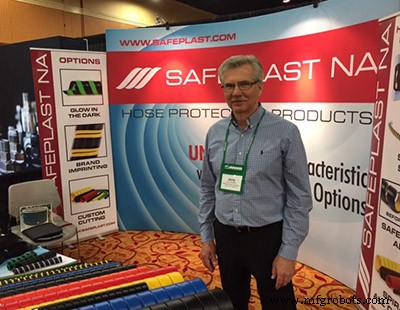 I recently had the opportunity to speak with Jerry Pawluk, President of Safeplast NA, a manufacturer of hose guards and sleeves. The oil and gas sector is a big one for the company, and Pawluk said the company has seen a big uptake in the sector over the past few months. In fact, the company has really been getting the word out on the need for these types of products—over 10 years in business, they have had growth every single year. We discussed why safety is so important when you’re working with high pressure hydraulics.
“There are various reasons for focusing on hose safety. Employee safety is number one, but then also for equipment safety. Hydraulic fluid is quite volatile itself. So, if you spring a leak, there are many instances where that fluid has caught fire and machinery is lost as a result,” he said.
Some designers may incorrectly believe that their hose is tough enough and additional hose protection products aren’t necessary. But Pawluk was quick to counter this line of thinking.
“In one instance, we put some spiral wrap on a hose that was on a drill ship—this was for a modified hose. That hose itself was work $150,000 dollars. Hoses are expensive. And for the cost of about $3,500 worth of our spiral hose wrap, the customer figures they got twice the life out of the hose, Pawluk said. “So, there’s certain economic benefit aside from the safety issues.”
Safeplast uses a high-density polyethylene for their wraps and the company has a unique production method for creating the spiral wrap.
“Most of the spiral you see in the marketplace is actually extruded pipe where they then cut the spiral,” Pawluk explained. “Doing that, using that sort of process, really weakens the plastic because you cut the strength of the material. Whereas when we produce ours, we actually produce it in the spiral shape. So, the strength of that plastic follows the spiral and that gives it some unique attributes. We’re also able to produce the wrap it in colors.”
One of the interesting parts of the color aspect is that the company can produce dual color wraps—one color on top of another. This is critical for some customers for picking out problems before they occur. If the operator starts to see, for example, yellow starting to bleed through the black wrap, he knows that’s his pressure point. Maybe he can fix it before it becomes a problem. Colors in general are also helpful from a safety aspect, as it can make otherwise dark hoses that may be temporarily stretched across a floor much more visible.
“We’re now doing laser marking where you can actually mark the spiral—for advertising or promotion,” he said. “But it can also be used to identify the underlying hose. Some companies don’t want to use wraps because they can’t tell what the hose is underneath. So, if we can mark the spiral to indicate what the hose is underneath, it eliminates that problem.”
“Hydraulics move the world,” Pawluk said. “You have so many moving points in those systems. And those moving points are naturally going to cause abrasion on the hose just by the fact that they’re moving around. That’s where the danger to hoses is for sure.”
Industrial equipment
- Automotive Shop Safety Rules: Expert Guidance for Technicians
- Top 6 Essential Warehouse Safety Practices
- Essential Warehouse Safety Accessories for Accident-Free Operations
- Safety Bollards FAQ: Choosing the Right Type for Every Purpose
- Essential Ladder Safety Guidelines for Workplace and Home
- 3 Proven Steps to Boost Hose Safety and Cut Plant Costs
- Optimizing Hydraulic Hose Routing for Reliable, Long‑Term Performance
- 11 Essential Tips to Boost Compressed Air Hose Safety & Protect Your Workplace
- Why Is My Hydraulic Hose Leaking? Common Causes & Quick Fixes
- Understanding the Role of G-Force in Hydraulic Systems