



Four Proven Manufacturing Methods for Durable O‑Rings
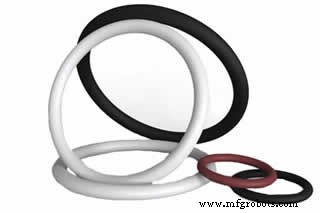
O‑rings are ubiquitous seals in industrial machinery, engineered from elastomers to block fluid and gas leaks at mating surfaces. While all O‑rings perform the same sealing function, the method used to manufacture them can dramatically affect their durability, dimensional stability, and cost. Below we examine the four most widely adopted manufacturing processes and the key advantages each brings to the table.
1. Extrusion
Extrusion is the most common route for producing O‑rings. In this process, heated or softened elastomer is forced through a ring‑shaped die, instantly adopting the die’s cross‑section. The simplicity of extrusion makes it ideal for high‑volume, cost‑effective production. Variants include:
- Hopper extrusion – material is fed into a heated hopper before being pushed through the die.
- Cold extrusion – a single material is used for both the extrusion and the subsequent molding steps.
- Friction extrusion – the die is rotated, generating heat through friction to soften the material.
- Microextrusion – precision extrusion for very small or high‑accuracy O‑rings.
2. Pressure (Compression) Molding
Also known as compression molding, this technique uses heat and pressure to shape preheated elastomer within an open cavity. The material is first poured or injected into the mold, then a plug or platen is pressed against it. As pressure builds, the elastomer conforms to the cavity, producing a ring that can be trimmed to final dimensions. This method is favored for its ability to produce complex cross‑sections with high dimensional fidelity.
3. Transfer Molding
Transfer molding is a close‑cavity variation of compression molding. Preheated material is introduced into a closed mold, allowing the system to build higher internal pressures. The result is an O‑ring that is often thicker, with a more uniform cross‑section and superior mechanical properties. Transfer molding excels when tight tolerances and high strength are required.
4. Injection Molding
Injection molding uses small pellets of elastomer that are heated until molten and then injected into a fully closed mold cavity. The rapid cooling of the molten material locks in precise dimensions, making injection molding ideal for complex geometries and mass production. While the upfront tooling cost is higher, the repeatability and surface finish make it a popular choice for high‑performance O‑rings.
Industrial equipment
- Joining vs. Forming in Manufacturing: Key Differences Explained
- Blow Molding Unveiled: The Three Key Processes Explained
- Rotocasting vs. Rotational Molding: Key Differences Explained
- Understanding the Three Core Molding Processes: Compression, Injection, and Liquid Injection
- Top 5 Proven Clean Manufacturing Systems That Drive Sustainability and Profitability
- Additive Manufacturing: Redefining Scale Economics and Driving Integrated Production
- Top 3 Priorities for U.S. Manufacturers in 2019: Growth, Regulation, and Trade
- How to Choose the Right Manufacturing Partner for Prototype Molding: 5 Proven Tips
- Top 6 Essential Machines for the Manufacturing Sector
- Top 10 Cybersecurity Firms Protecting the Manufacturing Industry