



Revolutionizing Plastics Production: How Industrial & Collaborative Robotics Solve Today's Challenges
The plastics sector is under constant pressure to stay competitive. Industrial and collaborative robots can address many of the bottlenecks that slow production and inflate costs. This article examines the core challenges facing modern plastic manufacturers and shows how robotics can transform operations, ensuring higher quality, safer workplaces, and stronger margins.
Daily Challenges: Streamlining with Robotics
Production delays and inefficiencies
In a busy plant, any machine hiccup or sick employee can halt the entire line, jeopardizing delivery schedules. Industrial robots, working nonstop, maintain a steady throughput. For example, robot arms that move mold parts between stations eliminate hand‑to‑hand transfers, cutting cycle times and reducing downtime.
Workforce constraints and skill shortages
Finding qualified operators is increasingly difficult. When high‑volume orders arrive, manual labor often falls short. Robots can take over repetitive, hazardous tasks—such as handling hot plastic straight from the injection mold—freeing humans to focus on value‑added tasks like process optimisation and creative problem solving. A collaborative robot (cobot) can work side‑by‑side with staff, enhancing productivity while preserving the human touch.
Maintaining quality and consistency
Human inspection is prone to fatigue and oversight. Industrial robots equipped with advanced vision systems perform real‑time quality checks, instantly spotting defects in the molding process. This precision reduces waste, eliminates rework, and guarantees that every part meets stringent specifications.
Safety and workplace injuries
Plastic manufacturing exposes workers to high temperatures, sharp tools, and heavy machinery. Robots can handle the most dangerous tasks—loading, unloading, and positioning hot parts—dramatically cutting injury risk. This shift not only protects employees but also reduces medical claims and lost‑time costs.
Unplanned downtime and maintenance challenges
Unexpected equipment failures halt entire lines and rack up expensive downtime. Robots fitted with IoT sensors provide continuous health monitoring, enabling predictive maintenance that flags potential issues before they disrupt production. Additionally, robotic cells are engineered for reliability, further minimizing maintenance interruptions.
Applications of Robotics in Plastics Manufacturing
Robotics enhances every stage of the production cycle, from machine tending to post‑processing, driving productivity and quality.
- Machine tending – Robots load and unload injection moulds, reducing injury risk and improving consistency.
- Insert molding – Automated handling of inserts shortens cycle times and boosts profitability.
- Overmolding – Six‑axis robots streamline the process, cut labour costs, and ensure product quality.
- In‑mold labeling – Robots deliver precise, repeatable labeling, improving efficiency.
- Post‑processing – Automated inspection, testing, and hot‑stamping reduce manual effort and errors.
Case Study: CFM Robotique – Overmolding Automation
Initial need
A Tier‑1 automotive supplier wanted to upgrade its overmolding of EPDM plastic inserts. The existing manual process required 12 operators to hit target cycle times and annual volumes, but consistency and precision were hard to maintain.
Challenges
- Production delays and inefficiencies from manual errors.
- High turnover and costly recruitment for skilled operators.
- Inconsistent quality and frequent defects.
- Safety hazards from knife handling.
- Frequent downtime due to operator fatigue and equipment wear.
Solution
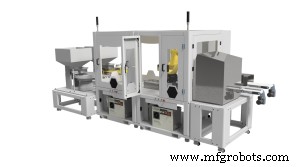
The integrator installed two Comet 44 robotic cells with laser‑cutting technology. Automation eliminated manual cutting, dramatically cutting cycle times.
Results
- Improved throughput and reduced cycle times, smoothing production flow.
- Reduced operator count from 12 to 6, cutting recruitment and training costs.
- Achieved 98 % OEE with laser‑cut precision, delivering consistent quality.
- Eliminated knife‑related injuries, boosting worker safety.
- Lowered unplanned downtime thanks to reliable robotic performance.
Financial impact
The $300,000 investment in laser‑trimming cells saved roughly $900,000 over three years through lower labour, fewer defects, and higher throughput.
Conclusion
Industrial and collaborative robotics offer plastics manufacturers a pathway to greater efficiency, superior quality, and safer work environments. While initial capital and workforce adaptation require planning, the long‑term benefits—reduced downtime, higher output, and lower operating costs—are compelling. As the robotics market grows, integrating automation into injection‑moulding lines will be essential to meet evolving customer demands and maintain a competitive edge.
Facing production challenges? Elevate your manufacturing line with DIY solutions
Struggling with inefficiencies or delays? Our cutting‑edge DIY resources can tailor automation to your specific needs, propelling your production line to peak performance.
Ready to take the next step?
Schedule a meeting today and discover how we can support your automation journey and elevate operational efficiency.
Industrial equipment
- Conveyor Systems 101: Answers to the 10 Most Asked Questions by Business Owners
- Mastering Gearbox Troubleshooting for Mining Conveyors
- Expert Guide to Laser-Cut Leather: Proven Tips for Perfect Results
- Volvo Electric Equipment: Unlocking New Opportunities in Heavy-Duty Jobs
- Essential Overhead Crane Training: Requirements & Tips to Pass the Test
- Understanding the Morse Taper: A Key to Secure Drill Bit Attachment
- Rotary Screw Technology Proven to Cut Energy Costs in Meat Processing
- Manual Machinist Positions – 2 Openings in Precision Engineering
- Explore Tornos' Advanced Multi-Spindle Turning Centers for Precision Machining
- Extend Pump Life Post-Rebuild: Proven Strategies for Optimal ROI