



How Conveyors Drive Efficiency in Leaching: From Crushing to Recovery
Published April 27, 2026 by admin
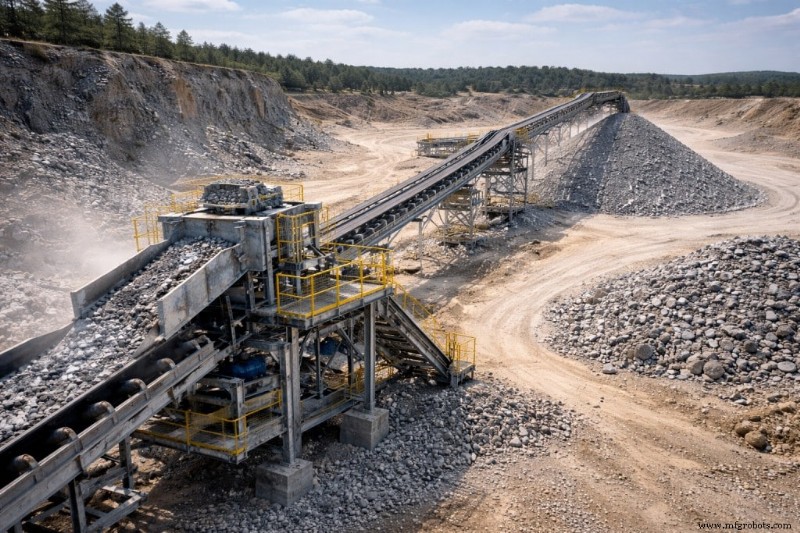
Leaching is often framed in terms of chemistry—solutions, reactions, and recovery rates—but the backbone of every successful operation is a robust material‑handling system that keeps everything moving at the right pace. Conveyors are the unsung heroes that ensure consistent throughput, eliminate bottlenecks, and stabilize input conditions across every stage of the leaching cycle.
From Crushing to Leach: Preparing and Feeding Material
Before material reaches a leach pad or tank, it must travel from crushing and screening circuits. At this point, conveyors:
- Move material from crushers to stacking or feed systems
- Regulate flow into leach pads or processing tanks
- Maintain a consistent feed rate to avoid overloading or starving downstream processes
Fluctuations in feed delivery can upset material distribution across a leach pad or disrupt slurry introduction into tanks, creating a ripple effect that compromises the entire operation. Operators quickly recognize that conveyors are more than transport equipment—they are the stabilizers that keep input conditions predictable.
Feeding Leach Pads and Tanks with Consistency
Once material reaches the leaching stage, precise placement and distribution are critical.
Heap Leaching
- Conveyors transport ore to stacking systems
- They help maintain uniform lift height and layering
- Consistent flow supports even solution percolation
Tank Leaching
- Conveyors deliver ore to feed points or transfer systems
- They maintain a steady supply to agitation or mixing stages
Uneven feed leads to uneven exposure to leaching solutions, causing variability in recovery rates.
Transferring Material Between Process Stages
Leaching operations often involve multiple steps beyond the initial solution application. Material may move between intermediate processing stages, additional treatment points, and separation or classification systems. Conveyors create a seamless link between these stages, preventing unnecessary delays.
- Accumulation at a single stage can stall overall throughput
- Downstream equipment may receive material at an inadequate rate
- Inconsistent transfers undermine the balance of the entire system
Conveyors therefore function as a coordinated network that keeps the entire leaching sequence intact.
Supporting Post‑Leach Material Handling
After leaching, ore must still be moved for further processing, disposal, or recovery. Conveyors are used to:
- Transport spent ore away from leach pads
- Move processed material to recovery or disposal areas
- Maintain steady flow into final handling systems
Even when the chemical process is complete, consistent material movement remains vital to sustain production efficiency.
How Conveyor Performance Impacts the Entire Process
Across every stage—from feed to recovery—the single factor that dictates success is consistency.
- When conveyors operate smoothly, material moves at a predictable rate and each stage receives the expected volume.
- When performance fluctuates, bottlenecks form, some areas become overfed while others are starved, and overall efficiency drops.
Small variations in flow can produce ripple effects that compromise the leaching cycle, underscoring the direct influence of conveyor systems on process outcomes.
Integrating Conveyors into the Full Leaching Flow
Leaching systems rely on precise coordination. Each stage depends on the one before it, and conveyors are the glue that keeps the sequence intact.
- Match conveyor capacity to process requirements.
- Align transfer points with process flow.
- Maintain consistent throughput across all stages.
When conveyors are fully integrated into the broader system, operations run more smoothly and predictably, delivering higher recoveries and lower downtime.
Keep Your Leaching Process Moving
Leaching performance depends on more than chemistry—it hinges on how reliably material moves through each stage of the operation. West River Conveyors partners with mining operations to design conveyor systems that support continuous, balanced material flow from feed to recovery. With a focus on integration and real‑world operating conditions, our team ensures your system performs as intended across every phase.
Speak to an expert today.
Industrial equipment
- Are Your Heavy Equipment Assets Ready to Win Competitive Bids?
- What Is a Dissolution System? Key Role in Tablet Quality Control
- Lathes 101: A Complete Guide for Professionals & Hobbyists
- Keep Your Air Compressors Running Smoothly and Avoid Downtime
- Why Troubleshooting Your Hydraulic System Is Critical for Business Continuity
- Hardinge GS 51: Compact Turning Center with Collet-Ready Spindle for Precision and Durability
- Linde HPR-01 Hydraulic Pump: A Comprehensive Performance Review
- How to Choose the Right Industrial Parts & Service Provider
- Key Criteria for Choosing a Reliable Manufacturing Equipment Partner
- GHS VSD+: Minimal Maintenance—Only One Service Per Year