



Expert Guide to Mining Conveyor Transition Technology & Design
Posted on October 24, 2025 by admin
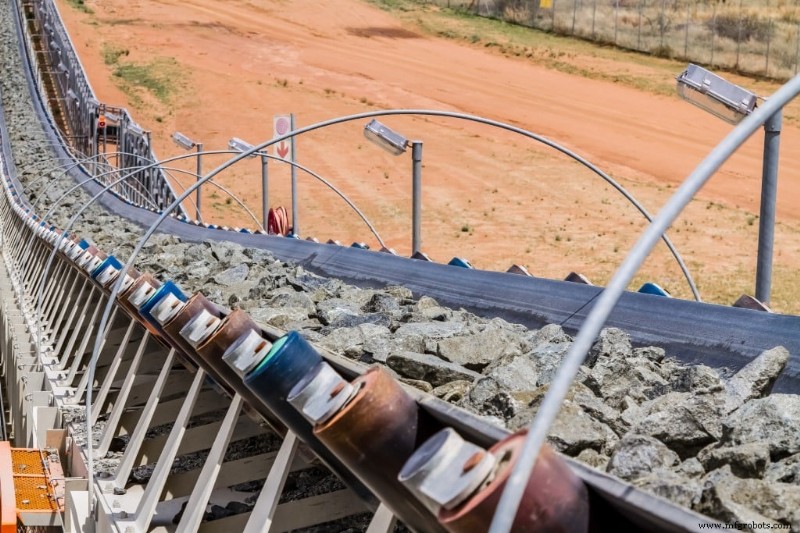
While conveyors are often associated with drives, pulleys, and belt movement, the most critical—and frequently overlooked—component is the transition. Proper transition design is essential for smooth material flow, belt longevity, and overall system reliability.
WHAT IS CONVEYOR TRANSITION TECHNOLOGY?
Conveyor transition technology is the engineered interface that links the belt to terminal equipment—pulleys, drives, and idlers—and gradually shapes the belt from flat in the loading zone to fully troughed in the carrying zone. Transition idlers play a pivotal role in:
- Reducing belt stress and vibration.
- Preventing spillage and material rollback.
- Extending belt and splice life.
- Maintaining continuous operation with minimal downtime.
In essence, transition technology synchronizes every component, ensuring the conveyor functions as a cohesive system.
UNDERSTANDING TRANSITION DISTANCE
Transition distance is the measured length of belt required for the belt to achieve its full trough angle after leaving the terminal pulley. Incorrect distances—whether too short or too long—introduce unnecessary strain on the belt, idlers, and splices.
Key factors that dictate the correct transition distance include:
- Belt width – Wider belts typically need longer transitions.
- Trough angle – Steeper troughs (20°, 35°, 45°) require more gradual transitions.
- Belt tension and stiffness – Heavy‑duty belts demand longer, gentler transitions to avoid stress points.
- Material type – Aggressive, abrasive media such as coal or aggregates demand longer distances than finer loads like salt or frac sand.
Failure to design the correct transition distance can lead to premature belt wear, splice failure, edge damage, and excessive spillage—costly issues that robust engineering can prevent.
TRANSITION REQUIREMENTS FOR DIFFERENT APPLICATIONS
Each mining operation presents unique challenges, so a one‑size‑fits‑all approach is ineffective. For example:
- Heavy, sharp, or abrasive materials (coal, rock) necessitate extended transitions to mitigate belt damage.
- Light or fine materials (salt, frac sand) may allow shorter transitions, but careful design remains essential to avoid spillage and belt stress.
By customizing transitions to the specific material and process, operators can maximize performance while extending belt life.
WRC’S APPROACH TO TRANSITION DESIGN
West River Conveyors (WRC) recognizes that transitions are often the source of conveyor inefficiencies. Our team applies proven engineering principles and decades of industry experience to calculate optimal transition distances and select the appropriate technology for each customer’s unique application.
Whether you’re building a new conveyor or retrofitting an existing line, WRC’s solutions balance belt durability, material handling efficiency, and system reliability.
CUSTOM SOLUTIONS FOR COMPATIBILITY & PERFORMANCE
No two mining operations are identical, and neither are their conveyor systems. WRC specializes in bespoke transition designs that integrate seamlessly with both new equipment and legacy systems. When a current transition is causing belt stress, spillage, or accelerated wear, we can re‑engineer the layout to resolve these issues and improve overall performance.
PARTNER WITH WRC FOR TRANSITION EXPERTISE
While often hidden, transitions are among the most critical elements of a conveyor system. Correctly engineered transitions protect the belt, extend component life, and guarantee consistent material flow.
West River Conveyors has the expertise to design tailored transition solutions for new systems or retrofits. If you’re encountering conveyor transition challenges, we’re ready to help.
Contact West River Conveyors today for a consultation that keeps your conveyor operating at peak performance.
Speak to a Mining Conveyor Expert
Industrial equipment
- Hemming vs. Seaming in Metalworking: Key Differences and Applications
- Effective Leak Detection and Repair for Industrial Air Systems
- Laser-Cut Glass: Definition, Benefits, and Applications
- Top 5 Premium Brake Pad Brands for Industrial Safety
- Managing Air Pollution in Fiberglass Manufacturing: Challenges & Solutions
- Unlock 100% Section 179 Expensing for Robotic Automation in the U.S.
- Axiom Equipment Group Relocates to State‑of‑the‑Art Facility in Oxbow, Saskatchewan
- Trumpf Laser Cutting Machines: Power, Precision, and Pricing
- How to Adjust Hydraulic Speed for Peak Performance
- Cutting Industrial Emissions: The Power of Reusing Equipment