



Rent or Buy Power Equipment: Making the Right Choice for Your Business
Choosing whether to rent or buy power equipment is a pivotal decision for construction, landscaping, and other heavy‑industry businesses. With the equipment‑as‑a‑service model gaining traction and each option offering distinct benefits, you must evaluate your operational needs, project scope, and long‑term objectives before deciding. This guide highlights the key factors that help you choose the most cost‑effective and practical approach for your company.
Understanding Your Equipment Needs and Power Requirements
Begin by assessing the specific machinery you need. Consider the types of projects you undertake, the power and capability required for each task, and any specialized attachments or safety features that are essential. Aligning the right equipment with your operational demands enhances efficiency and safety on the job site.
Ask yourself whether your projects demand the latest technology, advanced safety systems, or unique attachments, and how frequently those needs might change. Determine whether you need consistent equipment for regular work or short‑term rentals for seasonal jobs.
Size and Capacity Considerations
Match equipment size and capacity to the scale and complexity of your projects. Renting provides access to a wide range of models, allowing you to select the optimal fit for each job. Buying, on the other hand, may be preferable if you repeatedly use equipment of a specific size or capacity.
Owning equipment enables customization and upgrades tailored to your business, while renting offers the flexibility to swap models as project requirements evolve. Access to top‑tier power equipment can be a decisive advantage, directly impacting profitability.
Initial Costs vs. Long‑Term Investment
Cost is a major consideration. Renting typically involves lower upfront expenses, making it attractive for companies with limited capital or those seeking to preserve cash flow. It converts fixed costs into variable ones, simplifying budgeting on a project‑by‑project basis.
Buying is a long‑term investment that can enhance your asset register and, over time, add value to your business. For companies with enduring operations, ownership provides stability and a potential source of capital if you need to liquidate assets during challenging periods. Additionally, owning equipment can improve credit standing, which is essential for growth.
Purchasing used equipment offers a middle ground between renting and buying. For instance, Cat® Certified Used machinery undergoes a rigorous 140‑point inspection to ensure reliability. Certified standards include a clean cab with functional controls, fully operational lights, leak‑free cylinders, and genuine Cat parts for buckets, undercarriage, and batteries.
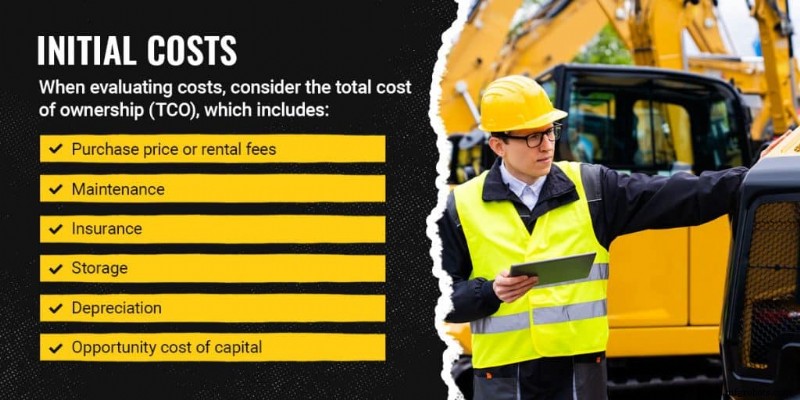
When evaluating cost, consider the total cost of ownership (TCO), which covers purchase price or rental fees, maintenance, insurance, storage, depreciation, and opportunity cost of capital. Consulting your financing team can help you compare rental and purchase options for your unique circumstances.
Maintenance Responsibilities
Maintenance is a critical factor. With rentals, the provider typically handles repairs, routine upkeep, and regulatory compliance, reducing your administrative burden and minimizing downtime. This is especially valuable for firms lacking in‑house maintenance teams.
When you own equipment, you bear full responsibility for upkeep, repairs, and compliance with safety regulations. While this offers greater control, it also demands time, expertise, and additional costs for storage and insurance.
Unexpected breakdowns can result in costly downtime. If you own machinery, field maintenance and repair services can keep your equipment on site and production uninterrupted.
Frequency of Use
How often you use power equipment should guide your decision. Renting suits short‑term, seasonal, or variable demands, enabling you to scale your fleet up or down as project needs shift. It also lets you test new technology without a long‑term commitment.
Buying is advantageous when equipment is used frequently and consistently, and project requirements remain stable. Over time, the cost per use decreases and you build equity in your assets. Underutilized owned equipment, however, can inflate costs and diminish returns.
When to Rent vs. Buy
There is no one‑size‑fits‑all answer. Both renting and buying have roles in a well‑run operation. Consider renting if:
- You need equipment for a short‑term or specialized project.
- You want access to the latest models and technology.
- You prefer to avoid maintenance and storage responsibilities.
- Preserving cash flow is a priority.
Choose to buy if:
- You use certain equipment regularly and for extended periods.
- You wish to customize or modify your machinery.
- Building asset value and long‑term investment matters to you.
- You have the resources to manage maintenance and storage.
Industry trends show a growing preference for rentals due to flexibility and technology access, yet ownership remains a solid choice for firms with steady equipment needs. When weighing the benefits of renting versus buying, sustainability goals, operational flexibility, and financial strategy all play a role.
Rent or Buy Power Equipment From Blanchard Machinery Company
Whether you opt to rent or buy, you need a trusted dealer with proven experience. Blanchard Machinery offers high‑quality rental gear and can help you secure the best deals on new and used heavy equipment. Our team will guide you toward a wise investment that serves your long‑term goals.
Regardless of your decision, rely on us for all your equipment needs across construction, landscaping, and mining. Find a local location or contact our team today to discover how we can support your project requirements.
Industrial equipment
- Concrete Cladding: Durable, Cost-Effective Exterior & Interior Finishing
- DUCTA‑Series™ Rotary Foundry Drums – High‑Performance, Low‑Maintenance Solutions for Safer Casting Operations
- Top 3 Reasons to Choose Used CAT Parts for Your Equipment
- How to Choose a Reliable Used Press Brake: Expert Guidance
- Understanding Magnet 'Reach Out': How Far Their Magnetic Field Extends
- The Secret Ingredient: How Compressed Air Drives Chocolate Production
- Achieving Five‑Fold Production Growth with Cincinnati Machine CNC Turning Centers
- Key Factors for Safe Oversized and Wide Load Transport
- Discover the True Value of Your Tools Beyond Cost
- What Is Fiber Optic Cable? A Complete Guide to High‑Speed Data Transmission