



Mastering Caster Selection: Practical Guidance for Buyers and Manufacturers
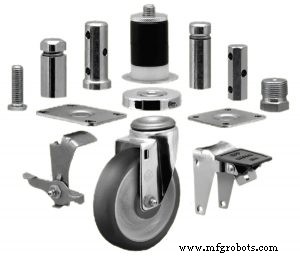
When you’re faced with a worn‑out caster or planning to integrate one into a new product, understanding the fundamentals of caster selection is essential. Whether you’re replacing a single wheel on a piece of furniture or sourcing thousands for a new line of equipment, the right choice will affect performance, durability, and cost.
Caster Basics
Modern casters enable heavy items to roll effortlessly in confined spaces, offering 360‑degree mobility with minimal effort. They are found on everything from grocery carts and hospital beds to office chairs and industrial material‑handling systems. As a mass‑produced commodity, casters are manufactured at high speed in automated plants, which keeps prices competitive. Consequently, a caster purchased at a local hardware store could originate from any of several countries.
For replacement, it is usually safest to match the original caster’s specifications. If the original is custom or obsolete, consider replacing all wheels with the nearest available match to maintain balanced handling. Typical sourcing options include hardware stores, industrial supply retailers, or a focused online search. Look for identifying information such as a logo or part number; if that’s missing, start with the application—e.g., “industrial cart caster” or “hospital wheel.”
When casters are part of a manufactured product, the process differs. You’ll likely engage an industrial distributor that specializes in material‑handling solutions. Large orders—hundreds of thousands of units—are usually routed through distributors rather than directly from manufacturers. Distributors can offer multiple product lines across quality and price tiers, ensuring you receive the exact specifications required.
Key Considerations for Distributors
- Application Context: Casters are engineered for specific industries. Specifying the end use (e.g., dental cart, hospital bed, office chair) narrows the options and speeds up selection.
- Functionality: Decide between fixed, swivel, or brake casters. Swivels pivot with applied force; fixed casters remain stationary; brake casters lock in place when needed.
- Load Rating: Choose between light‑duty, medium‑duty, or heavy‑duty ratings based on the maximum expected load.
- Wheel Size & Material: Outside diameter, material type, and tire durometer affect performance on different floor surfaces.
- Mounting Method: Options include socket stems, bolt‑on frames, or heavy‑duty brackets.
- Quality & Durability: Consider bearing type (roller, ball), lubrication requirements, and material grades.
Specifying a Caster
To request the right product, outline these core attributes:
- Type: Fixed / Swivel / Brake
- Load Rating: Light, Medium, Heavy
- Mounting Style: Socket stem, bolt‑on frame, heavy‑duty bracket
- Wheel Diameter: Outside measurement
- Wheel Material: Aluminum, steel, etc.
- Tire Material & Durometer: Soft for quiet operation, hard for heavy‑duty wear resistance
- Overall Height / Load Height: Distance from mounting surface to wheel bottom
- Bolt Hole Spacing: Must match the mounting surface on the vehicle
For example: “A fixed, heavy‑duty caster with a steel bolt‑on frame, 5‑inch aluminum wheel, high‑durometer rubber tire, and 750‑lb load rating.”
Common Caster Terminology
Understanding industry language helps you communicate precisely with suppliers:
- Vehicle: The object the caster is attached to (chair, bed, cart).
- Swivel Radius / Offset / Lead / Trailing Distance: The offset between the axle center and swivel axis, influencing steering behavior.
- Bolt Hole Spacing: The pattern of mounting holes on the caster frame.
- Swivel Bearing: The pivot mechanism—often a roller or ball bearing within a race.
- Durometer: Measure of rubber hardness; lower values yield quieter, smoother movement on smooth floors; higher values offer better wear resistance on rough surfaces.
- Stem / Spindle: The shaft that fits into a socket on the vehicle; diameter and length affect strength.
- Fork: The part of the frame that holds the wheel; a curved fork sets the correct offset.
See Monroe’s Casters
Industrial equipment
- How to Choose the Right Magnet for Your Project: A Practical Guide
- Key Considerations When Buying a Used CNC Machine
- Key Factors to Evaluate Before Purchasing a Used CNC Machine
- Top 5 Key Considerations When Purchasing a Fiber Laser Machine
- Key Factors to Consider When Choosing an Ironworker
- Key Factors to Consider When Purchasing a Plate Rolling Machine
- Key Factors to Consider When Purchasing Angle (Profile) Rolls
- Thermoplastics Explained: Definition, Properties, and Recycling Benefits
- Understanding Pilot Lamps: Function, Types, and Safety Applications
- How to Choose the Right D9 Bulldozer: Key Factors for Buyers