



Defining a Robot’s Workspace: Understanding Its Operating Environment
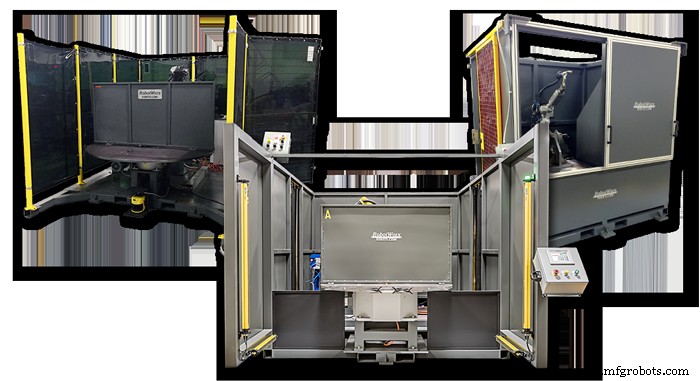
When humans operate in factory setting, they usually have a set workspace, a place where all the tools they need to do their job are located. The same can be said for a robot workspace in an industrial setting.
There are many different ways to think about a robot’s workspace, but it is basically defined as the space in which the robot operates. This could be on a production line or in a workcell. It does not matter where they are operating, every industrial articulated robot has a defined workspace – the amount of room it is able to move around an area.
Of course, the robotic workspace is going to be vastly bigger than a human workspace. These metal masters of accuracy can sit over 8 feet high, when in a crouched position, and have an extensive reach when need be. A robotic workspace may have the diameter of 20-30+ feet, or even much longer. There are also smaller robots that may have smaller workspaces, like spider robots, which are programmed to locate smaller objects on a line or in a bin.
It is important for manufacturers to work with robotic companies or integrators to determine how much robotic workspace is needed when designing the system. If a facility is too small, it may not be suited for a large robot, or the robot’s operation may be destructive.
One thing that is necessary is that human workers stay out of a robot’s workspace during operation. While humans may be able to enter each other’s workspace, entering a robot’s workspace could result in injury or death, due to the amount of speed and force with which a robot works.
Most robotic workspaces are noted by floor markings, fencing or other safety measures to keep humans from crossing into a dangerous area. As mentioned above, the speed and accuracy that makes robots so attractive to manufacturers can also be deadly if a worker decides to disregard safety procedures.
The best rule of thumb is to let it work – it will have its workspace, and you can have yours.
Our highly-skilled group of engineers will work with you to design a system or workcell that will fit in the space you have available in your facility.
Industrial robot
- Autonomous Robots: What They Can—and Cannot—Do
- Robotic Machine Tending: Benefits, Drawbacks, and Investment Considerations
- Robot Machine Tending: Definition, Function, and Industrial Benefits
- Robots vs. Machines: Understanding Their Distinct Roles in Modern Technology
- iRobot Unveils Advanced Roomba s9+ and Braava Jet m6: The Ultimate Cleaning Duo
- Optimizing Blast Furnace Design for Superior Performance and Longevity
- Graphene: The Ultra‑Strong, Ultra‑Conductive Carbon Layer Changing Technology
- Quickly Program an Industrial Pick‑and‑Place Robot with RoboDK
- GE Leads Innovation in Industrial Robot Automation Software
- KUKA Robotics: Pioneering Precision Milling Solutions