



Cleanroom Environments: Safeguarding Products from Particle Damage
Cleanrooms are environments that are controlled against particles and other contaminants. Products that may become compromised by too many contaminants in the air are manufactured in these cleanroom environments.
According to an article from CoastWide Labs, contaminants are generated by people, processes, facilities and equipment, and they must be continually removed from the air. That is where the environment of a cleanroom comes into play.
The cleanroom has scrubbers that do not let the air get above a certain level of particles that are 0.5 microns or larger per cubic foot of air. Usually, a cleanroom will be a class 10, 100, or 1000, meaning it only allows up to that many microns per cubic foot of air. To give you a comparison between a cleanroom environment versus an uncontrolled environment, a typical office building has anywhere from 500,000 to 1,000,000 particles in the air, 0.5 microns or larger, per cubic foot of air.
Why do these cleanroom environments protect against particles that are 0.5 microns or larger and limit the number in the air? And what is a micron, anyway? Well, to give a comparison, the article stated that a human hair is about 75-100 microns in diameter. So, the particles that the cleanroom protects against are 200 times smaller than a human hair. But, they can cause major disaster.
Products made within the environments of cleanrooms are sensitive to particles in the air, which is why they must be made in this controlled environment. When one of these products is contaminated, it can lead to loss of profit for the manufacturer, as well as downtime to investigate why the product was contaminated and an increase in production costs. An example of a particle that did billions in damage? According to the article, the particle that damaged the Hubble Telescope, making it unable to perform, was smaller than 0.5 microns.
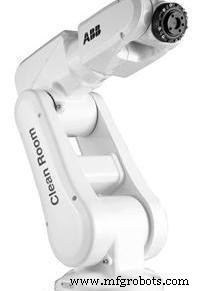
It is also important that if robots are used in cleanroom facilities, that they be specialized for cleanrooms. Cleanroom robots are specially designed with parts that do not put as many particles into the air as their other robot kin.
RobotWorx, a certified integrator of cleanroom robots from Fanuc, Motoman and KUKA, has several models available for use in cleanrooms from class 1 to class 10,000 and beyond. For more information about automating your cleanroom processes with RobotWorx, contact us today online or at 877-762-6881.
Industrial robot
- Air Purifiers: Design, History, and Future Trends
- Oxygen: From Ancient Discovery to Modern Industrial Powerhouse
- Air Bag Systems: Design, History, and Future Innovations
- Advanced Personal Protection for Hydrogen Sulphide Exposure
- Preventing Engine Damage: The Impact of Dirt & Dust on Heavy Equipment Air Filters
- Safeguarding Data in Use with Trusted Execution Environments
- Advanced Cleanroom Robots: Precision & Sterility for Modern Manufacturing
- Cleanroom Environments: Safeguarding Products from Particle Damage
- Enhance Cleanroom Quality with Motoman’s Advanced Particle‑Control Robots
- KUKA Cleanroom Robots: Reliable Protection Against Particle Fallout