



Air Bag Systems: Design, History, and Future Innovations
Background
An air bag is an inflatable cushion that protects automobile occupants from serious injury during a collision. It is part of an inflatable restraint system—also known as an Air Cushion Restraint System (ACRS) or Supplemental Restraint System (SRS)—and works in tandem with seat belts to provide comprehensive protection. While seat belts keep the occupant securely positioned, the air bag deploys instantly to cushion the body, especially in frontal impacts.
A typical system includes an air‑bag module (inflator plus bag), crash sensors, a diagnostic monitoring unit, a steering‑wheel connector coil, and an indicator lamp. All components are wired together and powered by the vehicle’s battery. Even after the ignition is turned off, a reserve charge keeps the circuitry live for up to ten minutes, allowing a self‑test to run at each startup—indicated by a brief dashboard light.
The crash sensors prevent false deployment on bumps or minor collisions. When a frontal impact equal to a 9‑mph (14.5‑km/h) barrier is detected, the sensors send a signal that ignites an initiator—essentially a tiny wire that heats and pierces the propellant chamber. The propellant, largely sodium azide, reacts explosively to produce nitrogen gas. Within 1/20 of a second the bag inflates, reaching full size for 1/10 of a second before deflating by 3/10 of a second. Talcum powder or corn starch inside the bag prevents sticking and aids deployment.
History
The concept dates back to air‑filled bladders described in 1941, with the first patents emerging in the 1950s. Early systems were bulky, using compressed air, nitrogen, freon, or CO₂. Some early designs produced dangerous by‑products—one gun‑powder‑heated freon system released lethal phosgene gas.
John Hetrick received the first automotive air‑bag patent on August 18, 1953, after a near‑miss in 1952. His design called for a compressed‑air tank under the hood and inflatable bags in the steering wheel, dash, glove compartment, and seat backs. Subsequent inventors refined the idea, leading to the modern sodium‑azide propellant pioneered by chemist John Pietz in 1968. This solid propellant replaced the older, bulkier systems.
Since the 1960s, controlled tests and real‑world data have confirmed the life‑saving power of airbags. An Insurance Institute for Highway Safety study of 1985‑1991 data found a 28 % reduction in driver fatalities in frontal collisions for vehicles equipped with airbags. A 1989 General Motors study reported a 46 % drop in driver deaths and 43 % in front‑passenger deaths when airbags were paired with lap‑shoulder belts.
In response to safety concerns and insurance pressure, U.S. regulations mandated passive restraint systems for all cars from the 1990 model year. By 1994 passenger‑side airbags were required, and by 1998 all cars (and by 1999 light trucks and vans) had to carry both driver and passenger airbags.
Raw Materials
The core of an air‑bag system is the module: the bag, inflator, and propellant. The bag is sewn from woven nylon and may feature a heat‑shield coating to protect the fabric during deployment. Talcum powder or corn starch is applied to prevent fabric adhesion; newer silicone or urethane‑coated bags reduce the need for heat shields.
The inflator canister is stamped from stainless steel or cast aluminum. Inside is a filter assembly of stainless‑steel wire mesh with ceramic material, surrounded by metal foil to keep the propellant sealed. The propellant—sodium azide mixed with an oxidizer—is stored as black pellets between the filter and the initiator.
The Manufacturing Process
Air‑bag production is organized into three distinct assemblies that ultimately form the finished module. Some manufacturers source pre‑made components, while others build the entire module in‑house. The following overview focuses on driver‑side modules; passenger‑side assembly follows a similar but slightly altered workflow.
Propellant
- 1. Sodium azide and oxidizer are received from vetted suppliers, inspected, and stored separately.
- 2. The two powders are blended under computerized control in isolated bunkers to mitigate explosion risk. High‑speed water‑deluge systems are ready to neutralize any accidental spark.
- 3. The mixture is compressed into disks or pellets and stored until needed.
Inflator Assembly
- 4. Components—canister, filter assembly, initiator—arrive from suppliers, undergo inspection, and are assembled on an automated line.
- 5. The inflator sub‑assembly is combined with the propellant and initiator. Laser welding (CO₂ gas) joins stainless‑steel parts; friction‑inertial welding joins aluminum parts.
- 6. The completed inflator is tested and stored.
Air Bag
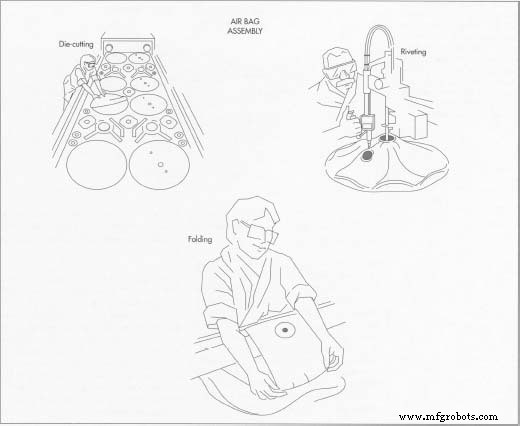
- 7. Woven nylon fabric is inspected, die‑cut to shape, and sewn. The bag is then inflated to check for seam integrity.
Final Module Assembly
- 8. The bag is mounted onto the tested inflator, folded, and fitted with a breakaway plastic horn‑pad cover. The finished module undergoes inspection and final testing.
- 9. Modules are boxed, shipped, and delivered to vehicle manufacturers.
Other Components
- 10. Crash sensors, diagnostic unit, steering‑wheel coil, and indicator lamp are integrated with the module during vehicle assembly, all linked by a wiring harness.
Quality Control
Because an air‑bag system saves lives, rigorous quality control is mandatory. Key focus areas are pyrotechnic (propellant) testing and static/dynamic bag and inflator tests.
Propellants undergo ballistic tests to predict behavior. Inflators are sampled from the line and subjected to full‑scale pressure‑vs‑time tests in large tanks (15.84 or 79.20 gallons). These tests confirm that the inflator can generate the required gas volume at the correct rate. Bags are inspected for fabric defects, seam integrity, and leaks.
Automated inspections occur at every stage. One manufacturer uses radiography (X‑ray) to compare each inflator against a master configuration stored in a computer; any deviation results in rejection.
The Future
Air‑bag technology continues to evolve toward lighter, cheaper, and more integrated systems. Key future directions include:
- Side‑impact airbags mounted in door panels that deploy toward the window, complemented by foam padding and head/knee bolsters.
- Hybrid inflators that combine pressurized inert gas (argon) with a heat‑based propellant, reducing propellant quantity and cost.
- Elimination of sodium azide in favor of safer chemicals, alongside advanced bag coatings that may eventually be unnecessary.
- Smart sensors that adjust deployment based on occupant size, presence, and seating position, minimizing injury risk from improper deployment.
- Exploration of aftermarket retrofit systems, though precise sensor tuning remains a challenge.
As automotive safety standards rise, air‑bag systems will keep advancing, ensuring greater protection for every driver and passenger.
Manufacturing process
- Air Purifiers: Design, History, and Future Trends
- Oxygen Tank Manufacturing: From Raw Materials to Quality Assurance
- Punching Bag: History, Design, and Cutting‑Edge Innovations
- Air Freshener: From Ancient Scents to Modern Plug‑In Technology
- The Great Highland Bagpipe: Heritage, Craftsmanship, and Modern Legacy
- Oxygen: From Ancient Discovery to Modern Industrial Powerhouse
- Air Conditioning Systems: Design, Manufacturing, and Future Trends
- Hot Air Balloons: From Montgolfier to Modern Flight
- The Art and Science of Tea Bags: From Ancient Roots to Modern Production
- Essential Winterization Guide for Air Compressors: Protect Your Equipment from Cold Damage