



The Great Highland Bagpipe: Heritage, Craftsmanship, and Modern Legacy
Background
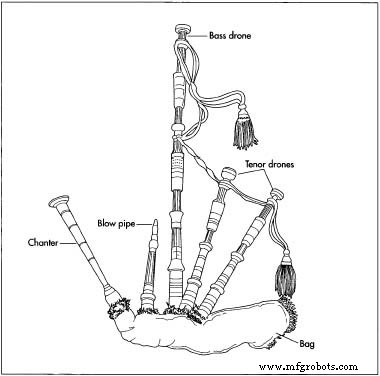
The Great Highland bagpipe is a wind instrument comprising a chanter, three drones (one bass and two tenor), and a windbag. The chanter, equipped with finger holes, produces the melody, while the drones provide continuous harmonic accompaniment tuned to the chanter. Air is supplied by the piper’s breath, which fills a leather bag made from animal hide. The bag’s airtight nature allows the piper to sustain a continuous sound, and a slight squeeze releases supplemental air to maintain the drone’s pulse during long passages. The five pipes are joined to the bag by wooden stocks; a non‑return valve in the blowpipe stock prevents backflow of air.
Professional pipers employ grace notes to articulate separate tones, giving the impression of detached notes despite the instrument’s continuous sound. Because the pipe’s range is fixed, music is often transcribed or arranged specifically for the bagpipe.
History
While the familiar Great Highland bagpipe dominates modern images, similar instruments appear in many cultures worldwide. Some scholars suggest origins in Sumer or China around 5,000 B.C., though no definitive evidence exists. The earliest documented references date to Alexandria, Egypt, circa 100 B.C. Roman and Greek sources mention bagpipes around A.D. 100, and the instrument was widespread across Europe by the ninth century.
Early forms likely evolved from a pair of single‑reed pipes—one for melody, one for drone—bound together by a simple skin bag. Modern examples of this basic design persist in the Arabian and Greek peninsulas, North Africa, and Eastern Europe.
Literary mentions include Geoffrey Chaucer’s Canterbury Tales and Shakespeare’s The Merchant of Venice, indicating the instrument’s popularity in medieval England. From the thirteenth to sixteenth centuries, England produced a variety of bagpipes, ranging from rustic models to ornate court versions. The courtly tradition faded after 1560, and many regional variants declined in the south and east of the country.
In Western Europe, France’s cornemuse and Italy’s zampogna are well‑known folk bagpipes. The cornemuse features a chanter and a tenor drone and is bellows‑blown; it is still played by folk ensembles. The French musette gained popularity during Louis XIV’s reign and combines two chanters with four drones, all housed in a single stock. The Italian zampogna has two chanters and two drones, with all pipes emerging from one stock. These instruments were established before 1700.
By the eighteenth century, the British Isles—especially Scotland, Ireland, and northern England—became the heartland of bagpipe culture. The French musette is thought to have influenced the British small pipe family, notably the Northumbrian small pipe, which remains in use today. The Northumbrian pipe’s cylindrical chanter, seven keys, and four single‑reed drones yield a staccato style that relies on breath control rather than grace notes.
Ireland’s uilleann pipe, a bellows‑blown system with a chanter, three drones, and three regulators, represents the most complex form. Regulator pipes, resembling closed chanters, are played by the right hand’s wrist to provide harmonic accompaniment. The chanter’s position against the piper’s knee raises the reed, extending the instrument’s melodic range.
Scotland produces several varieties: the Highland small pipe, the “hydrid” or Pastoral pipe, the Lowland pipe, the Border pipe, and the Great Highland bagpipe. The Highland small pipe, now enjoying renewed interest, is a compact, mouth‑blown or bellows‑blown instrument with three drones. The Lowland pipe, roughly half the size of the Great Highland bagpipe, features a bellows‑blown, cylindrical bore and has been revived by traditional instrument makers. The Border pipe shares many characteristics with the Great Highland bagpipe but has a quieter tone and a bellows‑blown system.
The Great Highland bagpipe, known in Gaelic as piob mh6r, served as a martial instrument from the sixteenth century, rallying Highland clans in battle. Solo pipers also played laments at funerals and performed folk music at social gatherings. The rise of pipe bands began after the clans were subdued and Scottish regiments were raised under Queen Victoria. Today, pipe bands are emblematic of Scottish heritage worldwide.
The instrument’s design is large: five stocks accommodate the chanter, two tenor drones (each ~16 in, 40 cm), a bass drone (~31.5 in, 80 cm), and the blowpipe. Drones are cylindrical, tuned to an octave and two octaves below the chanter, respectively.
Participants enjoying a traditional Scottish Highland Games.
Scots cherish large “gatherings of the clan,” celebrating heritage and fostering community among clan members. States with significant Scottish or Scotch‑Irish populations—such as New York and Michigan—host Highland Games featuring sports like caber tossing. In North Carolina, the Grandfather Mountain event draws thousands of participants each July, where Campbells, MacGregors, and Andersons share whisky and traditional cuisine.
The chanter’s nine holes—including a double‑vent and eight fingered—create a conical bore that yields a penetrating, loud tone. Its sound has spread worldwide through British imperialism, migration, and military deployment, becoming a staple of Scottish identity even in former colonies.
Raw Materials
Early Great Highland bagpipes (1700s) employed bog oak for pipes. With the expansion of global trade, tropical hardwoods such as African Blackwood and Brazilian rosewood became preferred due to their density and tonal qualities. Cocus wood was used until the 1920s but is no longer common. The choice of wood also depends on local humidity; for example, ebony is suitable for the damp British climate but may not perform as well in the drier United States.
For the bag, sheepskin remains standard in the United Kingdom, while elk or cow hide is used in the United States, and kangaroo hide is common in Australia. Modern synthetic options like Gortex can replace natural hide when durability is a concern.
Reeds have evolved from natural water reeds to contemporary materials such as polyvinyl chloride, metal, and brass. Historically, ivory—sourced from elephants, walruses, and narwhals—was the material of choice for ornamentation. Today, antlers from elk and moose, as well as imitation ivory and celluloid, are favored to avoid endangered species concerns.
Manufacturers source wood and antler in log form, plastics in sheets or rods, and metal ferrules and caps in tubing or castings made from aluminum, brass, nickel, or sterling silver.
Design
The Great Highland bagpipe’s form has remained largely unchanged since the 1700s, characterized by its straight, elegant lines. Victorian artisans introduced elaborate carving and beading, a tradition that continues in high‑end instruments. While the bore dimensions of the chanter and drones are tightly controlled to preserve tonal consistency, individual makers still imprint subtle differences through handcrafting techniques.
The Manufacturing Process
Wood Drones and Chanter
- 1. African Blackwood logs are sliced into planks and squares, then air‑dried for 3–7 years. Some makers now use kiln‑drying to reduce time and cost.
- 2. Once moisture‑content is suitable, a single‑flute drill, twist drill, reamer, or carbide‑tipped gun drill bores the cylindrical drones. The gun drill’s coolant helps remove chips during drilling.
- 3. The clean bore serves as a template for turning the drone’s exterior on a lathe. Ferrules and mounts are press‑fit, glued, and finished with wax, oil, lacquer, or varnish, depending on wood type and maker preference.
- 4. The chanter’s conical bore is step‑drilled and reamed with a tapered reamer (13 in long, 0.13 in narrow end, 0.87 in wide end). Precise boring is crucial for tonal quality. Finger holes are milled after the bore is complete, then the chanter receives the same surface finish as the drones.
- 5. Stocks are carved with straight holes and tie‑in grooves. Ferrules at the top prevent splitting, and the stocks are sized to accommodate drone reeds.
The Bag
- 6. Bags are cut from elk or cow hide; typically 4–5 bags come from one hide side. The hide is folded, seams glued with contact adhesive, and reinforced with a leather welt. Hand stitching with double needles completes the seam; a single bag takes roughly two hours.
Assembly
- 7. The 14 components of a Great Highland bagpipe are tied together. Stocks are secured to the bag using waxed linen, hemp, or nylon. The chanter and drones attach to the stocks, and reeds are inserted to finish the assembly.
- 8. Final finishing involves sanding from 80‑ to 120‑grit, followed by 400‑grit wet sanding. Heated oil or wax is applied by hand with a fine cloth. If lacquer or varnish is chosen, 220‑grit sanding precedes application with camel‑hair brushes or spray in a controlled booth.
Reeds
- 9. Reeds are handcrafted from metal tubing and water reed. The chanter’s double reed uses a brass or copper tube; two reed slices are wrapped around the tube. Drone reeds use cane or reed segments, with nodes marked by natural growth. The reed tongue—created by precise cuts—is critical for vibration and tone. Modern manufacturers may use plastic tubes and tongues for drone reeds. Insertion of reeds completes the instrument.
Byproducts/Waste
Wood dust generated during cutting and sanding is highly toxic; manufacturers must wear respirators and hearing protection. Most natural materials used are biodegradable, and plastic waste is minimal and landfilled responsibly. Thinners and organic solvents used in finishes are stored in small quantities to limit environmental impact.
Quality Control
Quality assurance is paramount; each bagpipe is handcrafted and inspected throughout production. Tolerances are exceptionally tight: internal dimensions must not deviate more than ±0.0005 in (0.013 mm), while exterior diameters may vary by ±0.1 in (0.25 mm). These strict specifications ensure consistent tonal quality and playability. A maker’s reputation hinges on the uniform excellence of both appearance and sound.
The Future
Interest in the bagpipe is rising, especially in the United States and Canada, the world’s largest markets. Demand for well‑made instruments has remained steady, and the number of pipers is growing. Master maker Mark Cushing attributes this surge to ethnic heritage pursuits and the instrument’s evocative sound. Pipe band associations across North America offer lessons, encouragement, and audiences, fostering a vibrant future for the craft.
Manufacturing process
- Punching Bag: History, Design, and Cutting‑Edge Innovations
- Bean Bag Plush Toys: From Ty Warner’s Beanie Babies to Today’s Collectible Market
- The Art and Science of Tea Bags: From Ancient Roots to Modern Production
- Air Bag Systems: Design, History, and Future Innovations
- Mobile Sanitary Bulk Bag Discharger – Dust‑Free, Stainless‑Steel, and Mobile
- Mobile Sanitary Bag Dump System with Tilt‑Down Flexible Screw Conveyor
- Advanced Features of Paper Bag Machines: Efficiency & Innovation
- How to Choose the Right Bulk Bag Filler for Safe Material Handling
- Thermal Bags Explained: Safely Transporting Food and Vaccines
- Efficient Bag Grippers for Safe, Fast Palletizing