



Air Conditioning Systems: Design, Manufacturing, and Future Trends
Background
Global demand for residential and commercial cooling is rising, turning air conditioning from luxury to necessity. Manufacturers have driven down costs by boosting efficiency and refining technology, intensifying industry competition.
Units range from compact residential models to large commercial systems powered by diverse energy sources. Central air in homes has surged, while commercial installations increasingly adopt natural‑gas‑driven chillers and advanced heat‑exchange technologies.
Raw Materials
Air conditioners are constructed from a mix of metals and lightweight polymers. Copper or aluminum tubing, prized for their thermal conductivity, form the core of evaporators and condensers. Stainless steel and other corrosion‑resistant alloys reinforce structural components.
Self‑contained refrigerant packs are typically encased in sheet metal, then protected with paint or powder coatings to resist environmental degradation.
The refrigerant—historically Freon—has evolved to safer alternatives such as hydrofluoroolefins, ammonia, or water, chosen for their thermodynamic efficiency and reduced environmental impact.
Design
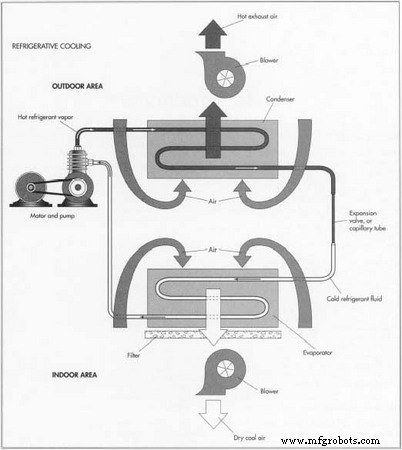
Every air conditioner comprises four essential elements: a pump, evaporator, condenser, and expansion valve, each operating with a refrigerant loop and a counter‑flow medium.
Power sources vary: most rely on electric motors, while gas‑powered chillers pair a pump with a gas engine to deliver higher torque. Regardless of design, the cycle follows the same thermodynamic principles.
At the heart of the cycle, the high‑pressure refrigerant vapor is condensed into liquid, then expanded to low pressure before evaporating in the room, releasing cool air. Modern units replace Freon with eco‑friendly refrigerants to comply with environmental regulations.
The Manufacturing Process
Creating Encasement Parts from Galvanized Sheet Metal and Structural Steel
- Air conditioners originate from raw structural steel shapes and sheet metal. Fabrication cells shape, cut, punch, drill, shear, and bend the metal into functional forms. Galvanized sheet metal, coated with zinc, protects against corrosion and forms the outer shell, base pans, face plates, and brackets.
Punch Pressing the Sheet Metal Forms
- The sheared sheet metal enters a CNC punch press guided by CAD/CAM or custom CNC programs, precisely creating holes and bends. NC press brakes then bend the metal into final geometries using dedicated dies.
- High‑volume brackets, fins, and sheet components are often outsourced, arriving ready for assembly once the unit is ready.
Cleaning the Parts
- All components must be free of oil, grease, and contaminants before powder coating. Methods include immersion in cleaning solvents, pressurized spray washes, vapor degreasing, and, for outsourced parts, pre‑degreasing. Many parts receive a phosphate primer bath before drying.
Powder Coating
- Brackets, pans, and wrappers are routed through a powder‑coating booth. A dry powder is electrostatically sprayed onto moving parts, then baked in an oven to form a durable finish in under ten minutes.
Bending the Tubing for Condenser and Evaporator
- Copper or aluminum coils form the heat exchangers. Tubing is uncoiled, straightened, and then fed into an NC bender that creates identical hairpin bends. Mandrels maintain tube integrity during bending.
- Coil lengths are cut on abrasive saws; aluminum plates are punched and formed with waves to maximize heat transfer.
Joining Copper Tubing with Aluminum Plates
- Stacked copper tubes are mechanically fused to aluminum plates by driving a mandrel through the tubes, expanding them against the plate’s inner wall. This secure bond facilitates efficient heat transfer.
- Condenser coils, typically air‑cooled, are similarly mounted on brackets and connected to the evaporator. The expansion valve, sourced from a vendor, completes the refrigerant circuit.
Installing the Pump
- The pump, pre‑assembled by a supplier, is fitted with fittings, braced, and bolted to the structural frame. The entire assembly is sealed within the sheet‑metal enclosure, which is riveted or bolted for protection.
Quality Control
Quality checks occur at multiple stages: incoming parts undergo dimensional inspections; fabrication cells maintain quality plans; and finished units undergo performance tests to certify efficiency and reliability.
The Future
Manufacturers must balance efficiency gains with cost reductions while addressing environmental concerns. Emerging refrigerants—such as ammonia or water—offer lower global warming potential. Continued research into advanced fluids and components will sustain industry competitiveness and drive innovation.
Manufacturing process
- Air Purifiers: Design, History, and Future Trends
- Oxygen Tank Manufacturing: From Raw Materials to Quality Assurance
- Air Freshener: From Ancient Scents to Modern Plug‑In Technology
- Correction Fluid: Composition, Production, and Future Trends
- Oxygen: From Ancient Discovery to Modern Industrial Powerhouse
- Hot Air Balloons: From Montgolfier to Modern Flight
- Air Bag Systems: Design, History, and Future Innovations
- Expert Guide to Properly Size Your Commercial Air Conditioner for Optimal Performance
- Mastering Fluid Mechanics: Principles, Applications, and Impact
- How to Recharge Your Car's Air Conditioner: Step-by-Step Guide