



Acrylic Fingernails: From Chemistry to Craftsmanship
Background
Acrylic nails have become a staple of modern nail care, offering a durable, customizable alternative to natural nails. The term “acrylic nail” encompasses a range of products—press‑on nails, nail tips, and sculpted extensions—all based on the same fundamental chemistry. Early press‑on acrylics appeared in the 1970s, but they were rudimentary and did little to strengthen the natural nail. Today’s formulations bond seamlessly to the nail bed, creating a natural look and feel that has won widespread popularity.
Raw Materials
Monomer Liquid
The core of acrylic nail resin is a methacrylate monomer. When mixed with a polymer powder, the monomers link head‑to‑tail, forming long chains that polymerise into a rigid structure. The process mirrors the dental acrylics that once raised concerns about allergic reactions; advances in resin chemistry have largely eliminated those risks.
Polymer Powder
Polyethylmethylmethacrylate (PMMA) is the most common polymer used. It provides hardness and durability, though it can be blended with softer polymers to improve flexibility. During mixing, the polymer fibres cross‑link, creating a net‑like scaffold that hardens into a nail‑shaped finish.
Resin Modifiers
Cross‑linking agents such as ethylene glycol dimethacrylate and initiators like benzoyl peroxide (also found in acne treatments) drive the polymerisation reaction. Catalysts fine‑tune the reaction speed, while inhibitors keep the monomer liquid until it’s ready for use. Plasticisers reduce brittleness, and color stabilisers absorb UV light to prevent yellowing.
Miscellaneous Ingredients
Dyes and pigments—titanium dioxide for whitening, pink or blue cast for a natural sheen—impart color. Flow agents control polish spread, and stabilisers guard against discoloration over time.
Design
Every acrylic kit relies on the same chemistry, but the true artistry lies in the technician’s hands. Each client’s nails have unique dimensions and skin sensitivities, so a skilled nail technician customises the shape, thickness, and finish to achieve a natural, long‑lasting look.
The Manufacturing Process
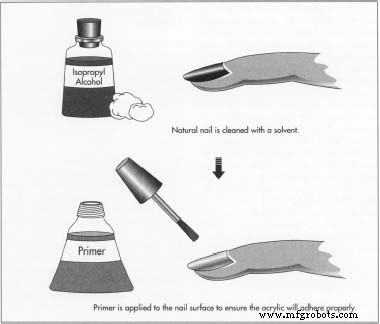
Sculpted acrylic nails are handcrafted, not mass‑produced. Each nail undergoes a five‑step cycle: cleansing, priming, mixing, sculpting, and finishing.
Cleansing the Nail
- 1. A nail‑bed cleanser—typically isopropyl alcohol—removes oils, dirt, and bacteria, preparing the surface for optimal adhesion.
Priming the Nail
- 2. A primer creates a bond between the natural nail and acrylic. Non‑etching primers act like double‑sided tape, while etching primers dissolve a thin layer of the nail using acids such as methacrylic acid for stronger attachment.
Mixing the Acrylic Resin
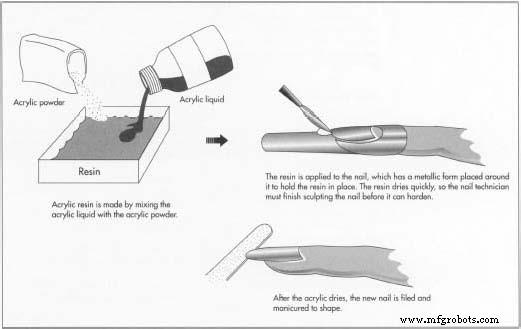
- 3. The monomer liquid and polymer powder are combined quickly; the mixture must be applied before it hardens.
Sculpting the Nail
- 4. A form—metal or plastic— is placed on the fingertip to shape the resin. The technician applies the resin, sculpting it into a natural silhouette before the primer fully sets.
Finishing the Nail
- 5. Once the acrylic dries, it is filed, manicured, and sealed with polish or clear coat. A protective acetate tip may be added for added strength.
Byproducts & Waste
Production generates vapours, liquids, and solids. Unused monomer or powder must be disposed of in dedicated containers to avoid contamination. Ventilation is essential to keep vapour levels safe, and technicians should wear a dust mask when filing acrylic to protect against inhalation.
Quality Control
The FDA monitors cosmetic chemicals. In the 1970s, it warned against methyl methacrylate due to allergic reactions. Today, technicians must monitor raw materials: inhibitors prevent premature gelling, solvents must be capped, and powders kept dry to avoid caking. Proper mixing ratios—typically 35‑40% polymer—ensure nails have the right balance of strength and flexibility.
Quality can also be compromised by air pockets, uneven adhesion, or reactions with the nail bed. Skilled technicians minimise these risks by controlling the mixing, moulding, and application steps.
The Future
Innovation in acrylic nail chemistry will continue to focus on easier application, greater durability, and reduced VOC content. Consumer demand for new styles and stricter state regulations on volatile organic compounds may shape future product formulations.
Manufacturing process
- Acrylic Plastic: Properties, Production, and Future Trends
- Maximizing Efficiency: How Nesting Boosts Polymer 3D Printing Performance
- Glass-Filled vs. Glass-Reinforced Acetal: Understanding the Difference and Its Impact on Performance
- Precision Acrylic CNC Machining: Accurate, Safe, and Efficient
- Revolutionary Piezoelectric Polymer Boosts Energy Conversion by 60%
- Polymer Adhesives: Definition, Properties, and Industrial Applications
- Understanding Polymer Resin: Properties and Applications
- Understanding Polyvinyl Acetate (PVA): Properties, Uses, and Benefits
- Acrylic Explained: Properties, Types, and Uses
- Thermoplastic vs Thermosetting Plastic: Key Differences Explained