



Accordion: From Free‑Reed Origins to Modern Innovations
The accordion is a portable, free‑reed instrument that combines a collapsible bellows with a keyboard and bass casing. Air drawn through the bellows vibrates metal reeds, producing its distinctive sound. Hand‑assembled from hundreds of parts, the accordion has evolved since the early nineteenth century into a versatile modern instrument.
History
The accordion’s lineage can be traced back to the ancient Chinese cheng, the first known free‑reed instrument, invented roughly 5,000 years ago. The cheng featured bamboo pipes, a resonator, and a wind chamber, and its phoenix‑shaped design was introduced to European musicians in 1777.
In 1822, German inventor Christian Buschmann patented the “Handaeoline,” an early accordion with expandable bellows, a portable keyboard, and free‑reed technology. Seven years later, Cyrillus Damian refined the design, adding four bass keys for chords, and secured a patent for the instrument that he named the accordion.
Throughout the 19th century, several key innovations were introduced. In 1850, the chromatic accordion replaced the earlier diatonic models, allowing each key to produce the same pitch regardless of bellows direction. Steel reeds were incorporated in 1857, and by the 1860s manufacturers such as Hohner, Soprani, and Dallape had begun mass production. The addition of more bass keys helped standardize the modern layout that emerged in the early 20th century.
Electronics entered the accordion world during World II. Early models were wired to electronic organs; later, dedicated amplification boxes allowed the instrument to be amplified directly. Today, many accordions include MIDI interfaces, enabling connection to synthesizers, electronic pianos, and other MIDI‑compatible devices.
Background
The modern accordion consists of three primary components: the expandable bellows, the treble end (which houses the keyboard), and the bass end (which contains bass buttons). Reeds and any electronic components reside inside the bellows.
As a free‑reed instrument—like the harmonica—the accordion uses metal strips riveted to a metal plate. Air passes through a slot on the side opposite the reed; when the air flows in the correct direction, the reed vibrates, producing sound. A flap on the opposite side prevents reverse airflow and conserves air. Each reed’s length and thickness determine its pitch; longer reeds yield lower notes.
The treble keyboard is commonly piano‑type. Each key is linked to a pallet that covers or uncovers a reed’s slot. When a key is pressed, the pallet opens, allowing air to reach the reed. Register keys control slides that swap in different sets of reeds, adding tonal variation.
The bass end uses a Stradella layout of up to 120 buttons. Instead of piano‑style keys, each button engages a rod‑and‑lever system that directs air to multiple reeds, enabling single notes or full chords.
Players hold the accordion with shoulder straps while the right hand operates the treble keyboard and the left hand manipulates the bellows and bass buttons. The bellows movement both drives the reeds and provides expressive dynamics.
In the United States, chromatic accordions—such as the piano accordion and the continental chromatic—are standard. Diatonic models remain popular for folk music; common types include the melodeon, the continental club model, and the British chromatic. Recent developments include electronic piano accordions: some retain traditional bellows and reeds plus an electronic tone generator, while others are fully electronic with bellows that merely control volume.
Raw Materials
Constructing an accordion requires hundreds of parts made from wood, metal, plastic, and other materials. The frame, pallets, and reed blocks are typically carved from poplar, chosen for its strength and light weight. Bellows are made from durable manila cardboard, reinforced with leather gussets and steel strips. The treble grill is a fretted metal cover, often stamped with the manufacturer’s logo.
Reeds are crafted from highly tempered watch‑spring steel and riveted to an aluminum‑alloy plate. Leather or plastic flaps seal the opposite side of each reed slot. Metal rods connect bass buttons to the reeds, while straps are leather‑padded for comfort. Plastic dominates the treble keys, buttons, and switches, and wax is occasionally used to seal air leaks.
Metal is also used to make many of the smaller pieces. For example, the reeds are made of highly tempered, watch‑spring steel. They are riveted to an aluminum alloy reed plate. To minimize the amount of air that goes through a slot, leather or plastic flaps are used to cover the side opposite the 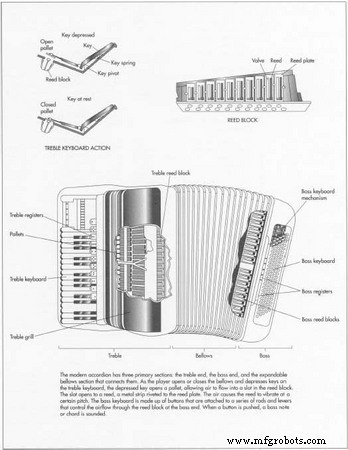 reed.
reed.
Manufacturing Process
The accordion production chain blends automated precision with skilled hand assembly.
Making the Parts
- Wooden components are cut by jigs and presses, ensuring consistent geometry and high precision.
- Plastic elements such as keys and buttons are produced by injection molding of polymer granules.
- Metal parts are cast or stamped, then tempered (for reeds) to achieve the required ductility and resilience.
Assembling Reeds, Keyboards, and Casings
- Reeds are riveted to an aluminum plate, with leather or plastic valves sealing the slots.
- The plate is mounted on a wooden reed block, and the treble keyboard or bass button layout is affixed.
Final Assembly
- The bellows, supplied by specialized manufacturers, is attached to the treble and bass casings and sealed with wax to prevent leakage.
Finishing Touches
- Decorative elements—paint, treble grill, manufacturer insignia—are added.
- The finished instrument is caseted, packaged, and shipped to distributors.
Quality Control
Quality starts with incoming raw materials. Resin for plastic parts is tested for appearance, melting point, and molecular weight; wood and steel are similarly verified. When external suppliers provide components, the accordion maker relies on the supplier’s QC records. Throughout assembly, trained inspectors conduct visual checks at every stage, catching defects early and ensuring each instrument meets rigorous standards.
The Future
Ongoing innovation continues to refine the accordion. Recent inventions allow musicians to “bend” notes, adding expressive nuance beyond the limitations of traditional reeds. Future models will likely incorporate lighter, stronger materials and advanced computer control, further enhancing tonal quality, projection, and playability. The integration of digital technology promises a new generation of accordions that are even more versatile than their predecessors.
Manufacturing process
- What is VMC Machining? An Expert Overview of Vertical Machining Centers
- Expert Guide to Aluminum Laser Marking: Precision, Durability, and Industry Applications
- MIG vs. TIG Welding: Selecting the Right Arc Welding Technique for Your Project
- Comprehensive Guide to Laser Marking: Types, Benefits, and Applications
- Key Considerations for High‑Volume Swiss Machining
- CNC Prototyping Guide: Precision, Speed, and Cost‑Effective Production
- Expert Shaft Manufacturing: Precision Processes & Custom Solutions
- Accordion: From Free‑Reed Origins to Modern Innovations
- Reed Relays Explained: A Complete Guide from Basics to Applications
- Reed Switch Circuit Explained: Principles, Applications, and DIY Build Guide