



Reed Switch Circuit Explained: Principles, Applications, and DIY Build Guide
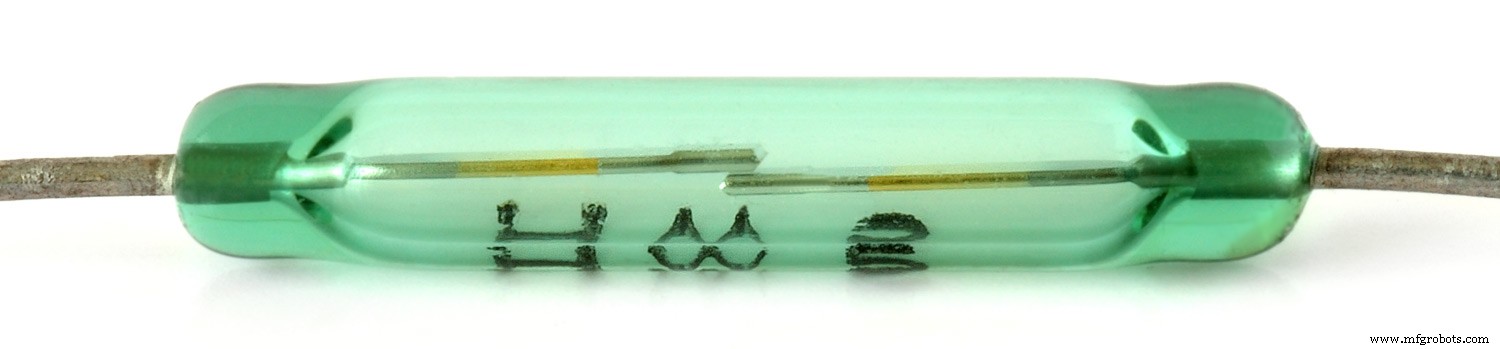
Reed Switch
Source: Wikimedia Commons
Do you need an ideal circuit for sensing and proximity applications?
Then, you should consider a reed switch circuit.
Why? The switch has reduced potential for electrical interference, and the device applies in various consumer electronics.
For instance, you can place a reed switch in an alarm system to sense if your windows or doors are closed or open. Also, you can use this switch to make your system tamper-proof.
So, do you want to learn more about this circuit?
Let’s get to work.
What Is a Reed Switch?
This device is an electrical or electromagnetic switch that helps control the current in a circuit.
Interestingly, the reed refers to the metallic part of the switch that is thin and flexible. And it has internal pressure with an external wire lead.
That said, simple reed switches have two or more ferromagnetic material reeds enclosed in a small glass tube-like envelope.
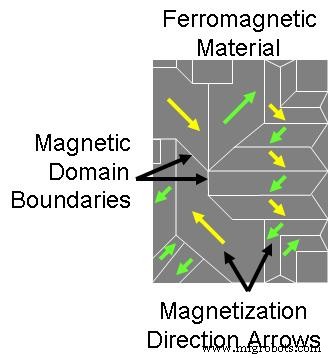
A sketch showing how a Ferromagnetic material works
Source: Wikimedia Commons
These structures then magnetize and move separately or together when a magnetic field applies towards the switch.
In addition, the reed switch operates as a bridge or gate. So, when the two reeds make contact in an electric circuit, the current will circulate.
A remarkable feature of this switch is that it works independently with magnetic fields once you set it up.
Furthermore, you can build a reed relay by bringing a permanent magnet close to the switch or activating the device with an electromagnetic coil.
Types of Reed Switch
The following types of reed switches are available:
- Cylindrical reed switch
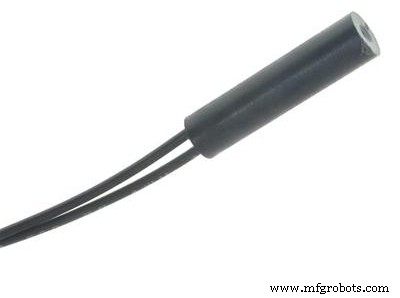
Cylindrical reed switch
Source: Pixlr
- Mini reed switch
- Arduino reed switch (relays, modules, counters, speedometers)
- Encapsulated reed switch
- Waterproof reed switch
- High current reed switch
- Electric reed switch
- Plastic reed switch
- Bistable reed switch
- Magnetic reed switch
- Micro reed switch
- Latching reed switch
- Hamlin reed switch
- Hall-effect sensor
- Changeover reed switch
But, all the variants above fall into two fundamental categories of the reed switches:
Normally Open Reed Switch
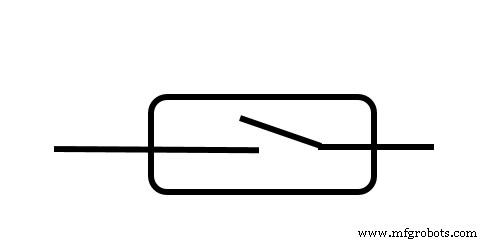
Normally open reed switch
The normally open reed switch comprises two reeds made from materials like iron alloy. So, each of the reeds is usually apart.
But when you apply a magnet towards the switch, it pulls one of the reeds to make contact with the other one. Hence, the reeds will return to their original position if you remove the magnet.
Normally Closed Reed Switch
Normally closed reed switch
The “normally-closed” type reed switch has full reed contact when the device comes on. But when the magnet is close to the switch, the reeds separate.
Also, the reed switch has a third configuration. And this device features three contact points—where one of the points is a common lead. So, when energy passes through the common lead, it toggles between the two contacts.
That is, when the switch is in its usual position, the common lead has contact with one of the other leads.
But when you apply a magnetic field, the common lead makes contact with the second lead. And when you remove the magnet, the common lead returns to its default position.
How Does a Reed Switch Work?
Typically, the reed switch consists of switch contacts constructed from metals like rhodium, tungsten, mercury, etc. And the switch contacts are a few microns apart.
So, when you apply a magnet to an open reed switch, the blades make contact. Consequently, there will be electrical flow in the device. But when you remove the magnet, the blades separate and shut off the electricity.
Also, when you add a magnet to a normally closed reed switch, the blades will separate, which shuts off the electrical current. But when you remove the magnet, the leads make contact and allow current flow.
How to Build a Reed Switch Circuit
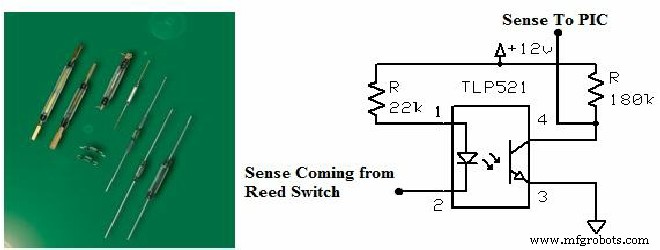
Circuit diagram showing reed switch circuit
Source: Researchgate ℅ Sadeque Reza Khan
You need the following components to build this simple circuit:
- Reed switch
- Breadboard
- Magnet
- 470Ω resistor
- LED (any color)
You can easily get a cheap reed switch from a reputable online store. Also, you can use an NC or a close reed switch if you have one. And that’s because the device works in reverse.
Also, the LED helps you to know when there’s electrical flow in the circuit or not. In addition, the 470Ω resistor is responsible for limiting electrical current to the LED (to avoid burning out).
That said, you have to reference the schematic of the setup. That way, you can build your circuit on the breadboard.
Furthermore, the circuit works for a normally open reed switch by staying off when the contact leads are apart.
Then, when you introduce a magnet close to the circuit, the LED will come on. And if you remove the magnet, the circuit will go back to its default position.
But when you’re using a normally closed switch, your circuit will be on without a magnet. And when you add a magnet to the circuit, the LED and circuit will go off.
Applications For Reed Switches
You can use this device in the following application circuits:
- Floating switch
- Proximity sensors
- Brushless DC electric motors
- Computer cooling fans
- Burglar alarm
- Fluid level sensors
- Anemometer (for wind speed)
- Electric showers
- Speedometers
- Mobile phones
Advantages of Using a Reed Switch
Here are the unique advantages of a reed switch over a mechanical switch:
- It prevents mass loading of sensitive electronics because of its low component weight
- The switch doesn’t require operating voltage because magnetism triggers it
- High performance, reliable, simple sensing, and actuation abilities
- It has relative ease of customization
- Features a low-profile design that allows integration ease within a confined space
- It comes with durability over the extended service life
- It doesn’t experience mechanical wear since there is no physical pressure
- The device works efficiently while changing low magnitudes of electric current and voltage
- A unit goes for a low price
- Reed switch doesn’t need power for operation
Final Thoughts
The reed switch circuit is an electromagnetic device that can easily actuate with an applied magnetic field. And the functional life of the device is pretty impressive. Furthermore, the switch is cheap, and you can use it for all electronic applications.
Also, it works effectively while changing magnitudes of currents and voltage—which is a significant issue with regular switches. Plus, you can use this device for multiple operations without any problems. And it’s all thanks to the inert atmosphere and gold-plated reed contacts.
So, do you plan to get the best reed switch for your project? Please feel free to contact us.
Industrial Technology
- How to Build a Safe Taser Circuit: A Comprehensive Guide for Self‑Protection
- Alarm Circuit Explained: Construction, Operation, and Working Principles
- VFD Schematics Explained: Circuit Diagrams, Types, and Building a Variable Frequency Drive
- Understanding LDO Circuits: Principles, Design Tips & Applications
- Build Your Own Thermoelectric Generator: How It Works & DIY Guide
- Designing a Reliable Heat Sensor Circuit: Operation Explained & Step‑by‑Step Build Guide
- How to Build an RGB LED Controller Circuit: Principles & DIY Guide
- Mastering the Emitter Follower Circuit: A Practical Guide to Impedance Matching and Current Gain
- Low-Voltage Cutoff Circuit: Design, Operation, and DIY Guide
- Build a Pulsing LED Circuit: Step‑by‑Step Guide to Stunning Light Effects