



Understanding Doppler Radar: Principles, Function, and Real‑World Uses
A police speed gun/doppler radar helps law enforcers catch overspeeding individuals, among other important uses. It applies radar technology, which is also useful in detecting wind speed and weather radar applications. Thus, for a detailed exposition of how Doppler radar works, read this article.
What is a Doppler Radar?
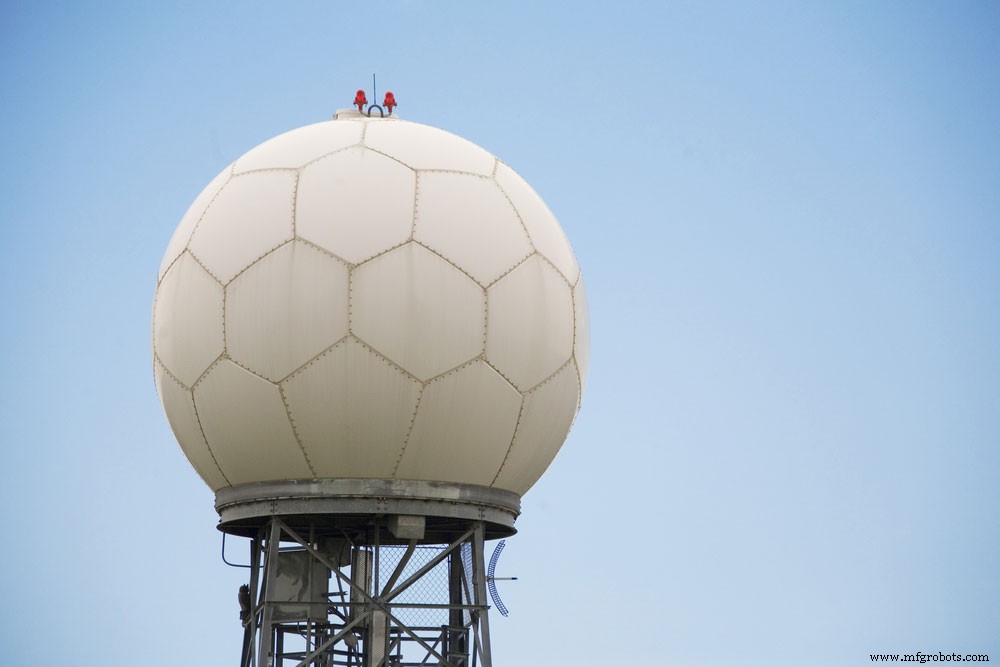
Fig 1: A Dopper Weather Radar System
It’s a specialized radar system that uses pulses of radio waves to detect the speed of an object by applying the Doppler effect principle.
How Does Doppler Radar Work?
The Doppler Radar is a conventional radar system that operates via the principle of the doppler effect in identifying an object’s speed.
Explaining the Doppler effect
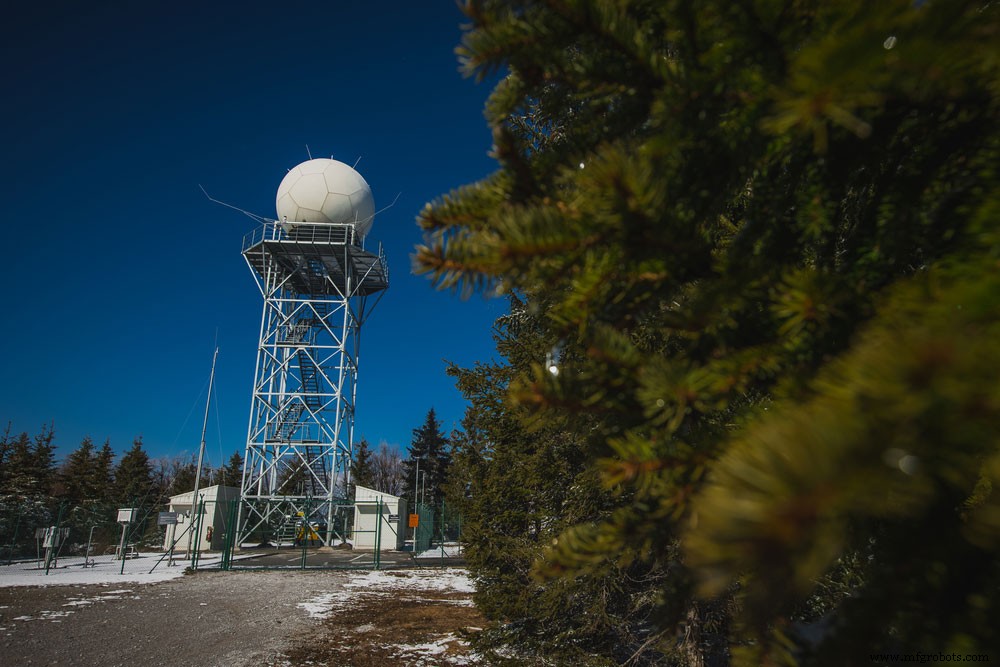
Fig 2: The Doppler Effect
Consider an object that generates electromagnetic radiation waves of a particular frequency. When the object travels toward a stationary observer, it’ll experience a higher frequency of waves than the source. Conversely, when the object moves away from the observer, its waves exhibit a lower wavelength than the source. This frequency shift phenomenon is the dopplers effect.
The difference in frequencies between the source and what the observer perceives is the Doppler shift.
Operation mode
During operation, a Doppler radar transmitter sends a radar beam of precise frequency to an object in motion. Subsequently, the radar signal interacts with the object and sends a radar echo to the radar receiver. From the frequency of the returning radar pulses, the Doppler radar can decipher the object’s velocity.
What is a Dual-Polarization Radar?
Fig 3: A Doppler Weather Radar
A dual-polarization radar (dual-pol) is an advanced technology weather radar. Besides, it’s a more enhanced version of the Doppler radar. Here are the key differences between these radars:
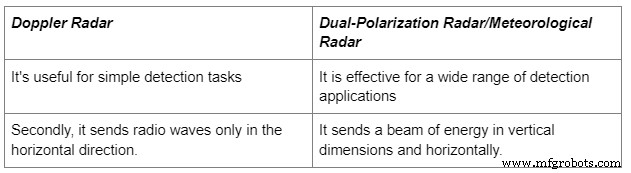
A dual-pol radar can identify the shapes of objects in the atmosphere hence its application in weather forecasting. It’s essential in determining precipitation types. Also, it is handy in detecting airborne tornado debris in the atmosphere.
Doppler Radar modules offered
Doppler Radar (BGT24LTR11) – 24GHz Transceiver
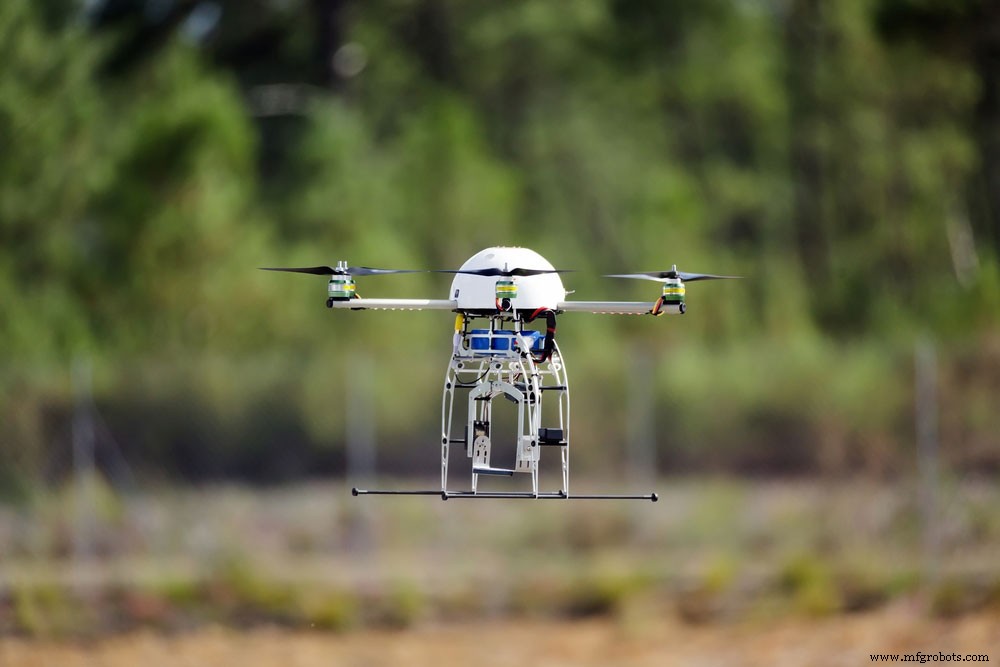
Fig 4: This radar is essential in UAV applications
It relies on the BGT24LTR11 Silicon Germanium MMIC, a 24GHz radar transceiver. Among its key upsides are the following:
- It utilizes low power so that you can use it for an extensive period. Also, it delivers high-precision measurements of the velocity of objects.
- Secondly, it’s compact and thus easy to deploy.
- Also, it endures harsh weather like strong thunderstorm winds and heavy precipitation without transmitter frequency interference.
- Besides, it guarantees high penetration. Thus you can deploy it behind objects and in heavy precipitation areas.
- Fifthly, it’s lightweight in design and suitable for UAV applications. It also delivers fast responses.
Millimeter-Wave Doppler Radar (SYH24A1) – 24GHz Transceiver
It’s also a 24GHz radar transceiver that relies on an SYH24A1 IC. The following are some of its benefits.
- First, It’s compactly sized and thus easy to deploy. Also, it has a two × eight microstrip antenna, which delivers a high range of measurements.
- It is fast in response, lightweight, and has high penetration capability.
- Third, it can operate under severe weather conditions such as strong thunderstorms and heavy rain.
- Additionally, it has a low power output and thus emits no excessive radiation.
- Lastly, it can detect human body functionalities such as movement, breathing, and the number of people.
Conclusion
For reliable forecasts, the Doppler Radar is one of the most important radar systems. It is handy for detecting the speed of objects and also weather for the Dual-Polarization Radar. Lastly, If you have further queries on its operation, reach out.
Industrial Technology
- Throttle Position Sensor: How It Works and Why It Matters
- RVG Sensor: How It Works and Why It’s Transforming Dental Imaging
- Pulse Sensor: How It Works and Key Applications for Makers
- Capacitors Explained: How They Store Energy and Power Modern Electronics
- Understanding LDO Circuits: Principles, Design Tips & Applications
- Mastering Microcontrollers: Structure, Functionality, and Practical Applications
- LM393 Comparator Overview: Pinout, Features, Applications & Operation
- CD4066 Quad Analog Switch: Key Features, Operation, and Practical Uses
- Variable Resistors Explained: Types, Uses, and How They Work
- IRF540 MOSFET Pinout & Specifications: Features, Operation, and Practical Uses