



Mastering the LM723: A Comprehensive Guide to Adjustable Voltage Regulation
There’s no doubt that you’ve come across several types of voltage regulators like 7805, 7812, etc., that regulate power supplies. While they are effective, they often only generate a fixed value output. Therefore, the LM723 circuit or LM317 IC voltage regulators are better options for inconsistent voltage regulation.
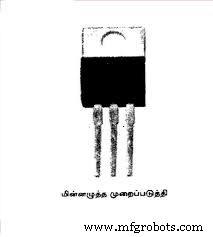
A voltage regulator
We’ll focus on LM723 IC that requires electronic components such as capacitors and resistors in its construction. Furthermore, it ensures the provision extreme amount of current with the help of an external pass transistor.
What is an LM723?
LM723 is a changeable voltage regulator whose primary purpose is to serve series regulator applications. Sometimes, you can substitute the LM723 with LM723C. They have similar features, but LM723C works in a temperature range of 0°C to +70°C rather than -55°C to 150°C.
- LM723 pin configuration
Now, let’s discuss the LM723 pinout as summarized in the table below.
| Pin No. | Pin Name | Function |
| Pin1 | NC/ Not Connected | It has no connection. |
| Pin2 | Current Limit | The second pin limits current. Furthermore, it reduces heat dissipation in faulty situations to prevent overheating. |
| Pin3 | Current Sense | In addition to limiting current, it’s also applicable in foldback applications. |
| Pin4 | Inverting Input i/p | It ensures there’s a constant output voltage. |
| Pin5 | Non-Inverting Input i/p | It provides a reference voltage to the inside of your op-amp. |
| Pin6 | Vref | It supplies a reference output voltage of approximately 7V. |
| Pin7 | -Vcc | It works similarly to a ground pin (GND). |
| Pin8 | NC | It’s similar to pin1 in that it’s not connected. |
| Pin9 | Vz | It often makes negative regulators. |
| Pin10 | Vout | It functions as the o/p pin. |
| Pin11 | Vc | Since it’s the collector input of the series pass transistor, it maintains a direct connection to the positive voltage supply. Also, an exterior transistor isn’t in use at the time. |
| Pin12 | V+ | It’s the positive supply input pin. |
| Pin13 | Frequency Compensation | Alongside a 100pf capacitor, it helps decrease noise. |
| Pin14 | NC | Lastly, we have pin14 with no connection. |
LM723 Features and Specifications
A couple of LM723 features and specifications include;
Features
- First, they can carry out different operations like shunt, floating series, and negative regulation.
- Then, they use an external pass transistor to supply 10A o/p current. However, if you lack an exterior pass transistor, the o/p current becomes 150mA.
- Further, its maximum input supply voltage is 40V.
- Also, you can use them to make linear or switching regulators.
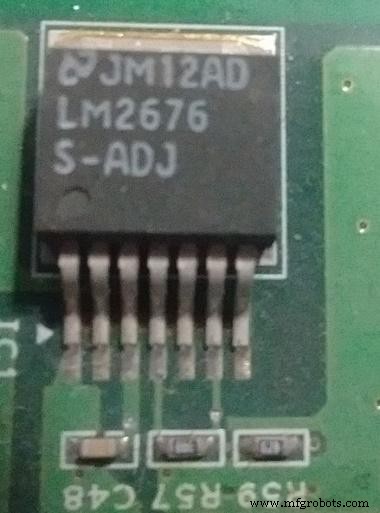
Example of a switching regulator
- Finally, you can modify its o/p from 3V to 37V.
Specifications
- Current supply from Vz pin = 24mA
- Maximum i/p voltage = 40V
- Range of output voltage = 3Volts to 37Volts
- Operating temperature range = -55°C to +150°C
- Current supply from Vref pin = 15mA
- Reference voltage = 7V
- Line regulation = 0.01% Vout
- Load regulation = 0.03% Vout
- Ripple rejection = 74 dB
How Does an LM723 Work?
Interior block diagram of LM723
We’ll need to divide the LM723 block diagram into two blocks for easy understanding. Therefore, we’ll have the reference voltage generator and error amplifier blocks.
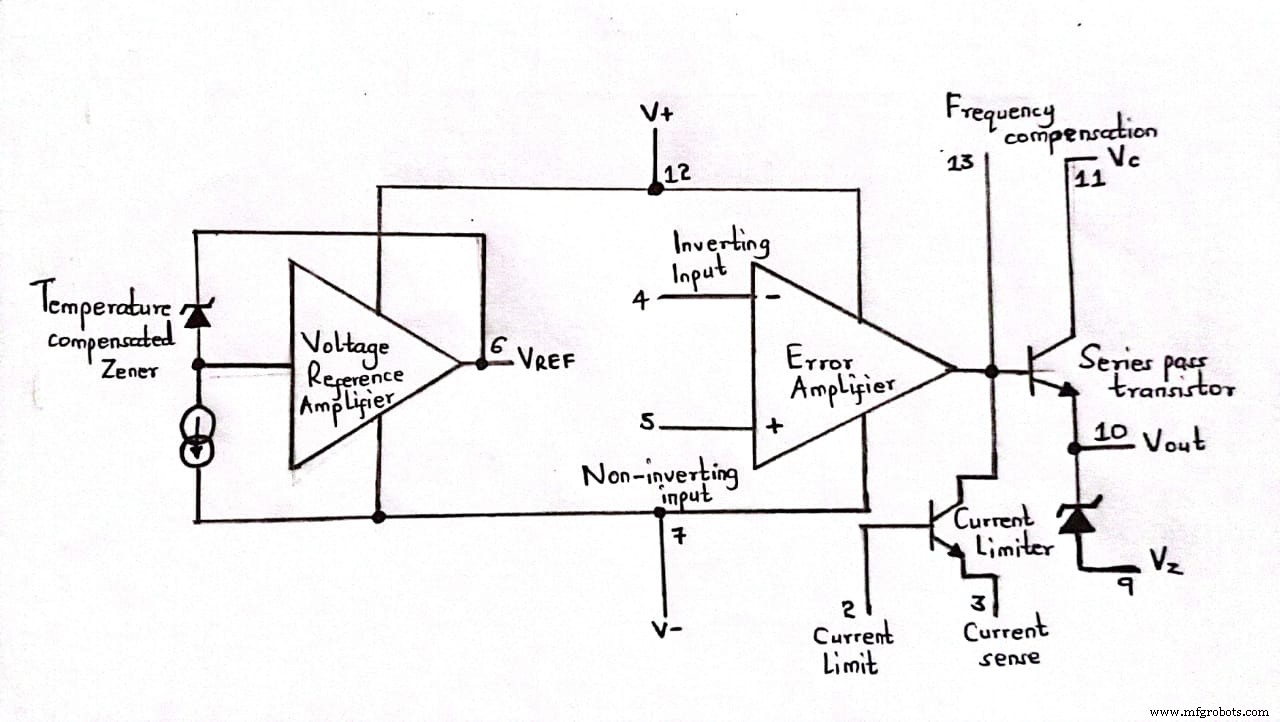
Interior block diagram of LM723
Reference block
Here, the Zener diode works at a set point. For that reason, the diode’s o/p becomes a permanent voltage. Additionally, its stable current supply arriving in the circuit, alongside an amplifier on the Vref pin, generates a stable voltage (7V).
Error amplifier block
For the second block, components include a transistor, error amplifier, and series pass Q1 transistor that limits current.

Error amplifier application
Error signals control transistor Q1 conduction. In turn, the transistor regulates the output voltage.
The error amplifier block promotes a contrast in voltages. For example, you’ll distinguish the o/p voltage from inverting terminal and Vref-reference voltage from the non-inverting terminal throughout the feedback.
It’s good to note that there’s no internal connection between the above voltages. And so, you’ll externally offer depending on the needed output voltage.
The working principle of LM723 circuit
- We start by putting a 9V voltage into the reference amplifier via pin 12. Consequently, we’ll gain a constant output voltage at pin 6.
- Then, the reference voltage proceeds to pin5 via a connection between capacitor and potentiometer. The potentiometer here is RV1 and not R1, and we can move the potentiometer to adjust the voltage when needed.
- At this point, you compare the inverting pin voltage using the non-inverting pin voltage.
- If the non-inverting input voltage is higher than the inverting pin voltage, the series pass transistor will receive a forward-biasing. Afterward, the current will flow to the emitter via a collector.
- Finally, we’ll get an output voltage through the Vout pin.
According to the voltage diver rule, we’ll calculate the output voltage as;
Vout = Vref (R2/RV1 + R2)
How to Design LM723 Circuits?
The circuit design here produces a variable output that ranges from 2.6 to 24 V.
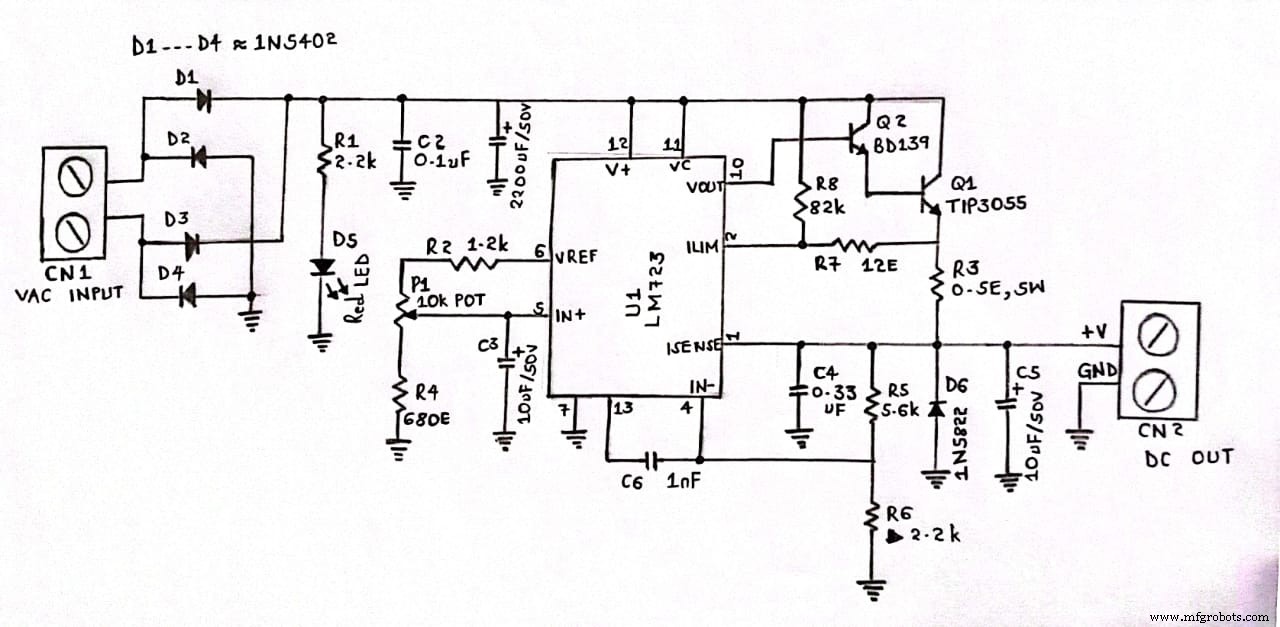
Application circuit design with LM723
Steps and Working of the Circuit
- Begin by connecting the 30V AC to the input terminal (VAC). The 1N5402 diodes will convert the AC voltage into DC.
- The red LED acts as input voltage indicators and displays the input signal status.
- C2 and C1 capacitors eliminate ripples from DC voltage, thus smoothing the voltage to LM723.
- The 10k (10k POT) variable resistor then adjusts the output voltage.
- The purpose of the TIP3055 NPN transistor is to act as an external bypass resistor. It functions to increase the handling capability of the output current.
The Advantages and Disadvantages of Using LM723
Advantages
- First, it has low noise production if you hook it up accordingly.
- It also has a wide voltage range. For instance, its input voltage can go up to a constant 40V and allow 50 pulses.
- Additionally, it can support external pass transistors.
- Further, you can directly modify the frequency response.
- Besides being a temperature controller, you can also use it as a negative, floating, or shunt regulator.
- Lastly, it’s cost-effective and durable.
Disadvantages
- Undeniably, it’s complex to handle and comprehend.
- Then, it lacks an exact current limiting.
- It has a moderate error amplifier gain and a low error amp bias current.
- Thirdly, the regulated o/p voltage (2.5V) and dropout voltage (10V) is low.
- Finally, an overload can affect the current limiting sensitivity.
Conclusion
To conclude, if you’re considering LM723 as a voltage regulator, then you’re on the right track. You may use it in applications like a temperature controller, current regulator, or shunt regulator. Often, the applications have 150mA current o/p but lack exterior pass transistor.
For more questions, don’t hesitate to contact us.
Industrial Technology
- Voltage Regulator Experiment with a 12‑Volt Zener Diode
- Voltage Follower Amplifier: Design, Build, and Measurement Guide
- Build a Low‑Frequency Astable Multivibrator Audio Oscillator with Discrete Transistors
- Understanding TRIACs: Bidirectional Power Control in AC Applications
- Analyzing Circuit Response to Multi‑Frequency Sources
- High-Current Voltage Regulator: The Complete Expert Guide
- Understanding LDO Circuits: Principles, Design Tips & Applications
- Step‑by‑Step Guide to Building a Reliable DC Voltage Booster Circuit
- Comprehensive Guide to the LM7815 Voltage Regulator: Usage, Features & Applications
- LM7805 Voltage Regulator Circuit: Complete Overview & Practical Guide