



Modular Cells: Enhancing Manufacturing Flexibility and Efficiency
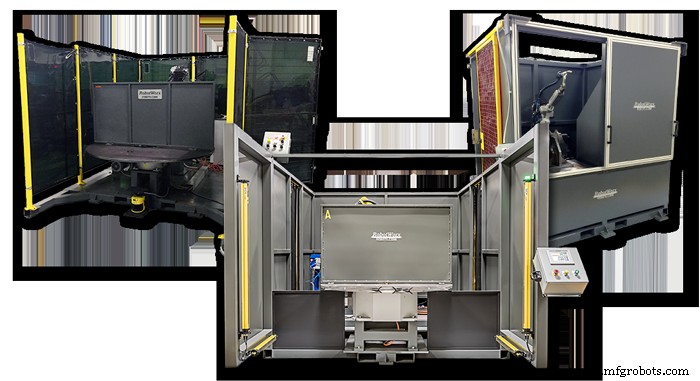
Workcells allow for leaner, more concise manufacturing, giving companies the ability to use fewer robots and workers to perform more applications. Going a step further in that logic, manufacturers who use modular cells are able to operate via plug and play, and can be changed as necessary.
When designing manufacturing systems, they are usually engineered to perform certain tasks or make a certain product. As product lines are discontinued or products change, manufacturers need to have modular work cells that can adapt to the changes in the factory without increasing downtime with resetting and reprogramming the entire line.
By using these modular workcells, which are mobile for easier integration into a workspace, the production line can be changed if necessary. Think of a group of modular cells like building blocks for production. They may work well “stacked” one way for this product, but once the product is changed or enhanced, the modulated cells may need to be stacked a different way to optimize productivity.
If these cells were fixed, instead of modular, manufacturers would have to continually have to reinvest in equipment every few years. With the right care, and modularization, these cells can still be working day in and day out for 20+ years, cutting down on production costs and labor costs for the manufacturer.
Using hyper-modular cells makes production line configuration easier for manufacturers, despite the changes in their products over the coming decades.
RobotWorx, a certified integrator of modular work cells from several companies, including Fanuc, Motoman, ABB, Universal Robots, and KUKA, can build work cells that are fixed or modular, depending on the needs of the customer. If your industry has a high turnover, our staff can engineer a modular cell that will have the adaptability necessary to keep you in the game with your competitive market.
Industrial robot
- Nano‑Heterojunctions: Boosting Solar Cell Efficiency with Colloidal Quantum Dots
- Additive Manufacturing in Aerospace: How 3D Printing Transforms Aircraft Design
- Optimizing PCB Design for Manufacturing: Key Strategies & Best Practices
- PCB Manufacturing in the Era of 5G: Trends & Challenges
- Industry 4.0 and Distributed Manufacturing Drive Sustainable Production
- Why 5G is Essential for Modern Smart Manufacturing
- Ericsson's 5G Solutions Drive Manufacturing Digital Transformation
- Are Manufacturers Ready for XR? A Guide to VR, AR, and MR.
- 5 Agile Robot Applications Driving Manufacturing Growth
- Boosting Ohio Manufacturing: How Robotics Elevates Production Efficiency