



Proven Quality Control Practices for Industrial Metal Finishing
In metal fabrication, quality control is essential, yet for industrial metal finishing it is paramount—customers judge a product first by its appearance.
Other production stages may meet specs, but the coating and protective layers determine the product’s visual and tactile quality that customers are willing to pay a premium for. Inconsistent finishes can jeopardize the product’s longevity, undermining customer confidence and return on investment.
Foundational Quality Control Techniques
Quality control typically splits into inspection and statistical analysis.
Inspection involves examining key quality indicators on each item—or on a representative sample in high‑volume runs—to achieve statistically reliable confidence in the finished product.
Sampling shifts part of the responsibility to customers, who may return defective goods. While acceptable in consumer markets, this practice can erode trust in B2B relationships where quality assurance is paramount.
Statistical analysis demands systematic sampling of processes, tracking acceptances and rejections, and standardizing the causes and effects of defects. A comprehensive statistical framework ensures the highest quality and consistency across the entire production line.
However, diminishing returns can set in when production volumes are low. Classical statistical confidence often requires 100–1,000 samples, which may be impractical for runs below 1,000 parts.
When volumes are small, direct inspection remains the only viable approach, albeit labor‑intensive. The optimal strategy is to prevent defects through robust, reliable processes.
Strategies to Elevate Quality Control in Industrial Metal Finishing
Quality in industrial metal finishing hinges on the precision and tolerance of every fabrication step—smelting, stamping, cutting, bending, welding, and more. Although automation can assist, solutions rarely cater to high‑mix, low‑volume manufacturers seeking greater efficiency.
High‑throughput processes are most commonly applied during finishing—coating or surface treatment—before the product reaches its final state. This stage often leads to rework, rejections, and returns, making preventive measures—and robotic finishing—critical for success.
Robotic finishing, once rare, is gaining traction as labor shortages intensify and customer expectations rise. When selecting robotic solutions, focus on three core attributes:
- Consistent, reliable, and safe robotic hardware—leading brands such as ABB and FANUC deliver proven performance.
- Minimal jigging and fixturing—reducing setup time that can rival the finish process itself.
- Zero or minimal programming—enabling rapid deployment without extensive coding.
Experienced users recognize the scarcity of such turnkey solutions—but today a new generation of autonomous robots offers exactly that.
Why Autonomous Robots Are Ideal for Industrial Metal Finishing
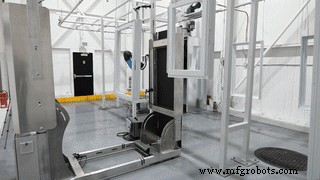
Autonomous robots simplify finishing by automatically generating and executing programs based on the real‑time position of each part within the booth.
This eliminates the need for jigs, fixtures, or extensive programming, reducing dependence on scarce skilled labor and safeguarding workers from repetitive, hot, and hazardous tasks.

Beyond operational simplicity, autonomous robots operate on a subscription model, letting you tailor or outsource cell design to fit precise production needs.
These robots represent a transformative leap, not merely automating a finishing step but enabling flexible adaptation while sustaining quality and consistency—essential for high‑volume shops that cannot scale without additional capacity.
Omnirobotic delivers autonomous robotic solutions for spray and finishing processes. Its Shape‑to‑Motion™ technology can SEE parts, PLAN unique programs, and EXECUTE them in real time using standard industrial robots. Check our payback calculator to determine if an autonomous robotic cell fits your operations.
Industrial robot
- Secure Remote Access & Control for Mitsubishi Industrial Robots
- Top Heat‑Conducting Metals & Their Applications – A Practical Guide
- Top Metal CNC Machines for 2022: Boost Efficiency & Precision
- Mastering Quality Control: Strategies for Consistent Excellence
- Why Steel Remains the Gold Standard for Agricultural Implements
- Top Metal Finishing Techniques: Choose the Best Method for Superior Surfaces
- Comprehensive Quality Control Techniques for Sand Casting Components
- Ensuring Precision: Comprehensive Quality Inspection & Control in CNC Machining
- Professional Surface Finishing Techniques for Machined Metal Parts
- Essential Industrial Robot Applications Leveraging 3D Laser Vision Systems