



How Industrial Robots Drive Cash Flow: A Practical Guide
Investing in robotics raises several critical questions. Will the capital outlay align with future demand? Are maintenance and engineering costs sustainable enough to guarantee uninterrupted production? Can robots adapt to the diverse mix of products, parts, and processes that drive both current and future operations?
For large, mass‑manufacturing firms, robotics is typically a cash‑flow positive investment. In specialized or less varied processes, they can also deliver significant cash‑flow gains by eliminating bottlenecks that strain scarce skilled labor or stall entire lines. But what about high‑volume lines that still handle a mix of products? How can you control costs when a robot’s task isn’t strictly repeatable? The answer lies in understanding the full economic picture.
Impact of Industrial Robots on Manufacturing Economics
On average, an industrial robot—including systems engineering—costs about $250,000. Annual maintenance stays below $10,000, while the overall unit labor cost savings can reach 40‑60% depending on how deeply the robot is integrated into the finished‑good production chain. Beyond direct labor, robots also reduce peripheral expenses such as insurance, health‑and‑safety premiums, and the need for specialized tooling that supports hazardous or repetitive tasks.
Industry estimates show a full payback window of 2‑10 years across diverse labor markets, even in regions with lower wage levels such as Southeast Asia. A robot’s service life can extend up to 25 years, but the lion’s share of the cost—60‑80%—typically resides in systems integration and programming.
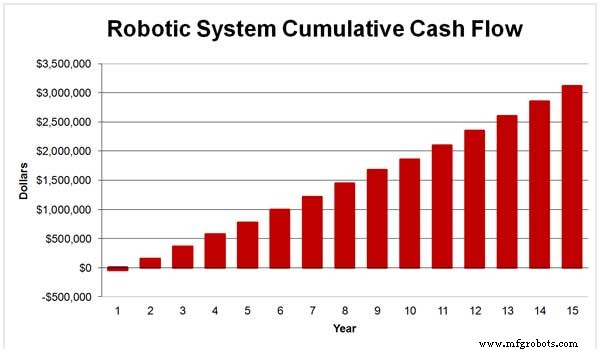
Because robots can work continuously, they provide a 30‑40% boost in productivity compared with processes that rely solely on skilled labor. Consider a scenario where a robot displaces two workers at a fully‑loaded cost of $15/hour across three shifts and 350 working days per year—a realistic schedule for many mass‑manufacturing plants. In this case, the payback period is roughly one year relative to the median single‑robot integration cost. After that, the vast majority of the initial expense—over 90%—converts into free cash flow.
Such rapid payback is achievable only in the highest‑volume manufacturing sectors. Smaller or high‑mix manufacturers often face higher integration hurdles, and even large firms cannot rely on robotics for every process—some tasks remain outside current robot capabilities.
Enhancing Cash Flow with Better Integration Strategies
The greatest benefits accrue to the most repeatable operations, but there is a clear upside for smaller or high‑mix manufacturers as well. The key is to reduce the three main cost centers: hardware, systems integration, and manual programming/validation for each part.
1. Lowering Hardware Costs
Collaborative robots (cobots) or purpose‑built units can cut hardware costs by 50% or more. Hardware prices have already fallen 22% between 2014 and 2017, with an additional 24% expected by 2025. A milestone in this trend was Q4 2020, when non‑automotive robot orders surpassed automotive orders for the first time.
2. Streamlining Systems Integration
Large manufacturers often have tightly integrated material‑handling networks that span entire facilities. For high‑mix or contract producers, adopting non‑continuous, autonomous handling reduces integration to a matter of weeks of low‑intensity engineering—an insignificant upfront cost that can still deliver mass‑customization benefits.
3. Automating Robot Programming
Traditional programming is a major cost driver, especially for high‑mix lines that process dozens of parts in a single year. By eliminating manual programming, manufacturers can unlock the full cash‑flow potential of robotics across a broader spectrum of products.
Autonomous Robots: Breaking the Incremental Programming Barrier
Autonomous robots that “program themselves” are already common in mobile‑robot and material‑handling applications, but industrial manufacturers urgently need similar capabilities for value‑added processes. These systems can boost productivity and enable firms to employ more workers at higher profitability.
Omnirobotic’s Shape‑to‑Motion™ Technology is a breakthrough that allows a robot to see, plan, and execute a process for any part placed before it, regardless of orientation or position.
The technology uses 3D vision to capture the part in its real environment. This data feeds into a Digital Twin that employs AI to compute the optimal motion path and tool‑path for the specific task. The resulting virtual plan is then translated into real‑world instructions compatible with leading industrial‑robot brands such as FANUC, ABB, and Universal Robots.
Current implementations cover spray processes—painting, powder coating, sandblasting—and additional processes are in development. With this autonomous approach, manufacturers can enjoy the cash‑flow benefits of robotics without incurring the costly integration required for each part changeover—an absolute win for the next generation of industrial leaders.
Omnirobotic provides Autonomous Robotics Technology for Spray Processes, enabling industrial robots to see parts, plan their own motion program, and execute critical coating and finishing tasks. See what kind of payback you can get from it here.
Industrial robot
- Robot Vision in Industry: From Vision to Self‑Programming
- What Is a Self‑Programming Robot and Why It Matters
- Top 15 Robotics Solutions Boosting Efficiency in the Electronics Sector
- Fanuc Robotics: Leading Innovations in Industrial Automation
- KUKA Robotics: Pioneering Innovation in Industrial Automation
- Superior Gantry Robots for Precise Dispensing Solutions
- Introducing the Next-Gen Factory Robot: Safer, Smarter, and Human-Friendly
- ABB's IRB 120: Compact Assembly Robots for Precision and Efficiency
- Discover the Power of Motoman Six-Axis Robots for Versatile Automation
- Discover the CR-7iA: Fanuc’s Latest Collaborative Robot